Electric Scooter Sample Evaluation: A 7-Test Protocol Before Your Bulk Order
·
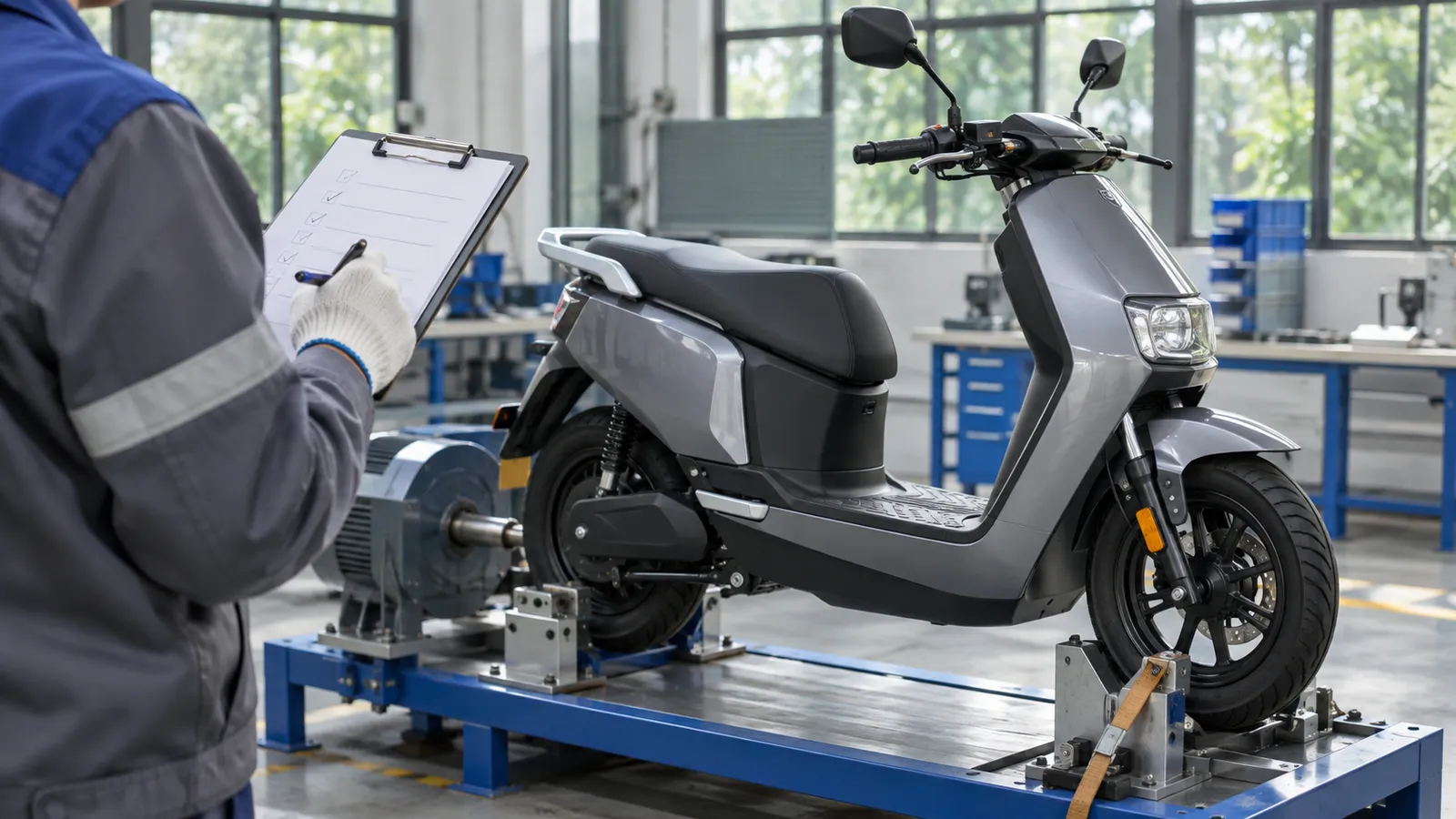
A structured electric scooter sample evaluation tests loaded range, braking, hill climbing, water spray, charger, fit-finish and documents against the quotation. This guide gives the methods, pass thresholds and a weighted scorecard you can reuse.
Contents
- What can a sample tell you, and what can it not?
- How do you run an electric scooter sample evaluation step by step?
- How do you measure loaded range on a sample?
- How should you test the brakes on a sample?
- How do you check hill climbing and water resistance?
- What should you check on the charger and the finish?
- Which documents must match the quotation?
- How do you score the sample and turn it into a bulk spec?
- How do you get evaluation units from STARGO?
- Frequently Asked Questions
Key Takeaways
- A structured electric scooter sample evaluation tests loaded range, braking, hill climbing, water spray, charger, fit-finish and documents against the quotation.
- This guide gives the methods, pass thresholds and a weighted scorecard you can reuse.
An electric scooter sample evaluation should test seven things before you commit to a bulk order: loaded range, braking, hill climbing, water resistance, the charger, fit-and-finish, and whether every label and document matches the quotation. Do it with a written protocol and a weighted scorecard, so the decision is based on measured results rather than a first impression in the showroom.
Quick answer: Evaluate a scooter sample with seven tests: range with a real rider and cargo load, dry braking distance at a fixed speed, a full-load hill climb, a spray test matched to the stated IP rating, charger output and charge time, a fit-and-finish inspection, and a label-by-label document match. Score each test, set a pass threshold, and write the approved configuration into the proforma invoice.
What can a sample tell you, and what can it not?
A sample tells you whether the design, configuration and component choices fit your market; it cannot tell you whether the 200th unit will match it. That is why sample approval and pre-shipment inspection are two separate steps.
Use the sample to answer product questions: is the real range enough for your riders, do the brakes feel safe at local speeds, does the charger suit local mains, will the finish survive your climate? Leave production-consistency questions to the container-level checks covered in our electric scooter pre-shipment inspection checklist.
Before the sample arrives, prepare three things: the quotation and spec sheet you were offered, a fixed test route with a known gradient, and basic tools (digital multimeter, tyre gauge, a luggage scale or bathroom scale for load, a phone GPS app, and tape for marking a braking line).
How do you run an electric scooter sample evaluation step by step?
Run the tests in a fixed order so a failure in one does not hide another. Start with the non-destructive checks and finish with the water test.
- Unboxing and photo record. Photograph the carton, packing, frame number, motor marking and battery label before anything is touched.
- Document match. Compare every label with the quotation (details below).
- Fit-and-finish inspection. Panels, paint, welds, wiring, fasteners, tyres.
- Charger test. First full charge, timed, with output voltage measured.
- Loaded range test. One full discharge on your route.
- Braking and hill tests. After a recharge, on a closed, dry surface.
- Water spray test. Last, followed by a next-day re-check.
How do you measure loaded range on a sample?
Measure range with a realistic payload on a repeatable route, then convert the result into watt-hours per kilometre so you can compare models fairly.
Load the scooter to your typical rider weight plus cargo, set tyre pressure to the specification, and ride a mixed route (traffic stops, a gradient, some steady cruising) at the speed your customers actually ride until the controller cuts out at low voltage. Record kilometres and ambient temperature.
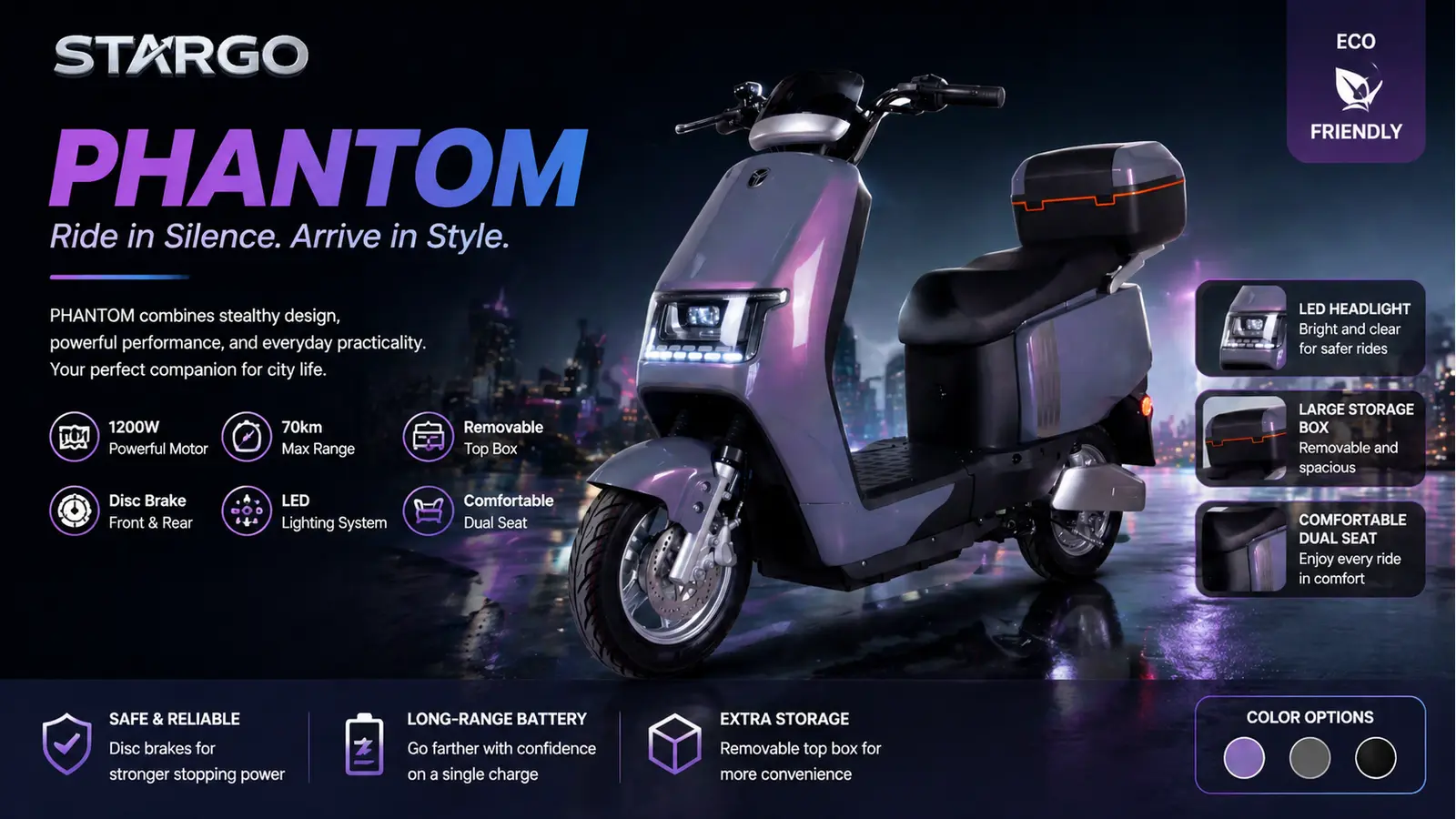
Then calculate consumption: Wh = V × Ah, and Wh/km = pack Wh ÷ km achieved. Example from our catalogue: the Avatar is listed at 72V 32Ah, which is 72 × 32 = 2,304 Wh nominal, with a catalogue range of 75 km. That implies about 30.7 Wh/km under the catalogue condition. If your loaded route returns 55 km, your real figure is about 41.9 Wh/km, and that is the number to put in your sales material. Remember that lead-acid packs deliver less usable energy at high discharge rates than their label suggests, so a lead-acid sample will usually fall further from the label than a lithium one. Our guide to real range versus claimed range explains the gap in more detail.
How should you test the brakes on a sample?
Test braking with a repeatable dry stop from a fixed speed and compare the distance with the limits used in UN Regulation No 78. This is a dealer screening test, not a homologation test.
UN Regulation No 78 sets braking requirements for L1 to L5 vehicles. For an L1 moped with a combined (CBS) or split service brake, the stopping-distance limit is S ≤ 0.1V + 0.0087V² (S in metres, V in km/h), tested at 40 km/h or 0.9 × Vmax, whichever is lower. At 40 km/h that works out to about 17.9 m. With the front brake alone, the L1 limit is 0.1V + 0.0111V², about 21.8 m at 40 km/h. For an L3 motorcycle tested at 60 km/h with CBS, the limit is 0.1V + 0.0076V², about 33.4 m.
Mark a line on a closed, dry surface, approach at a steady GPS-verified speed with the rider wearing full protective gear, brake hard, and measure from the line to the stop. Repeat three times with each brake and with both. Note pulling to one side, lever travel, fade on the third run, and whether ABS or CBS, if fitted, behaves smoothly. Results well outside the regulation figures are a reason to ask for a brake change before ordering. For the hardware behind these numbers, see our explainer on drum, disc, CBS and ABS brakes.
How do you check hill climbing and water resistance?
Climb your steepest local gradient at full load and spray the scooter to its stated IP rating; both tests reveal weaknesses that a flat showroom ride never will.
Hill test. Catalogue climbing angles are measured under the factory's conditions (for example, 35° is listed for the NOVA and 45° for the TANK). Your test is simpler: climb the steepest street your customers will use, fully loaded, from a standing start halfway up. Record speed at the top, whether the controller cuts back, and motor and controller temperature by hand or infrared thermometer after three climbs.
Water test. IP ratings come from IEC 60529. IPX5 covers water jets from a 6.3 mm nozzle, IPX6 covers powerful jets from a 12.5 mm nozzle, and IPX7 covers temporary immersion. A rating applies to a specific component, not automatically to the whole scooter: the JOVA, for example, is listed as vehicle IPX5 with the battery at IPX7. Spray the way rain and road splash would hit the scooter, never jet directly into connectors beyond their rating, then ride the next day and re-check the throttle, display, lights and charging port.
What should you check on the charger and the finish?
The charger must match your mains voltage and plug and charge within the quoted time; the finish must survive your climate and your customers' expectations.
- Charger: input voltage range and plug on the label, output voltage measured with a multimeter (it should sit slightly above the pack's nominal voltage), charge time from cut-off to full against the catalogue, and charger case temperature at the end. See charger voltage and plugs for export markets.
- Paint and plastics: colour match between panels, orange peel, overspray, sharp edges, panel gaps you can fit a fingernail into.
- Frame and welds: continuous welds, no spatter on visible areas, paint coverage inside the frame tubes where you can see.
- Wiring: harness clipped away from moving parts and sharp edges, connectors sealed or booted, no bare copper.
- Fasteners and tyres: torque marks on axle and brake bolts, no rust on screws out of the box, tyre size and date code readable.
Which documents must match the quotation?
Every label on the sample should match the specification you were quoted; any mismatch must be resolved before the proforma invoice is signed.
Check the vehicle nameplate and frame number, motor marking (rated power), battery label (nominal voltage, Ah, Wh, chemistry), charger label, tyre size and brake type. For lithium packs, ask for the UN38.3 test summary and the MSDS; these are also needed to ship the sample, because battery-equipped units are dangerous goods in transport. The IATA Lithium Battery Shipping Regulations explain why packing, marking and documentation matter, which is why sea freight is common for battery-equipped samples. Approvals such as CE or EEC are applied per model and market, so confirm in writing which apply to your configuration; our page on certifications and export documents lists what is available.
How do you score the sample and turn it into a bulk spec?
Weight each test by its importance to your customers, set a minimum score, and convert every finding into a written change request or approval line in the proforma invoice.
| Test | Weight | Method | Pass threshold (set by you) | Score 1–5 |
|---|---|---|---|---|
| Loaded range | 25% | Full discharge on fixed route with real payload | ≥ your customers' daily km × 1.3 | |
| Braking | 20% | 3 dry stops per brake from fixed speed | Within UN R78 formula for the category | |
| Hill climb | 10% | Steepest local gradient, full load, 3 climbs | No cut-out; components warm, not hot | |
| Water spray | 10% | Spray matched to stated IP rating, next-day re-check | All functions normal the next day | |
| Charger | 10% | Label, output voltage, timed full charge | Matches mains and plug; time within quote | |
| Fit and finish | 15% | Visual and touch inspection checklist | No defects a customer would return | |
| Document match | 10% | Every label versus quotation | Zero unexplained mismatches |
A simple rule: any score of 1 on braking or document match is a stop, regardless of the total. Then write the outcome down: the approved configuration (motor, controller, battery chemistry and Ah, charger, tyres, brakes, colours, logo), the list of agreed changes, and a reference to the golden sample photos. When you compare suppliers, use the same scorecard and our framework to compare electric scooter supplier quotes.
How do you get evaluation units from STARGO?
STARGO does not sell single units or sample orders below the MOQ. Your first order is the evaluation batch: the MOQ is 10 units per order and models can be mixed freely, so it can hold one or two units of each model and battery configuration you want to test. See samples and trial orders at STARGO: you share country, models, voltage, battery chemistry and quantities, STARGO recommends a configuration close to your planned production build, and the order is produced under normal QC.
Every order, the first one included, follows the same terms: MOQ 10 units per order (models can be mixed), including tricycles; lead time of 15–30 working days, depending on order quantity; and a pre-shipment production video (PSPV) for every container before the balance payment, which lets you compare production units against your golden sample. Vehicle lithium battery packs and BMS units are built in-house, so battery configuration questions raised by your evaluation units can be answered by the same team that builds the pack. Read more in quality control and the PSPV explainer.
Frequently Asked Questions
How many sample units should a dealer order before a first container?
Put at least one unit of each model and battery configuration you plan to sell into the first order. Two units of your main model are better: one for destructive or long tests, one kept untouched as the golden sample that the bulk order is compared against. At STARGO these units come from a mixed first order of at least 10 units; there are no single-unit sample orders.
How do I test the real range of a sample electric scooter?
Charge fully, load the scooter to your typical rider plus cargo mass, ride a fixed mixed route at normal speed until low-voltage cut-off, and record kilometres. Divide nominal pack energy (V × Ah) by distance to get Wh/km and compare it with the catalogue figure.
Is a garden-hose spray test enough to check water resistance?
It is a useful screening test, not a certification. Spray the scooter the way local rain and road splash would hit it, never aim a jet at connectors beyond their stated IP rating, then ride and re-check the display, throttle and lights the next day.
Which documents should match between the sample and the quotation?
Check the nameplate, motor marking, battery label (voltage, Ah, chemistry), charger label, tyre size and brake type against the quotation. Ask for the UN38.3 test summary and MSDS for the battery, and confirm which CE/EEC or local approvals apply per model and market.
Does a good sample mean the bulk order will be the same?
No. A sample proves the design and configuration; it does not prove production consistency. Lock the approved configuration into the proforma invoice, keep a golden sample, and use pre-shipment checks such as a production video or third-party inspection on every container.
Ready to test a model in your market? Send your country, target models, voltage and battery preference to STARGO sales or sales@stargomoto.com and ask for a quotation for a mixed first order of 10 units.
Entity note: STARGO is the export brand of Guangxi Xinli New Energy Technology Co., Ltd., which assembles two-wheelers in Guigang and three-wheelers in Chongzuo, Guangxi, China. First-order units are built to the configuration agreed at quotation, and that configuration is carried into the next order's proforma invoice.