Electric Scooter ABS vs CBS Brakes: Drum, Disc, Regen and TCS Explained
·
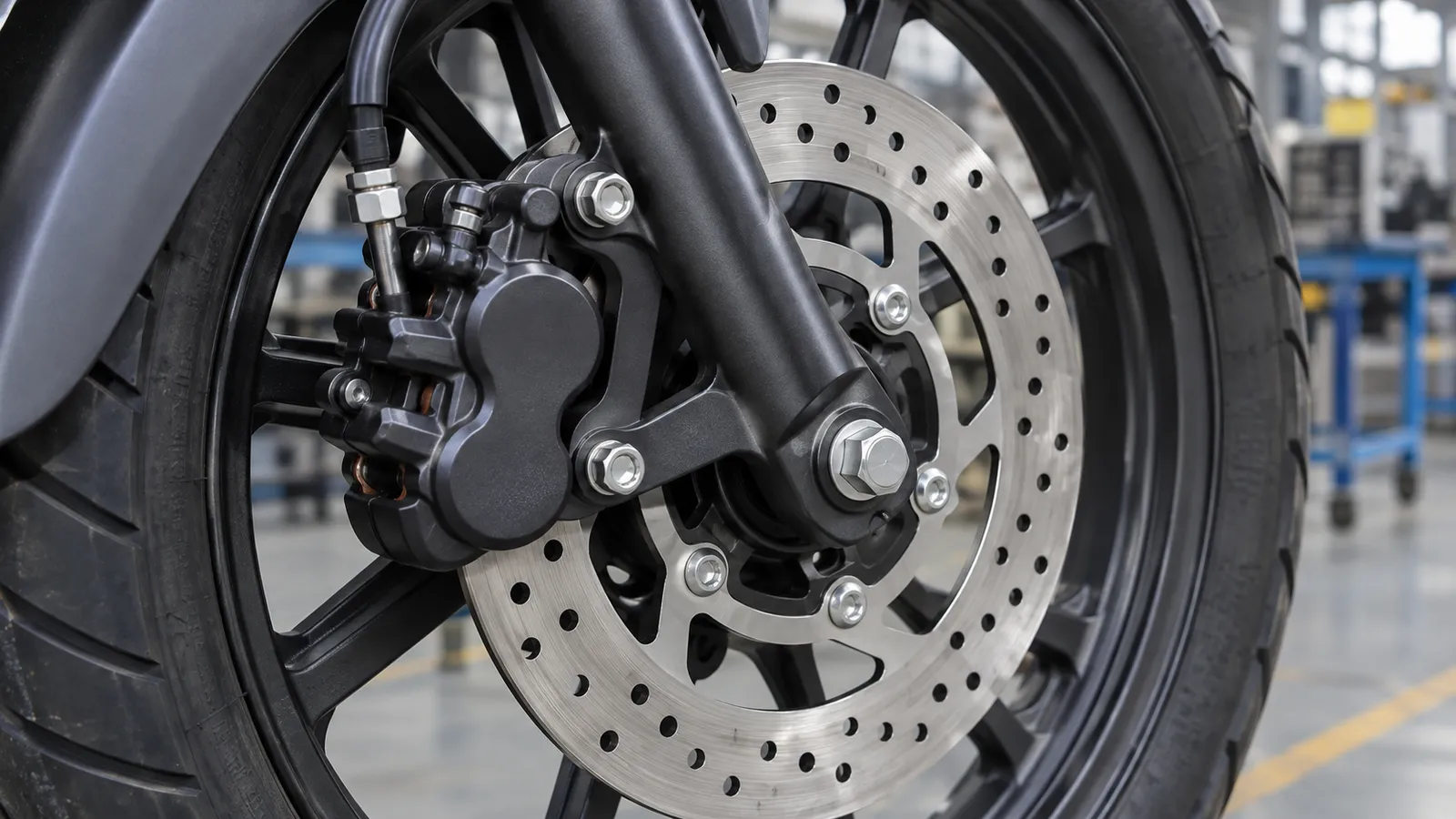
Electric scooter ABS and CBS brakes do different jobs: CBS links front and rear brakes for balanced stops, ABS prevents wheel lock. This guide covers drum vs disc, regen, TCS, EU ABS rules under Regulation 168/2013 and a brake check protocol.
Contents
- What brake types are used on electric scooters and motorcycles?
- What is CBS, and how is it different from ABS?
- When is ABS required for electric motorcycles?
- Does regenerative braking replace friction brakes?
- What does TCS add to the braking system?
- Which brake setup fits which speed and use?
- What should you check on brakes before a bulk order?
- Frequently Asked Questions
Key Takeaways
- Electric scooter ABS and CBS brakes do different jobs: CBS links front and rear brakes for balanced stops, ABS prevents wheel lock.
- This guide covers drum vs disc, regen, TCS, EU ABS rules under Regulation 168/2013 and a brake check protocol.
On electric scooters and motorcycles, ABS and CBS brakes solve two different problems: CBS (combined braking) links front and rear brakes so a single lever stops the bike evenly, while ABS (anti-lock braking) stops a wheel from locking under hard braking. Choosing the right electric scooter ABS or CBS brake setup depends on speed, weight, target market rules and who will ride the vehicle.
Quick answer: Drum brakes suit light city scooters; disc brakes give stronger, more controllable stopping for faster models. CBS links front and rear brakes for balanced stops. ABS prevents wheel lock and is required in the EU on L3e-A2 and L3e-A3 motorcycles. Regenerative braking and TCS help, but never replace mechanical brakes on both wheels.
What brake types are used on electric scooters and motorcycles?
Electric two-wheelers use drum brakes, cable or hydraulic disc brakes, and on faster models combined or anti-lock systems layered on top. The choice follows speed and mass more than price.
| Brake type | How it works | Strengths | Watch-outs | Typical fit |
|---|---|---|---|---|
| Drum (front and rear) | Shoes expand inside a drum | Sealed from dirt and water, low maintenance | Less heat capacity, fades on long descents | Light retro and city scooters around 50 km/h |
| Front disc + rear drum | Caliper pads clamp a front rotor | Strong front stopping where load transfers | Rear still drum; pad wear on front | Mid-range commuters 50–80 km/h |
| Front and rear disc | Hydraulic calipers on both wheels | Best feel and heat capacity | Fluid service, rotor care | Faster or heavier motorcycles |
| CBS / linked braking | One lever applies both wheels | Balanced stops for novice riders | Does not prevent wheel lock | Commuters, rental and delivery fleets, tricycles |
| ABS | Sensors detect slip and modulate pressure | Prevents wheel lock, keeps steering | Wheel sensors and modulator add cost and service items | Highway-capable motorcycles |
STARGO's catalogue shows the full spread: NOVA uses drum brakes, NINJA pairs a stainless front disc with a rear drum, TANK runs front and rear discs, and the Star Amber uses an opposed-piston front disc with a rear drum.
What is CBS, and how is it different from ABS?
CBS distributes braking between wheels from a single control; ABS manages slip at each braked wheel. One is about balance, the other about grip.
UN Regulation No. 78, the UNECE rule for braking on L-category vehicles, defines both. Its text describes an anti-lock system as one that "senses wheel slip and automatically modulates the pressure producing the braking forces", and a combined braking system as a service brake operated by a single control that applies at least two brakes on different wheels for two-wheelers, and all wheels for three-wheelers in L2 and L5. In plain terms, CBS helps a novice who grabs only the rear lever, while ABS helps everyone in a panic stop on wet paint.
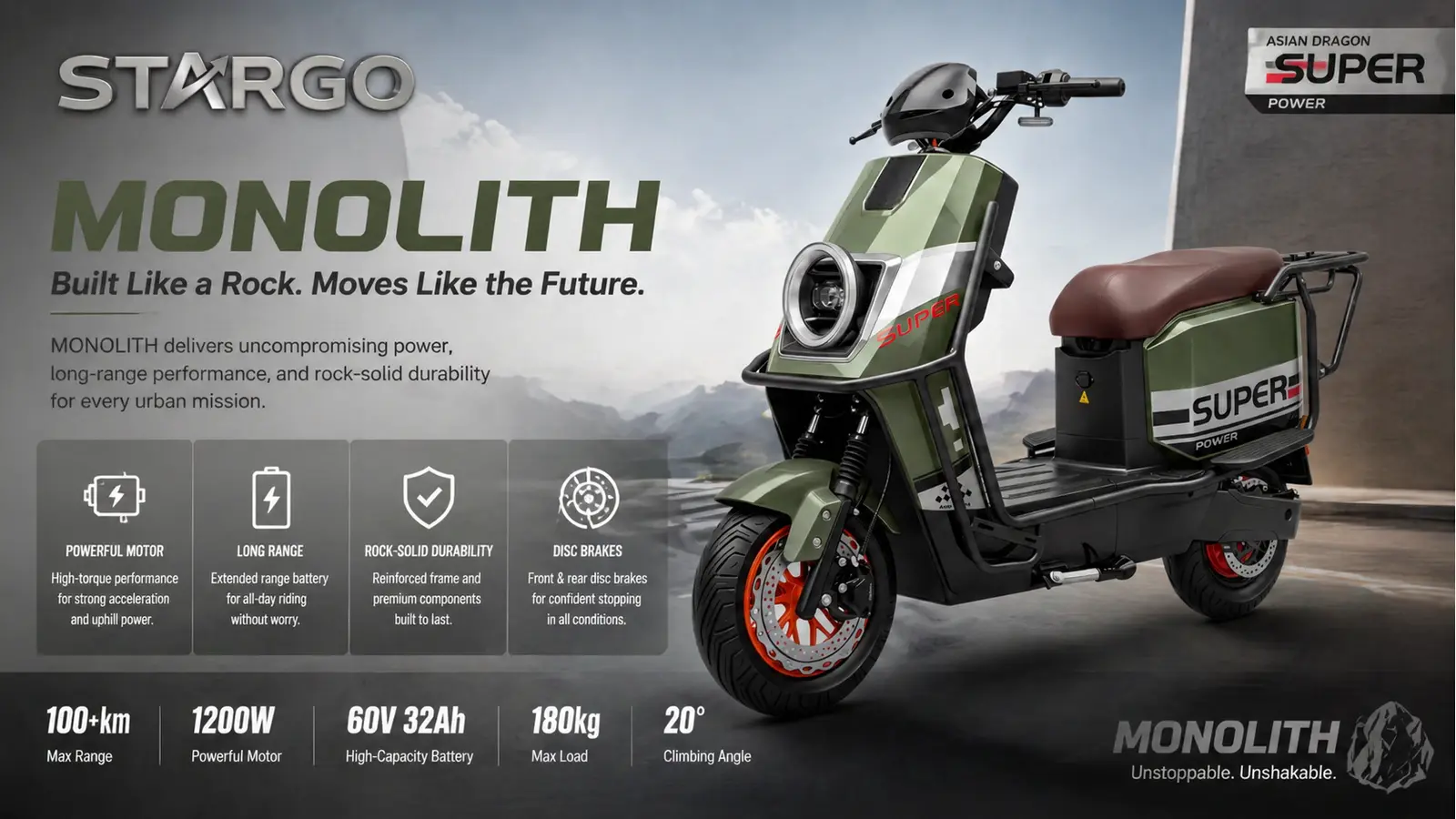
STARGO models use both approaches. The Monolith compact scooter uses GBS linked braking, the WIND DP-01 uses CBS while the DP-03 adds ABS, and the CT3-L passenger tricycle uses front and rear CBS hydraulic drum brakes to keep stops stable under passenger load.
When is ABS required for electric motorcycles?
In the EU, ABS is mandatory on L3e-A2 and L3e-A3 motorcycles, while L3e-A1 may use ABS, CBS or both. Other markets set their own thresholds, so confirm per destination.
Annex VIII of Regulation (EU) No 168/2013 sets these "advanced brake system" rules for new L3e motorcycles and exempts enduro and trial variants. Note the scope of UN R78 itself: it excludes vehicles with a maximum speed below 25 km/h, and where ABS is fitted it requires a yellow warning lamp that lights when a fault affects the ABS signal. Which L3e sub-category a model falls into depends on continuous rated power and power-to-weight ratio, covered in our sibling guide to EU L1e and L3e classification.
The safety case is measurable. The Insurance Institute for Highway Safety reports that the rate of fatal crashes is 22% lower for motorcycles equipped with optional ABS than for the same models without it. For importers selling faster models, that is a strong reason to stock ABS versions even where the law does not yet require them.
Does regenerative braking replace friction brakes?
No. Regenerative braking supplements the mechanical brakes; it can never replace them.
Regen makes the motor act as a generator, feeding a little energy back to the battery and adding engine-braking feel. But its force is limited by the controller and motor, it fades when the battery is full (the BMS will refuse charge current) or cold, and it only acts on the driven wheel. On hub-motor scooters that is usually the rear wheel, which carries less load under braking. Treat regen as a range and comfort feature, and ask the supplier whether its strength can be set per market; on STARGO models, regen settings are confirmed at quotation. For how the controller manages regen, see our explainer on sine wave vs square wave controllers.
What does TCS add to the braking system?
Traction control (TCS) manages grip under acceleration, the mirror image of ABS under braking. Electric motors deliver full torque instantly, so TCS matters more than on many small petrol bikes.
TCS watches wheel speeds or sudden rear-wheel acceleration and trims motor torque until the tyre grips again. It is most useful on high-torque models in rain, on painted lines and on gravel. The DP-PRO flagship (130 km/h, 96V semi-solid-state battery) and the Green Edge (105 km/h, 11 kW peak, 0–50 km/h in about 2.5 s) both pair ABS with TCS, as do the ST7 and SC5X. The K10 Max combines 220 mm front and rear discs with TCS.
Which brake setup fits which speed and use?
Match the brake package to top speed, laden mass and rider profile. This decision grid is a starting point; local rules always take priority.
| Top speed / use | Minimum sensible setup | Recommended upgrade | Catalogue examples |
|---|---|---|---|
| Up to 25 km/h, compact or youth | Drums or linked braking | Linked braking with good tyres | Monolith (25 km/h factory cap, GBS) |
| 25–50 km/h city commuter | Front disc + rear drum | CBS | Star Amber (45 km/h), Sunny and MOONCHASE (50 km/h) |
| 50–80 km/h commuter / delivery | Front and rear disc | CBS or ABS; TCS for wet climates | TANK, K10 Max, Peak God (CBS on high-spec) |
| Above 80 km/h, highway-capable | Front and rear disc with ABS | ABS + TCS | DP-PRO, Green Edge, ST7, SC5X |
| Passenger or cargo tricycle | Hydraulic drums on all wheels + parking brake | CBS hydraulic | CT3-L |
What should you check on brakes before a bulk order?
Test brakes on a sample, then specify the same checks for pre-shipment inspection. A short protocol catches most problems.
- Lever travel and feel; no sponginess on hydraulic systems.
- Each brake lever cuts motor power through its brake switch.
- Disc thickness and run-out, pad material, drum shoe contact.
- Hydraulic fluid type and level marked on the reservoir.
- CBS: one lever visibly applies both wheels.
- ABS: warning lamp lights at key-on, then goes out after moving off.
- Repeated stops from top speed with rider and luggage; check for fade and pulling.
Brake pads, shoes, levers and switches are fast-moving parts; plan them with our spare parts support checklist. STARGO's quality control process and the pre-shipment production video (PSPV) provided for every container let you see finished vehicles before the balance payment. Market-specific approvals are covered under homologation support, where CE / EEC / CB / COC / SONCAP are applied per model and market and confirmed at quotation.
Frequently Asked Questions
What is the difference between ABS and CBS on an electric scooter?
CBS (combined braking) links front and rear brakes so one lever applies both, spreading braking force. ABS senses wheel slip and modulates brake pressure so the wheel does not lock. CBS improves balance in normal stops; ABS protects against wheel lock in emergency or slippery stops.
Is ABS mandatory for electric motorcycles in the EU?
For L3e motorcycles, yes in most cases. Annex VIII of Regulation (EU) No 168/2013 requires ABS on L3e-A2 and L3e-A3 motorcycles, while L3e-A1 may use ABS, CBS or both. Enduro and trial variants are exempt. Mopeds in category L1e are outside this requirement.
Can regenerative braking replace mechanical brakes?
No. Regenerative braking slows the vehicle by making the motor work as a generator, but its force is limited and it fades when the battery is full or cold. Mechanical drum or disc brakes on both wheels remain the legal and safety basis; regen is a supplement.
Are drum brakes acceptable on an electric scooter?
Yes, for lighter, slower models. Drum brakes are sealed against dirt and water, cheap to maintain and adequate for city scooters around 50 km/h. Faster or heavier models benefit from a front disc or front and rear discs, ideally with CBS or ABS.
What does TCS do on an electric motorcycle?
Traction control (TCS) compares wheel speeds or monitors rapid rear-wheel acceleration and reduces motor torque when the driven wheel starts to spin. It matters on electric models because instant torque can break traction on wet paint, gravel or tram lines.
How should a dealer check brakes on a sample electric scooter?
Check lever travel and feel, that each brake lever cuts motor power, disc or drum condition, hydraulic fluid type and level, CBS front-to-rear action, and the ABS warning lamp self-test at key-on. Then do repeated stops from top speed with a rider and load.
Need ABS, CBS or upgraded disc brakes on a specific model for your market? Tell the STARGO export team the target speed class, rider profile and destination rules, or email sales@stargomoto.com, and we will confirm the brake configuration available per model. Browse the electric motorcycle category to compare models.
Entity note: STARGO is the export brand of Guangxi Xinli New Energy Technology Co., Ltd., which assembles two-wheelers in Guigang and three-wheelers in Chongzuo, Guangxi, China. Brake configurations from drum to ABS + TCS are listed per model and confirmed at quotation for each market.