L1e vs L3e Classification for Electric Mopeds and Motorcycles: EU L-Category Guide for Importers
·
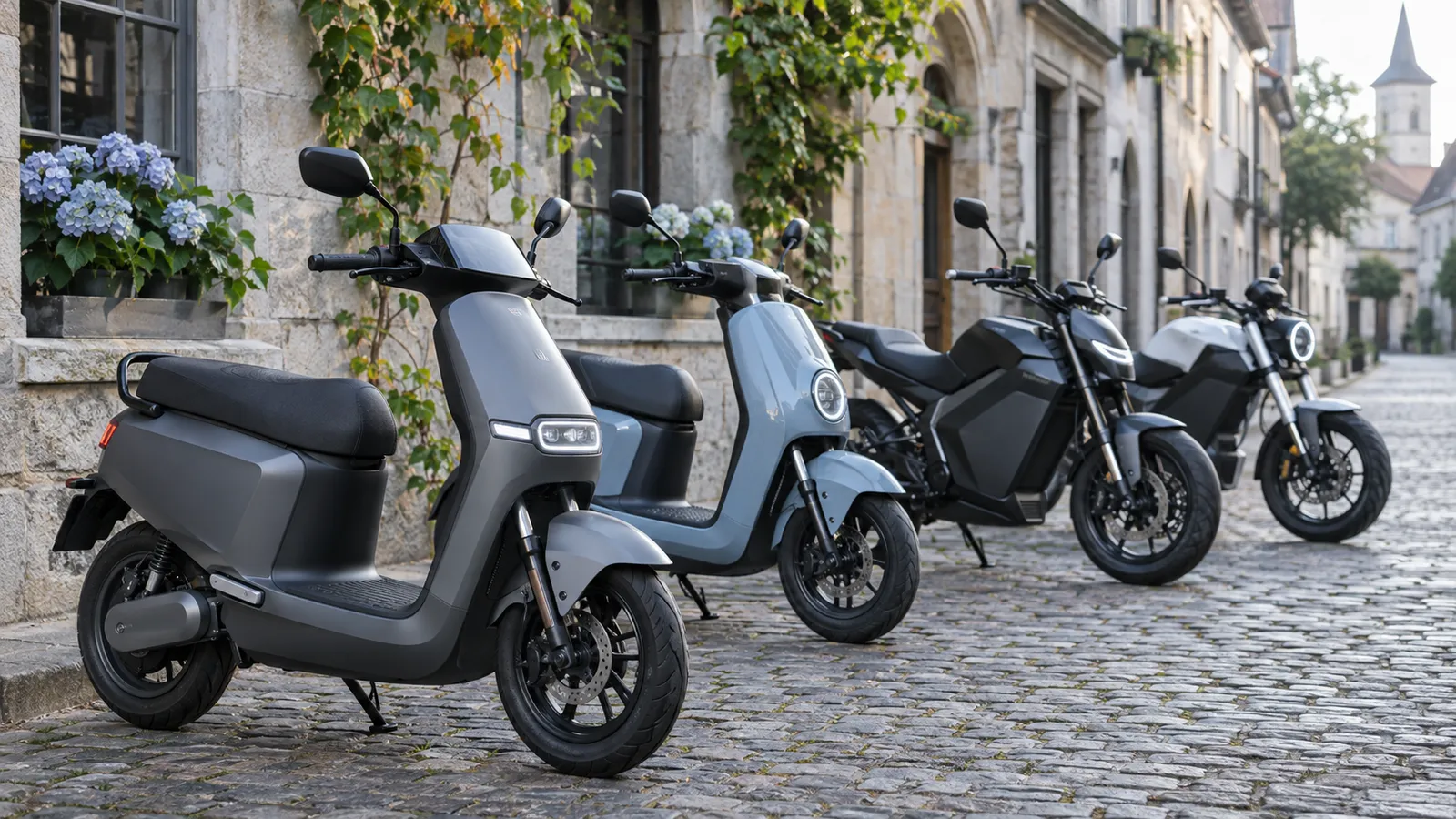
L1e vs L3e classification for electric two-wheelers depends on design speed and continuous rated power: L1e stops at 45 km/h and 4,000 W. This guide explains L1e-A/B, L3e-A1/A2/A3, L2e, L5e and what importers must confirm before choosing EU models.
Contents
- What are the EU L-categories for electric two- and three-wheelers?
- What is the difference between L1e-A and L1e-B?
- When does an electric two-wheeler become L3e?
- Where do electric tricycles and quadricycles fit?
- How do the categories compare at a glance?
- How do speed and power settings change a model's category?
- What should you confirm before choosing a model for the EU?
- Frequently Asked Questions
Key Takeaways
- L1e vs L3e classification for electric two-wheelers depends on design speed and continuous rated power: L1e stops at 45 km/h and 4,000 W.
- This guide explains L1e-A/B, L3e-A1/A2/A3, L2e, L5e and what importers must confirm before choosing EU models.
Under EU Regulation (EU) No 168/2013, L1e vs L3e classification for electric two-wheelers comes down to two numbers: maximum design speed and maximum continuous rated power. A two-wheeler limited to 45 km/h and 4,000 W is an L1e moped; anything faster or more powerful is an L3e motorcycle, with very different licensing, insurance and equipment rules.
Quick answer: EU L-categories sort two- and three-wheelers by design speed, continuous rated power and mass. L1e-B: two-wheel mopeds up to 45 km/h and 4,000 W. L3e: faster or more powerful motorcycles, split A1/A2/A3. L2e: light three-wheel mopeds up to 270 kg. L5e: heavier tricycles. Peak power does not decide the category; continuous rated power does.

What are the EU L-categories for electric two- and three-wheelers?
The L-categories are the EU vehicle classes for mopeds, motorcycles, tricycles and light quadricycles, defined in Regulation (EU) No 168/2013 on the approval and market surveillance of two- or three-wheel vehicles and quadricycles. Every road-going electric scooter, motorcycle or tricycle sold in the EU must be type-approved in one of them.
The category drives almost everything an importer cares about: rider licence class, insurance, registration plates, the technical tests in the approval file and the equipment the vehicle must carry. Picking a model before confirming its category is the most common and costly mistake new EU importers make. All L-category vehicles also share general dimension limits of 4.0 m length, 2.0 m width and 2.5 m height, with a 1.0 m width limit for L1e.
What is the difference between L1e-A and L1e-B?
L1e-A is a pedal-equipped "powered cycle" with assistance cut off at 25 km/h and up to 1,000 W; L1e-B is the two-wheel moped that covers every other L1e vehicle up to 45 km/h and 4,000 W.
The criteria come from Annex I of the regulation (see the classification table as in force on 1 January 2016). Below L1e-A sits the ordinary pedelec, which is outside the regulation altogether: Article 2(2)(h) excludes pedal cycles whose auxiliary motor has a maximum continuous rated power of 250 W or less, cuts out when the rider stops pedalling and stops assisting before 25 km/h. Throttle-only electric bikes and higher-power e-bikes therefore end up in L1e.
For most retro and city electric scooters, L1e-B is the target. A catalogue example: the Star Amber city commuter is set up for 45 km/h, and the Monolith compact model has a 2,000 W motor with a factory speed cap of 25 km/h, both inside L1e speed and power limits on paper. Final classification still depends on the approval authority's measurement of continuous rated power.
When does an electric two-wheeler become L3e?
A two-wheeler becomes L3e as soon as its design speed exceeds 45 km/h or its continuous rated power exceeds 4,000 W. L3e is then split by power and power-to-weight ratio.
- L3e-A1 (low performance): up to 11 kW and a power-to-weight ratio of up to 0.1 kW/kg (the 125 cm³ engine limit applies only to combustion models).
- L3e-A2 (medium performance): up to 35 kW and up to 0.2 kW/kg.
- L3e-A3 (high performance): every L3e motorcycle that is not A1 or A2.
Use this as a quick screening formula: power-to-weight = continuous rated power (kW) ÷ mass (kg). Using catalogue curb weight as a rough proxy, the ST7 (6.5 kW rated, 129 kg) gives about 0.05 kW/kg and the DP-PRO (10.8 kW rated, 185 kg) about 0.058 kW/kg, so both screen as L3e-A1 candidates on rated power even though their peak figures, 8.5 kW and 20 kW, are higher. The approval lab's measured values and the regulation's mass definition decide the final sub-category.
The sub-category also sets brake equipment. Annex VIII requires ABS on L3e-A2 and L3e-A3, while L3e-A1 may use ABS, CBS or both, at the manufacturer's choice. Our sibling article on ABS, CBS and disc brakes explains the hardware.
Where do electric tricycles and quadricycles fit?
Three-wheelers are L2e if they are light and slow, and L5e if they are heavier or faster. Four-wheel light vehicles are L6e or L7e quadricycles.
- L2e three-wheel moped: up to 45 km/h, 4,000 W continuous power, 270 kg mass in running order and two seats; L2e-U variants carry goods on a loading bed.
- L5e powered tricycle: mass in running order up to 1,000 kg; L5e-A passenger tricycles seat up to five including the driver, L5e-B commercial tricycles up to two.
- L6e light quadricycle: up to 45 km/h and 425 kg; L6e-A up to 4,000 W, L6e-B up to 6,000 W.
- L7e heavy quadricycle: up to 450 kg for passenger use or 600 kg for goods, with sub-categories up to 15 kW.
In catalogue terms, a 600 W, 48 V compact passenger pod such as Pudding (50 kg listed weight) screens as an L2e candidate, subject to seating and measured mass. The CT3-L passenger tricycle, at 450 kg with battery and 50 or 60 km/h depending on configuration, sits in L5e territory. For passenger tricycle selection more broadly, read the electric passenger tricycle buyer guide.
How do the categories compare at a glance?
This summary table condenses Annex I for the categories electric two- and three-wheeler importers meet most often.
| Category | Vehicle | Max design speed | Max continuous rated power | Mass / seats |
|---|---|---|---|---|
| L1e-A | Powered cycle (pedals) | Assistance cut off at 25 km/h | 1,000 W | — |
| L1e-B | Two-wheel moped | 45 km/h | 4,000 W | Width up to 1,000 mm |
| L2e | Three-wheel moped | 45 km/h | 4,000 W | Up to 270 kg; up to 2 seats |
| L3e-A1 | Low-performance motorcycle | Above 45 km/h | 11 kW; up to 0.1 kW/kg | — |
| L3e-A2 | Medium-performance motorcycle | Above 45 km/h | 35 kW; up to 0.2 kW/kg | — |
| L3e-A3 | High-performance motorcycle | Above 45 km/h | Above A2 limits | — |
| L5e-A / L5e-B | Passenger / commercial tricycle | Above L2e limits | Not limited by category | Up to 1,000 kg; 5 / 2 seats |
| L6e-A / L6e-B | Light quadricycle | 45 km/h | 4,000 W / 6,000 W | Up to 425 kg; 2 seats |
Two exclusions matter for importers: vehicles with a design speed of 6 km/h or less, and vehicles primarily intended for off-road use on unpaved surfaces or exclusively for competition, are outside the regulation. Off-road electric dirt bikes are therefore sold for tracks and private land; see our electric dirt bike buyer guide.
How do speed and power settings change a model's category?
The controller's speed cap and power limit can move the same platform between categories. That is useful, but each approved variant must match its settings.
Example: the Avatar retro scooter has a 1,500 W motor and is listed at 66 km/h with an unlock-configurable limit. At 66 km/h it screens as L3e-A1; limited to 45 km/h it could target L1e-B instead, which opens the market to riders with a moped licence. The approval file must state the locked setting, and dealers must not unlock it after registration. How the controller enforces these limits is covered in our explainer on sine wave vs square wave controllers.
What should you confirm before choosing a model for the EU?
Confirm the category, the approval route and the documents before you place the first order. This checklist keeps the conversation with your factory precise.
- Target category and sub-category for each model and variant.
- Continuous rated power (not peak) and the locked design speed.
- Brake configuration against Annex VIII for L3e models.
- Who holds the EU type-approval and issues each vehicle's Certificate of Conformity (CoC).
- Lighting, mirrors, plate holder, horn and labels in the approved configuration.
- Battery documents (UN 38.3, MSDS) and EU battery rules for the pack.
- Approval samples: quantity, lead time and who pays testing fees.
STARGO's position is factual: CE / EEC / CB / COC / SONCAP are applied per model and market and confirmed at quotation. Our homologation support page explains how approval projects are handled, the certification guide explains what each document means, and the export documents checklist lists what ships with each order. MOQ is 10 units per order (models can be mixed), which keeps approval-sample and pilot orders manageable.
Frequently Asked Questions
What is the difference between L1e and L3e?
L1e covers light two-wheel mopeds with a maximum design speed of 45 km/h and a maximum continuous rated power of 4,000 W. L3e covers two-wheel motorcycles that exceed either limit, split into A1, A2 and A3 by continuous power and power-to-weight ratio. Licensing, insurance and brake rules differ.
Is an electric scooter with a 2000W motor automatically L3e?
No. Classification uses maximum continuous rated power and design speed, not peak power or a sticker figure. A scooter with 2,000 W continuous rated power and a 45 km/h design speed fits within L1e limits. The same scooter set to 60 km/h would fall into L3e.
Are e-bikes covered by Regulation (EU) No 168/2013?
Pedal-assist cycles are excluded when the motor has a maximum continuous rated power of 250 W or less, cuts out when pedalling stops, and stops assisting before 25 km/h. Powered cycles beyond those limits, including throttle-only models, fall into L1e and need type-approval.
Which category covers electric passenger and cargo tricycles in the EU?
Light three-wheelers up to 45 km/h, 4,000 W continuous power and 270 kg mass in running order are L2e mopeds. Heavier or faster tricycles are L5e: L5e-A for passenger tricycles with up to five seats, L5e-B for commercial tricycles with up to two seats.
Can an electric dirt bike be registered as L3e?
Only if the model is designed and type-approved for road use. Vehicles primarily intended for off-road use on unpaved surfaces, and vehicles exclusively for competition, are excluded from the regulation, so off-road-only dirt bikes are sold for private land or tracks, not public roads.
What should an importer confirm with a factory before choosing a model for the EU?
Confirm the target category and sub-category, the continuous rated power and locked design speed, brake configuration against Annex VIII, who holds the EU type-approval and issues the Certificate of Conformity, documents and labels, and lead time for approval samples. Get these answers in writing before ordering.
Planning an EU launch? Send the target category, speed and licence class for each model to the STARGO export team or email sales@stargomoto.com, and we will confirm which configurations can be offered and which documents are available per model.
Entity note: STARGO is the export brand of Guangxi Xinli New Energy Technology Co., Ltd., which assembles two-wheelers in Guigang and three-wheelers in Chongzuo, Guangxi, China. For EU projects, speed and power settings are configured per variant and CE / EEC documentation is available on application per model and market.