Electric Passenger Tricycle Buyer Guide: Pods, E-Rickshaws and Shuttles
·
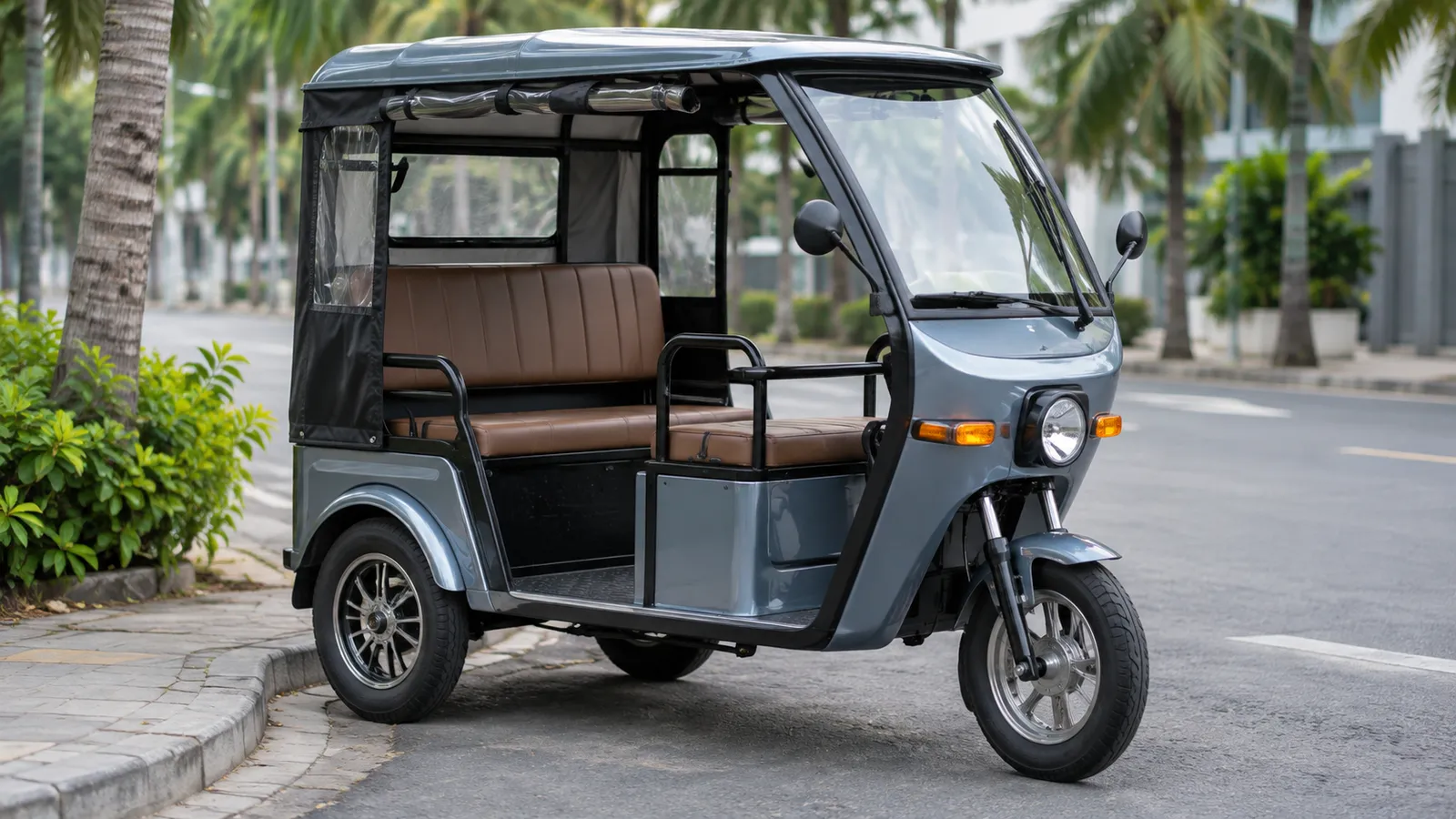
This electric passenger tricycle buyer guide starts with the permit class your market allows, then matches seating, stability, weather protection and battery to the route. It compares compact pods, standard tricycles and seven-seat shuttles with catalogue specs.
Contents
- Which permit class applies to passenger tricycles in your market?
- Compact pod, standard tricycle or premium shuttle — which fits your route?
- How many seats do you really need?
- How do you judge stability and ride comfort?
- How much weather protection do passengers need?
- How do you size the battery for a passenger route?
- How does STARGO supply passenger tricycles?
- Frequently Asked Questions
Key Takeaways
- This electric passenger tricycle buyer guide starts with the permit class your market allows, then matches seating, stability, weather protection and battery to the route.
- It compares compact pods, standard tricycles and seven-seat shuttles with catalogue specs.
An electric passenger tricycle buyer guide has to start with one question: what vehicle class does your market allow for carrying passengers? Once the permitted seats, speed and motor power are clear, you match seating, stability, weather protection and battery size to the route — and only then compare styling and price.
Quick answer: Confirm the legal class first (seats, speed, power, approvals). Then choose by route: compact 600W 48V pods for short, flat, low-speed trips; standard tricycles for daily taxi or family use; 72V LFP shuttles with suspension and hydraulic brakes for longer, busier routes. Size the battery from measured Wh/km with passengers aboard, plus a 30% margin.
The segment is large and regulated. The IEA Global EV Outlook 2025 reports nearly 700,000 electric three-wheelers sold in India in 2024, a 57% share, and that Türkiye accounted for 60,000 of the roughly 90,000 electric three-wheelers sold in the European market. The steps below work for importers in either kind of market.
Which permit class applies to passenger tricycles in your market?
Your market's vehicle class sets the maximum seats, speed and power you can sell, so confirm it before shortlisting models. Getting this wrong means vehicles that cannot be registered for paid service.
Two examples show how different the rules are:
- India (e-rickshaw): the ICAT ready reckoner for e-rickshaw type approval defines an e-rickshaw as carrying not more than 4 passengers excluding the driver, with net motor power not above 2,000 W and a speed not above 25 km/h, with electrical safety under AIS-156.
- European Union: Regulation (EU) No 168/2013 separates three-wheel mopeds (L2e, up to 45 km/h) from tricycles (L5e-A for passengers), each with its own approval route.
Many markets in Southeast Asia, Africa and Latin America have local e-trike or tuk-tuk rules, often set city by city. Ask your importer or homologation adviser for the written definition, then see STARGO's homologation support and certification overview.
Compact pod, standard tricycle or premium shuttle — which fits your route?
Match the format to trip length, speed and passengers per trip. The three formats below cover most passenger use cases; specs are from STARGO catalogue pages.
| Format | Typical use | Catalogue examples and specs | Key checks |
|---|---|---|---|
| Compact pod | Senior mobility, resorts, campuses, pedestrian zones | Pudding, CoCo Pod, Panda GO: 600W, 48V 20Ah lithium, 300 kg load | Step-in height, seat belts, low-speed limiter |
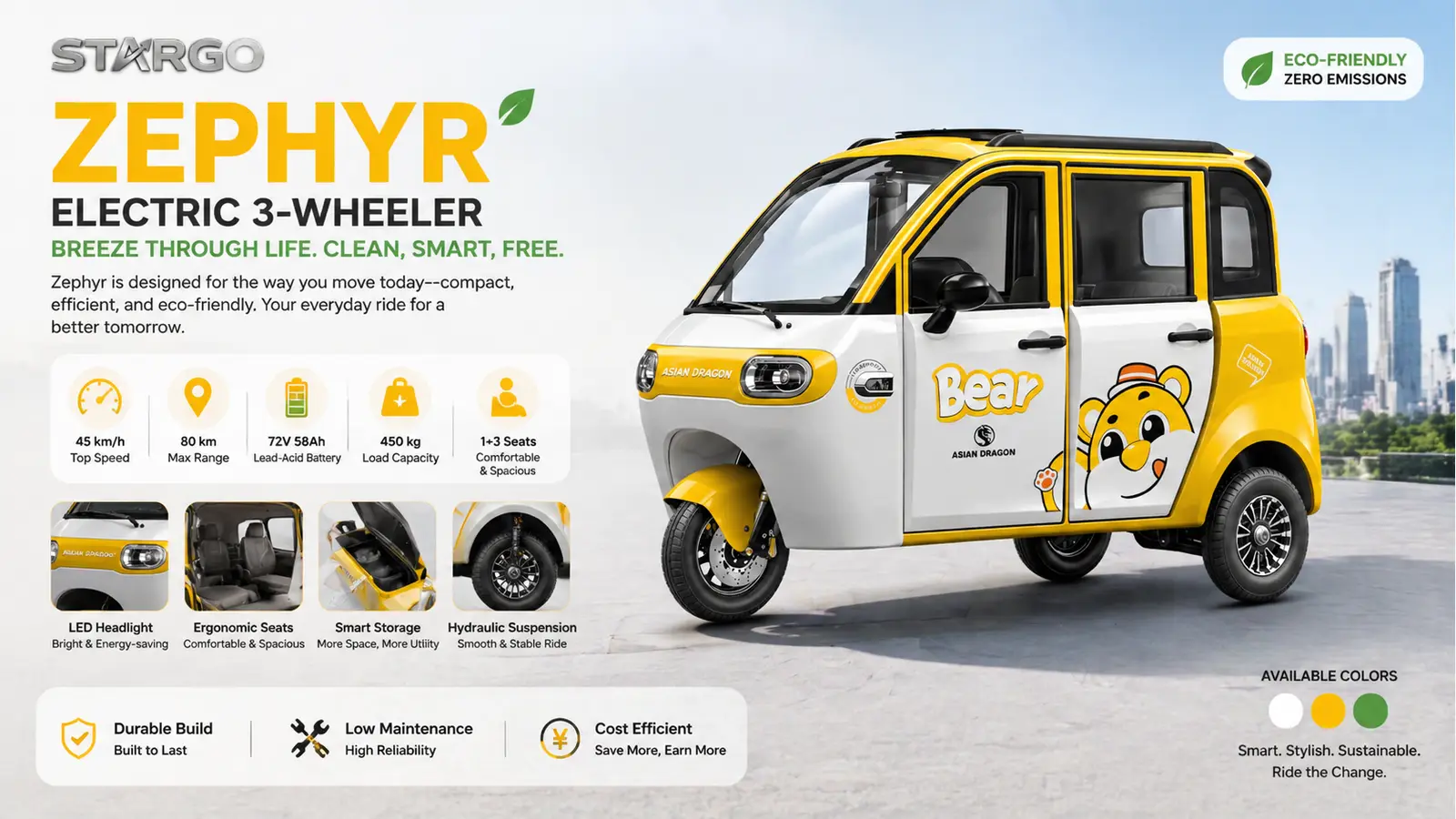
| Standard passenger tricycle | Family use, local taxi, community transit | Zephyr: 600W, 48V 20Ah lithium, 60 km+ range, 300 kg load. Also Oasis, BlissWay, JOYride | Seat count vs permit, canopy, luggage space |
| Premium pod | Tourist mobility, upmarket taxi fleets | Veloce Air: integrated ceiling and wiper, IPX6, 60–100 km, 50 km/h, 300 kg load | Finish quality, weather sealing, dashboard |
| Four-seat shuttle | Resorts, campuses, local shuttles | CT3: 3+1 seats, 2500W / 5000W, 72V 100Ah / 140Ah LFP, up to 60 km/h, ≥20° climbing | Permit class at that speed, charging time |
| Seven-seat shuttle | High-capacity tourist and community routes | CT3-L: 6+1 seats, 3400 mm body, 4000W / 5000W, 72V 100Ah LFP, 80–100 km, CBS hydraulic drum brakes | Turning circle, braking under full load |
For a deeper look at every pod in the range, read the STARGO passenger pod range guide; if you are still deciding between moving people and goods, see cargo vs passenger tricycles.
How many seats do you really need?
Choose the smallest seat count that covers your peak trip, within the permit limit. Extra seats add mass, length and braking demand on every trip, even empty ones.
A simple check: passengers per hour at peak ÷ round trips per hour = seats needed per vehicle. If the result exceeds your legal seat limit, add vehicles rather than seats. Remember that luggage counts: resort and airport shuttles carry bags, so a 3+1 layout like the CT3 may serve better than squeezing in a seven-seater.
How do you judge stability and ride comfort?
Stability comes from a wide track, a low centre of gravity and controlled speed. Comfort comes from suspension, seat design and a differential that stops the rear wheels scrubbing in turns.
- Track vs height: engineers compare half the track width with centre-of-gravity height; the larger the ratio, the more resistant to tipping. Tall roofs and high seats lower it.
- Rear axle: the CT3 lists independent rear suspension with a differential, which improves passenger comfort and cornering stability.
- Brakes: the CT3-L lists combined (CBS) hydraulic drum brakes, which share braking force between axles under passenger load.
- Test: do a full-load figure-eight at your operating speed and an emergency stop on a downhill section.
How much weather protection do passengers need?
Match protection to your climate and fares: canopies and side curtains for tropical rain, enclosed cabins for cold or premium service. Passengers pay for dry seats.
Check the roof material and drainage, side-curtain fixings, windscreen and wiper, and how electrics are sealed. The Veloce Air lists an integrated ceiling, wide-angle wiper and IPX6 rating. Whatever the model, ask which components carry the IP rating and keep vehicles out of deep standing water.
How do you size the battery for a passenger route?
Size the battery from daily kilometres and energy use measured with passengers aboard, plus a 30% margin: required Wh = daily km × Wh/km × 1.3.
- 48V × 20Ah = 960 Wh (compact and standard pods)
- 72V × 100Ah = 7,200 Wh (CT3 / CT3-L base pack)
- 72V × 140Ah = 10,080 Wh (CT3 larger option)
LFP chemistry, used on the CT3 series, is common in shuttle duty because it tolerates frequent deep cycles. If the vehicle runs two shifts, plan opportunity charging or a second pack; the CT3-L lists an optional dual battery. Compare chemistries in our battery selection guide.
How does STARGO supply passenger tricycles?
STARGO assembles three-wheelers at its Chongzuo base in Guangxi and supplies every passenger model from a minimum order of 10 units, with a 15–30 working-day lead time, depending on order quantity. Vehicle lithium packs and BMS units are built in-house.
For importers planning local assembly, the CT3-L catalogue entry lists SKD 16 units or CKD 18 units per package; kit levels are explained on the CBU / SKD / CKD page. Each container gets a pre-shipment production video before the balance payment, and the structural frame carries a 24-month warranty. CE / EEC / CB / COC / SONCAP are applied per model and market and confirmed at quotation. Browse the full electric passenger tricycle range or the market page for Bangladesh.
Frequently Asked Questions
What should I check first when buying an electric passenger tricycle?
Check the vehicle class your market allows for paid or private passenger transport: seat count, maximum speed, motor power and the approvals needed. That class decides which models you can register, so confirm it before comparing batteries, seats or styling.
Is a 600W 48V passenger tricycle powerful enough?
For short, mostly flat routes at low speed, yes. STARGO compact and standard pods use a 600W motor with a 48V 20Ah lithium pack and a 300 kg load rating. For hills, longer shuttles or higher speeds, consider a 72V model with a larger LFP battery.
How do I judge passenger tricycle stability?
Compare track width against seat and roof height, check the rear suspension and differential, and test a loaded turn at the speed you will operate. A wider track and lower centre of gravity resist tipping; speed limits matter more than any single spec.
What battery size does a passenger shuttle tricycle need?
Work from daily kilometres and measured energy use: required Wh = daily km × Wh/km × 1.3. A 48V 20Ah pack holds 960 Wh, while a 72V 100Ah LFP pack holds 7,200 Wh. Measure Wh/km with passengers aboard on your real route before choosing.
Can passenger tricycles be shipped as SKD or CKD kits?
Some can. The CT3-L catalogue entry lists packaging of SKD 16 units or CKD 18 units, which suits importers planning local assembly. Kit level, container plan and documents are confirmed per model and market at quotation.
Tell STARGO's sales team (sales@stargomoto.com) your market's passenger vehicle class, route length and seats per trip, and we will shortlist pods or shuttles, confirm documents per market and plan a sample or first container.
Entity note: STARGO is the export brand of Guangxi Xinli New Energy Technology Co., Ltd., which assembles two-wheelers in Guigang and three-wheelers in Chongzuo, Guangxi, China. The passenger tricycles in this buyer guide are Chongzuo-assembled models whose specifications are taken from STARGO catalogue pages.