Electric vs Petrol Motorcycle Cost of Ownership: A TCO Framework for Dealers and Fleets
·
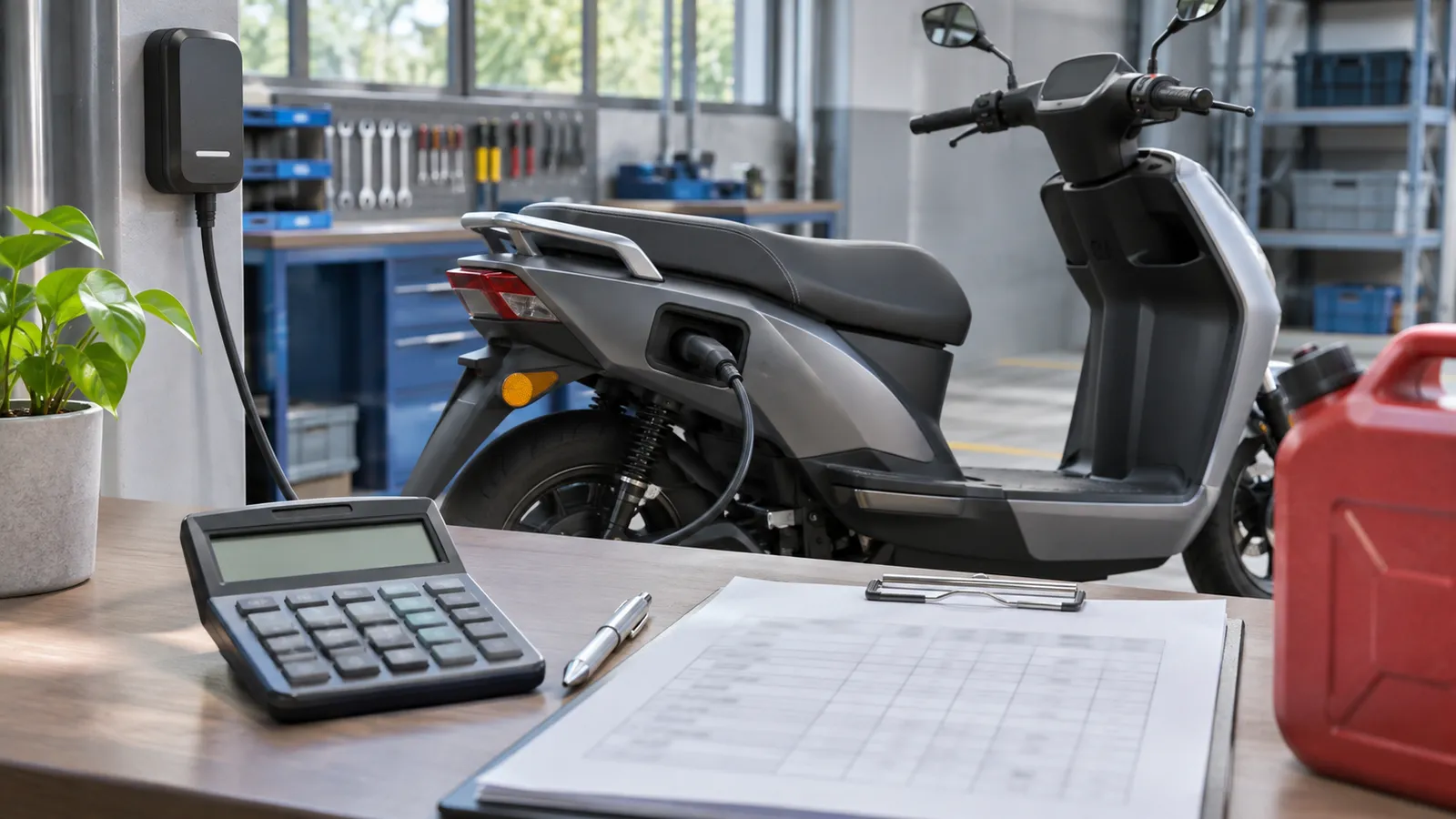
Electric vs petrol motorcycle cost of ownership comes down to five lines: purchase price, energy per km, maintenance, battery replacement and downtime. This framework gives dealers and fleet buyers the formulas to fill in with their own local prices.
Contents
- What goes into electric vs petrol motorcycle cost of ownership?
- How do you calculate energy cost per kilometre?
- Which maintenance costs disappear and which remain?
- How should you budget for battery replacement?
- What does downtime cost a fleet?
- How can a dealer turn the TCO model into a sales tool?
- How does STARGO support a TCO-based evaluation?
- Frequently Asked Questions
Key Takeaways
- Electric vs petrol motorcycle cost of ownership comes down to five lines: purchase price, energy per km, maintenance, battery replacement and downtime.
- This framework gives dealers and fleet buyers the formulas to fill in with their own local prices.
Electric vs petrol motorcycle cost of ownership is decided by five numbers, not by the sticker price: purchase price net of resale value, energy cost per kilometre, maintenance per kilometre, a battery replacement reserve, and the cost of downtime. Electric models usually win on energy and routine servicing; petrol models often win on upfront price and refuelling speed, so the answer depends on local prices and how hard the vehicle works.
Quick answer: Total cost of ownership (TCO) = purchase price − resale value + kilometres × (energy + maintenance + battery reserve per km) + downtime + fixed fees. Electric two-wheelers cut fuel and engine servicing but add a battery reserve. High-mileage fleets with cheap electricity tend to favour electric; low-mileage riders in markets with costly power or high import taxes may not.
What goes into electric vs petrol motorcycle cost of ownership?
A fair comparison includes every cost from purchase to resale, measured per kilometre over the same ownership period. Leaving out battery replacement flatters electric; leaving out oil changes and engine wear flatters petrol.
- Capital: purchase price, import duty and VAT, registration, minus expected resale value at the end of the period.
- Energy: electricity per km (including charger losses) versus petrol per km.
- Maintenance: scheduled service, wear parts and labour.
- Battery reserve: money set aside per km to replace the traction pack when it reaches end of life.
- Downtime: lost revenue when the vehicle is charging beyond shift breaks, waiting for parts or in the workshop.
- Fixed fees: insurance, road tax, parking and, for fleets, telematics.
Published studies reach different conclusions because these inputs differ by country. The IEA Global EV Outlook 2024 estimated that in India an electric two-wheeler bought in 2024 would be more than 40% cheaper than its combustion equivalent over five years of ownership. The ICCT's Viet Nam working paper found the opposite in that market: lower operating costs generally did not offset higher upfront prices, especially for lithium models. Your own spreadsheet is the only answer that counts.
How do you calculate energy cost per kilometre?
Use real-world consumption in Wh per km for the electric model and litres per 100 km for the petrol model, then apply your local tariffs.
- Pack energy: Wh = nominal voltage × amp-hours. A 72V 20Ah pack holds 1,440 Wh.
- Consumption: Wh/km = pack Wh ÷ real range. If that pack gives 60 km in your traffic, consumption is 24 Wh/km at the pack.
- Grid energy: divide by charger efficiency (η, measured or taken from the charger datasheet). At an assumed 0.85, the grid draw is about 28 Wh/km.
- Electric cost per km = grid Wh/km ÷ 1,000 × tariff per kWh.
- Petrol cost per km = (L per 100 km ÷ 100) × pump price per litre.
Do not use the brochure range for step 2. Catalogue ranges are measured at a steady speed and temperature; loaded riding, stop-start traffic and heat all shorten them. Our guide to real range versus claimed range shows how to derate. For a worked catalogue reference, the SC3 lists a 72V 20Ah pack and 75 km range (1,440 Wh ÷ 75 km = 19.2 Wh/km at the rated condition), while the Green Edge lists 5,068 Wh and 100 km at 50 km/h and 25°C, or about 50.7 Wh/km for a 105 km/h machine.
Which maintenance costs disappear and which remain?
Engine-related items disappear; tyres, brakes, bearings and electrics remain. Build both columns from your workshop's actual parts and labour rates.
| Item | Petrol motorcycle | Electric motorcycle / scooter |
|---|---|---|
| Engine oil and filter | Every service interval | Not applicable (some mid-drive or gear-reduction units need occasional gear oil) |
| Spark plug, air filter, valve clearance | Periodic | Not applicable |
| Clutch, carburettor or injector cleaning | Periodic or on failure | Not applicable |
| Final drive (chain / belt) | Chain adjustment and replacement | Hub motors: none; mid-drive: chain or belt like petrol |
| Tyres and brake wear parts | Yes | Yes; regenerative braking can reduce pad wear on some models |
| Bearings, suspension, lights | Yes | Yes |
| Electrical connectors, charger | Minor | Inspect regularly; charger is a wear item in heavy fleet use |
| Traction battery | Small starter battery | Main cost: handled in the battery reserve line |
Maintenance per km = (annual parts + annual labour) ÷ annual km. Keep the electric figure honest by including the time technicians spend on diagnostics: a dealer that has not yet trained staff on controllers and battery management will see higher labour per job in year one.
How should you budget for battery replacement?
Treat the battery as a consumable with its own reserve: replacement price divided by the kilometres the pack will deliver before it falls below your usable capacity threshold.
Battery reserve per km = replacement pack price ÷ (usable cycles × real km per cycle). Ask the supplier for the rated cycle life and the end-of-life capacity it refers to, then cross-check with your duty cycle. A courier doing one full cycle per day exhausts cycles quickly; a commuter doing a partial cycle every two days may hit calendar ageing first. Chemistry matters: lithium iron phosphate (LFP) packs usually tolerate more cycles than lead-acid, which is why the battery line can swing the whole comparison. Our lead-acid, graphene and lithium selection guide and the sibling article on how long electric scooter batteries last go deeper.
Warranty sets the floor of your risk. STARGO's published terms are: lithium battery 12 months at 70% or more remaining capacity; lead-acid and graphene batteries 6 months at 60% or more. Anything beyond the warranty period belongs in your reserve.
What does downtime cost a fleet?
Downtime cost = days off road × daily contribution margin per vehicle, and for commercial riders it can outweigh the energy saving.
- Charging: compare charge time with shift breaks. Catalogue charge times vary widely, from about 3.5 h on the ST7 to 6–8 h on many lead-acid scooters. If charging overlaps working hours, budget a spare pack or a spare vehicle per N riders.
- Parts lead time: a missing controller or charger can idle a bike for weeks if it ships from overseas. Hold a local kit; see our spare parts and after-sales page.
- Warranty turnaround: a fast, evidence-based claim process (photos, video, serial numbers) shortens time in the workshop. The warranty claim process explains what to record.
Petrol bikes refuel in minutes but have more failure points in the engine and fuel system. Record actual days off road for both fleets rather than assuming either is zero.
How can a dealer turn the TCO model into a sales tool?
Give customers a one-page worksheet that uses their own kilometres and tariffs, so the conclusion is theirs rather than yours.
| Line | Formula / input | Electric | Petrol |
|---|---|---|---|
| Net capital | Price + duty + registration − resale | Cₑ | Cₚ |
| Energy per km | Wh/km ÷ η ÷ 1,000 × tariff; or L/100 km ÷ 100 × pump price | eₑ | eₚ |
| Maintenance per km | (parts + labour) ÷ km per year | mₑ | mₚ |
| Battery reserve per km | pack price ÷ (cycles × km per cycle) | bₑ | ≈ 0 |
| Downtime | days off road × daily margin | Dₑ | Dₚ |
| Fixed fees | insurance + tax + telematics × years | Fₑ | Fₚ |
| TCO | C + km × (e + m + b) + D + F | Sum | Sum |
The breakeven distance is where the two totals meet: km* = (Cₑ − Cₚ + Dₑ − Dₚ + Fₑ − Fₚ) ÷ [(eₚ + mₚ) − (eₑ + mₑ + bₑ)]. If a customer rides beyond km* in the ownership period, electric is cheaper for them. Demand is moving this way: the IEA Global EV Outlook 2025 reports that electric models held around 15% of global two-wheeler sales in 2024, with about 10 million sold.
How does STARGO support a TCO-based evaluation?
STARGO supplies the inputs a TCO model needs: catalogue voltage, amp-hours and range per model, published warranty terms, and spare-parts kits. Battery packs and BMS units are built in-house, so pack specifications and replacement packs come from the same source as the vehicle. With an MOQ of 10 units per order, any model mix, a fleet can run a small pilot, log real Wh/km and downtime, then scale. Browse the electric motorcycle category, compare segments in electric motorcycle vs electric scooter, and structure a tender with our fleet RFQ template.
Frequently Asked Questions
Is an electric motorcycle always cheaper to own than a petrol one?
No. It depends on local fuel and electricity prices, taxes, daily kilometres and battery life. IEA found a large five-year saving in India, while ICCT found electric two-wheeler TCO generally higher in Viet Nam. Run the numbers with your own inputs before promising savings to customers.
How do I calculate electric motorcycle energy cost per kilometre?
Divide pack energy in Wh by real-world range to get Wh per km, divide by charger efficiency, then multiply by your tariff per kWh and divide by 1,000. A 1,440 Wh pack giving 60 km real range uses 24 Wh/km at the pack.
How much should a fleet reserve for battery replacement?
Reserve per km equals the replacement pack price divided by the kilometres the pack will deliver in its life: usable cycles multiplied by real range per cycle. Also check calendar life, because a lightly used pack can age out before it reaches its cycle count.
Which maintenance costs still apply to electric motorcycles?
Tyres, brake pads or shoes, brake fluid on hydraulic systems, wheel bearings, suspension, lights, connectors and the charger still need budget. Engine oil, oil filters, spark plugs, air filters and clutch work drop out, which is where most of the saving comes from.
What warranty terms should I use in a TCO model for STARGO vehicles?
STARGO covers the whole vehicle for 12 months, motor and controller for 12 months, the frame for 24 months, lithium batteries for 12 months at 70% or more remaining capacity, and lead-acid or graphene batteries for 6 months at 60% or more.
How does downtime change the comparison?
Every day a delivery bike is off the road costs its daily contribution margin. Long charging windows, slow parts supply or a failed battery with no spare can erase energy savings, so fleets should plan spare packs, a local parts kit and charging that fits shift patterns.
Building a TCO case for a dealer launch or a fleet tender? Send us your daily kilometres, tariff and preferred models through the contact page or sales@stargomoto.com, and we will return catalogue specs, battery options and warranty terms to plug into your model.
Entity note: STARGO is the export brand of Guangxi Xinli New Energy Technology Co., Ltd., which assembles two-wheelers in Guigang and three-wheelers in Chongzuo, Guangxi, China. Its in-house battery packs and BMS units give buyers one source for the vehicle and the replacement pack used in TCO planning.