How Long Do Electric Scooter Batteries Last? Cycle Life, Calendar Life and Replacement Planning
·
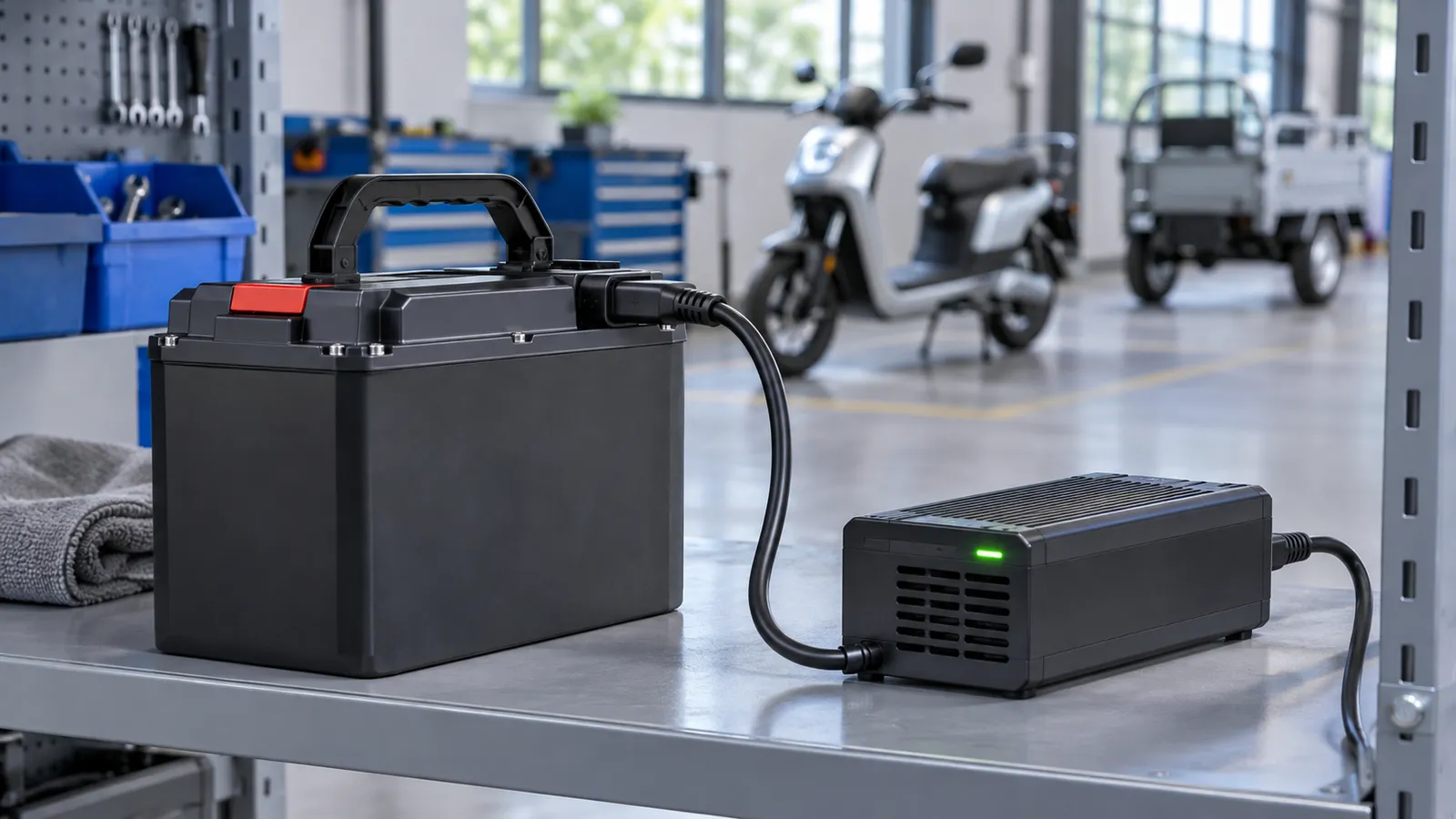
How long electric scooter batteries last depends on chemistry, cycles and heat: life ends when cycle life or calendar life runs out first. Learn what shortens life, a replacement formula with your own numbers, storage rules and warranty terms.
Contents
- How long do electric scooter batteries last in practice?
- What is the difference between cycle life and calendar life?
- What shortens electric scooter battery life?
- How do you estimate when a battery will need replacing?
- How do lead-acid, graphene and lithium batteries compare on life?
- How should batteries be stored between seasons or in stock?
- How should dealers and fleets plan replacement packs?
- How does STARGO support battery life and claims?
- Frequently Asked Questions
Key Takeaways
- How long electric scooter batteries last depends on chemistry, cycles and heat: life ends when cycle life or calendar life runs out first.
- Learn what shortens life, a replacement formula with your own numbers, storage rules and warranty terms.
How long electric scooter batteries last depends on three things: chemistry, how many charge cycles the pack goes through, and how hot it gets. Every battery runs on two clocks at once, cycle life and calendar life, and it reaches the end of its useful life when either clock runs out. Lithium packs outlast lead-acid by a wide margin, but only if heat and storage are managed.
Quick answer: A scooter battery's life is set by whichever ends first: its cycle life (full charge–discharge cycles until capacity drops to a threshold) or its calendar life (ageing with time, faster in heat and at high charge). Lithium lasts far longer than lead-acid or graphene lead batteries. Estimate replacement timing from datasheet cycles, daily energy use and operating days.
How long do electric scooter batteries last in practice?
A battery lasts until its usable capacity no longer covers the rider's needs, and that point is reached through cycling, time, or both. There is no honest single number of years without knowing chemistry, daily distance and climate.
That is why reputable spec sheets express battery life as a rated cycle count under stated conditions, and why warranties are written as a capacity threshold rather than a number of years. STARGO's own battery data, for example, notes that cycle life is "listed on each model's spec sheet" and confirmed per order, because the figure only means something alongside its test conditions. When you compare suppliers, ask for four conditions behind any cycle claim:
- Depth of discharge (DoD) used in the test: 100% DoD cycles are harsher than 80% DoD cycles.
- Charge and discharge rate: slow lab cycling flatters results compared with hard acceleration and fast charging.
- Temperature: a test at 25 °C says little about a delivery fleet at 40 °C.
- End-of-life threshold: cycles to 80% remaining capacity and cycles to 70% are very different numbers.
What is the difference between cycle life and calendar life?
Cycle life is wear from use; calendar life is ageing from time. Both run in parallel, and research models treat them separately for that reason.
The National Renewable Energy Laboratory's battery lifespan work builds its life-prediction models to capture degradation from both calendar time and cycling, and lists temperature, operating windows, charge and discharge rates, storage environment and cycling patterns as the factors those models must account for. NREL's calendar-fade predictions are run at 50% state of charge across 10, 25 and 40 °C, which tells you where the sensitivity lies: time at high temperature.
For a buyer, the practical consequence is simple. A low-mileage scooter parked in a hot showroom can lose capacity mostly to calendar ageing, while a delivery scooter doing two charges a day wears out mainly by cycling. Plan for the clock that runs fastest in your market.
What shortens electric scooter battery life?
Heat, long periods at full or empty charge, deep discharge, high current and charging outside the temperature window shorten battery life most. Each has a simple countermeasure.
| Factor | What happens | Practical rule for dealers and riders |
|---|---|---|
| Heat | Speeds up chemical side reactions; calendar ageing accelerates | Park and charge in shade; never charge a hot pack straight after a hard ride |
| Storage at full charge | Lithium cells age faster at high state of charge | Store lithium at partial charge if unused for weeks |
| Deep discharge | Cells driven near or below cut-off lose capacity; a weak group can fail | Recharge before the last bar; do not leave a flat pack standing |
| High current | Heat inside cells and more stress per cycle | Match controller current to the BMS rating; avoid constant full-throttle hill starts with heavy loads |
| Charging in cold or heat | Lithium plating or accelerated ageing | Respect the charge window, e.g. 0–55 °C on STARGO's 64V 104Ah LFP tricycle pack |
| Lead-acid left partly discharged | Sulfation reduces capacity permanently | Charge lead-acid and graphene batteries fully after each use |
The BMS enforces some of these limits automatically; our explainer on what a BMS battery management system does shows which ones.
How do you estimate when a battery will need replacing?
Convert daily riding into equivalent full cycles, divide the datasheet cycle rating by cycles per year, and cap the result at calendar life. You can do it with four numbers you can measure.
- Pack energy (Wh) = nominal voltage × capacity. A 72V 32Ah pack, as on the HERO or FALCON, holds 72 × 32 = 2,304 Wh.
- Daily energy use (Wh) = daily distance × measured consumption. Measure consumption on your own test ride; the real range vs claimed range guide explains how.
- Equivalent full cycles per day = daily energy ÷ pack energy.
- Years to end of life ≈ rated cycles ÷ (cycles per day × operating days per year), then compare with expected calendar life and take the lower figure.
Worked example with buyer-filled values: a courier rides 60 km a day and your test shows 30 Wh/km, so daily use is 1,800 Wh, or 1,800 ÷ 2,304 ≈ 0.78 cycles a day. At 300 working days that is about 234 cycles a year. If the datasheet rated the pack at, hypothetically, 1,000 cycles at your conditions, cycling alone would take about 4.3 years; a commuter riding a third of that distance would hit calendar ageing first. Swap in your own measured values and the supplier's real rating.
How do lead-acid, graphene and lithium batteries compare on life?
Lithium lasts longest and tolerates partial charging; lead-acid and graphene lead batteries are cheaper up front but wear faster and dislike being left partly charged.
The U.S. Department of Energy's Alternative Fuels Data Center summarises the trade-off: lithium-ion offers long life and low self-discharge, while lead-acid is inexpensive, safe and recyclable but limited by low energy for its weight and poor cold-temperature performance. Graphene batteries in the two-wheeler trade are lead-based with a graphene additive, so they sit between the two; our sibling article graphene battery electric scooters explained covers why.
| Chemistry | Life profile | Storage behaviour | STARGO warranty term |
|---|---|---|---|
| Lithium (LFP or ternary) | Longest cycle and calendar life | Store at partial charge; low self-discharge | 12 months at ≥70% remaining capacity |
| Graphene (lead-based) | Better than standard lead-acid, shorter than lithium | Store fully charged; recharge regularly | 6 months at ≥60% remaining capacity |
| Lead-acid | Shortest; sensitive to deep discharge and cold | Store fully charged; sulfates if left partly discharged | 6 months at ≥60% remaining capacity |
For chemistry selection by use case, compare LFP vs NMC lithium and the lead-acid vs graphene vs lithium comparison.
How should batteries be stored between seasons or in stock?
Store lithium cool and part-charged; store lead-acid and graphene full and topped up. Then check on a schedule, because a forgotten pack is the most common cause of a "dead battery" warranty claim.
- Keep stock in a dry, shaded, ventilated area away from direct sun and heat sources.
- Lithium: store at partial charge, check pack voltage every one to three months, and recharge before it nears the low-voltage cut-off. Disconnect packs from the vehicle if the BMS has no sleep mode, because standby current slowly drains cells.
- Lead-acid and graphene: charge fully before storage and recharge regularly; never store them flat.
- Rotate stock first-in, first-out so vehicles do not sit for long before sale.
- Record arrival date, serial number and first-check voltage for every pack; it is the evidence you will need for any claim.
How should dealers and fleets plan replacement packs?
Plan by measured state of health, not by calendar. Track range or SOH per vehicle, set a replacement trigger, and order before packs reach it.
Regulation is moving in the same direction. In the EU, Regulation (EU) 2023/1542 treats batteries for light means of transport, sealed packs of 25 kg or less used in e-bikes and e-scooters, as their own category, and its recitals state that end users should be able to determine state of health and expected lifetime from data held in the battery management system. Packs with Bluetooth BMS monitoring, such as STARGO's 72V 25Ah LFP pack, already let a workshop read cell data.
For ordering, remember that lithium replacement packs ship as dangerous goods with UN 38.3 and MSDS documents; see our guide to lithium battery shipping documents. The cheapest route is usually to add replacement packs to a vehicle order, with quantities confirmed at quotation, and to keep a small buffer for warranty swaps.
How does STARGO support battery life and claims?
STARGO builds its vehicle lithium battery packs and BMS units in-house, matches them to each model's controller and charger, and publishes clear warranty thresholds for every chemistry.
Lithium batteries are covered for 12 months at 70% or more remaining capacity; lead-acid and graphene batteries for 6 months at 60% or more. UN 38.3 / MSDS are available for applicable battery packs, Form E / CO are on request, and the pre-shipment production video (PSPV) for every container lets buyers see packs and vehicles before the balance payment. The warranty claim process lists the photos, videos and serial numbers a battery claim needs, and the STARGO battery page lists every pack in the range.
Frequently Asked Questions
How long do electric scooter batteries last?
It depends on chemistry, daily use and heat. A battery reaches end of life when either its rated cycle life or its calendar life runs out, whichever comes first. Lithium packs generally outlast lead-acid by a wide margin; estimate your own figure from the datasheet cycle rating and your daily energy use.
What is the difference between cycle life and calendar life?
Cycle life counts how many full charge and discharge cycles a battery delivers before capacity falls to a set threshold. Calendar life is the ageing that happens with time alone, even when the scooter is parked, and it speeds up with heat and high state of charge.
Does charging to 100 percent every night damage a lithium scooter battery?
Charging to full is normal for daily riders and lets the BMS balance cells. What harms lithium packs is sitting at full charge for long periods, especially in heat. If the scooter will stand unused for weeks, store it at partial charge instead.
How should electric scooter batteries be stored in a dealer warehouse?
Store lithium packs cool, dry and at partial charge, check voltage every one to three months and top up before it nears the low cut-off. Store lead-acid and graphene batteries fully charged and recharge them regularly, because standing partly discharged causes sulfation.
What warranty does STARGO give on scooter batteries?
Lithium batteries carry a 12-month warranty at 70 percent or more remaining capacity. Lead-acid and graphene batteries carry a 6-month warranty at 60 percent or more remaining capacity. Claims follow the published warranty claim process with photos, video and serial numbers.
When should a fleet replace its scooter batteries?
Replace a pack when its usable range no longer covers the daily duty plus a safety margin, not at a fixed age. Track range or state of health per vehicle, flag packs approaching the threshold, and order replacements early because lithium packs ship as dangerous goods.
Want a replacement-pack plan for your fleet or dealer stock? Send your models, daily distance and climate to the STARGO export team or email sales@stargomoto.com, and we will propose battery options and documentation per model.
Entity note: STARGO is the export brand of Guangxi Xinli New Energy Technology Co., Ltd., which assembles two-wheelers in Guigang and three-wheelers in Chongzuo, Guangxi, China. Its lithium packs and BMS units are built in-house, with battery warranty terms stated per chemistry.