Sine Wave vs Square Wave Controller: How the Controller Shapes Electric Motorcycle Performance
·
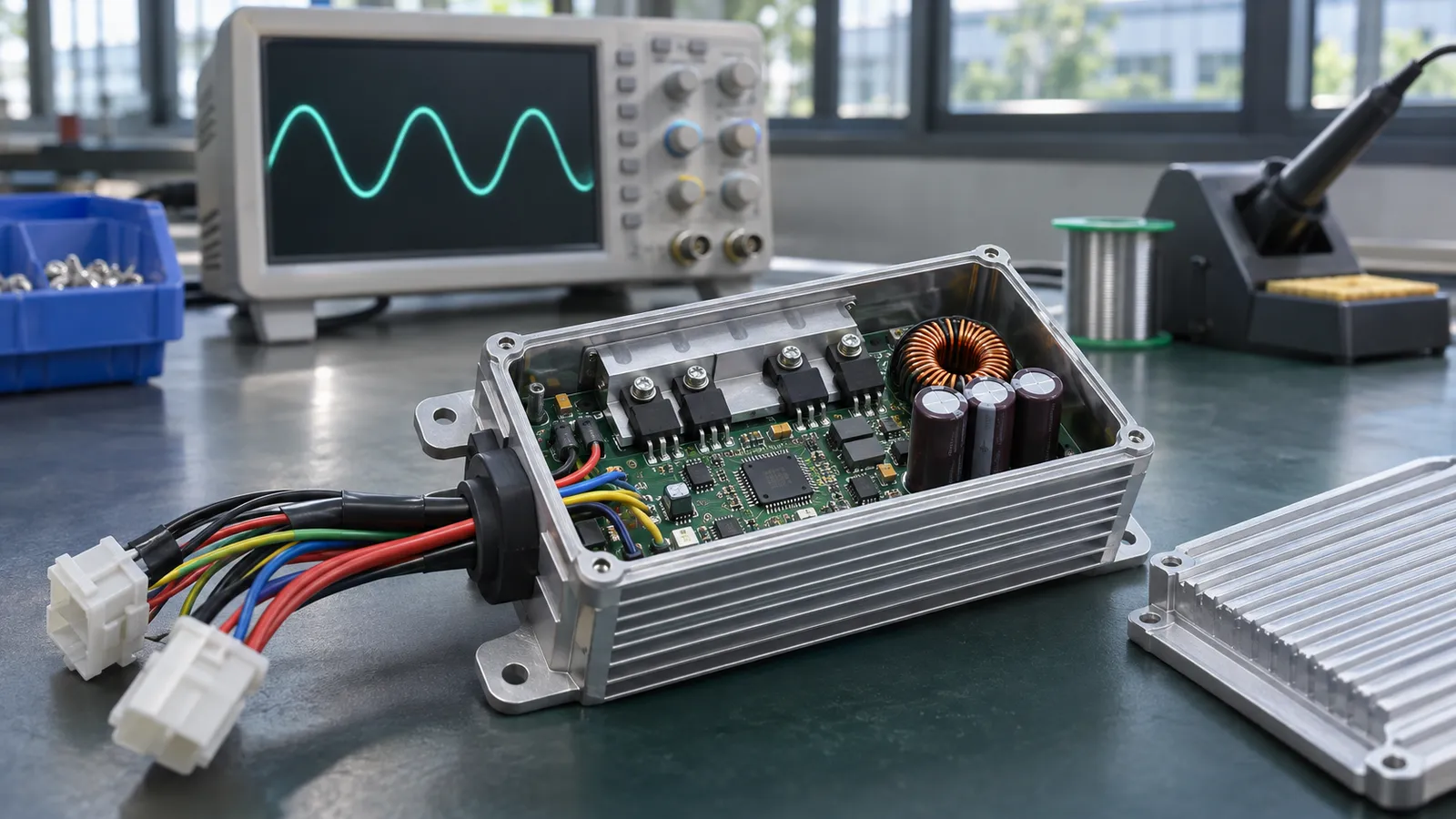
Sine wave vs square wave controller: square wave is simple and robust, sine wave is quieter, and FOC vector control is the most efficient across speeds. This guide explains tube count, current limits, heat and what to ask suppliers.
Contents
- What does a motor controller do on an electric motorcycle?
- What is the difference between a sine wave and a square wave controller?
- Is a vector controller the same as FOC?
- What do tube count and current ratings tell you?
- How does the controller limit real-world performance?
- How does heat affect a controller, and how can buyers check it?
- What should you ask a supplier about the controller?
- How does STARGO specify controllers?
- Frequently Asked Questions
Key Takeaways
- Sine wave vs square wave controller: square wave is simple and robust, sine wave is quieter, and FOC vector control is the most efficient across speeds.
- This guide explains tube count, current limits, heat and what to ask suppliers.
The difference between a sine wave vs square wave controller is how the controller shapes the current it sends to a brushless motor: square wave (six-step) switches current in blocks, while sine wave and FOC controllers feed smooth sinusoidal current. On an electric motorcycle that choice changes noise, low-speed smoothness, efficiency and how much of the motor's rating you can actually use.
Quick answer: A square wave controller is simple, cheap and robust but louder and less smooth at low speed. A sine wave controller gives quieter, smoother torque. A FOC (vector) controller adds precise current control for the best efficiency across the speed range. Whatever the waveform, the controller's current limits, MOSFET count and cooling set the real-world performance.
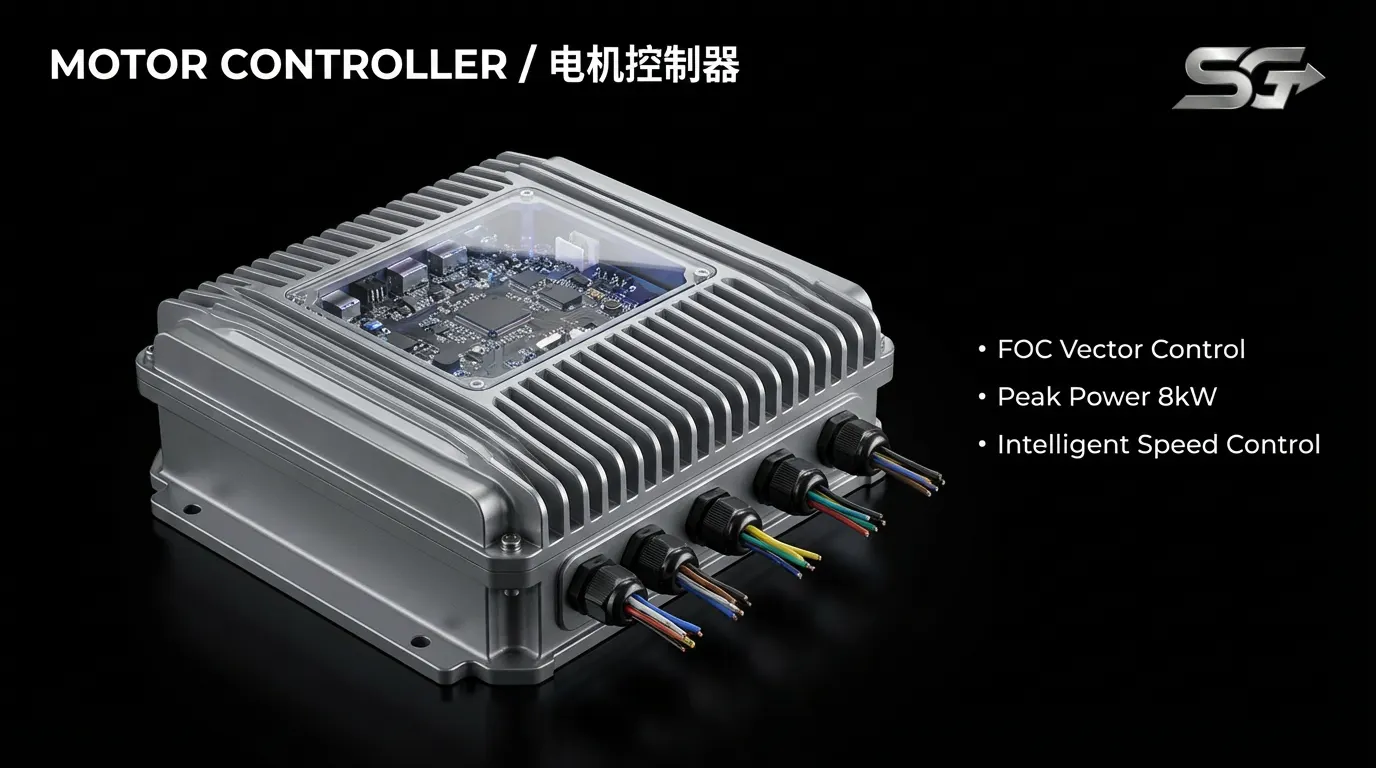
What does a motor controller do on an electric motorcycle?
The controller converts battery DC into three-phase AC for the motor and decides, hundreds of times per second, how much current the motor receives. It is the "engine management" of an electric two-wheeler.
The U.S. Department of Energy's power electronics programme describes the role plainly: an inverter is needed in an electric drive to convert DC energy from the battery into AC power to drive the motor, and it also acts as the motor controller. On a scooter, the controller also reads the throttle and brake switches, sets speed modes, handles regenerative braking, protects against overvoltage, undervoltage, overcurrent and overheating, and often talks to the dashboard and BMS.
Because it controls current, the controller, not the motor sticker, decides launch torque, top speed and how long full power can be held. Two scooters with the same "2000W motor" can feel completely different because their controllers are set differently. Our guide to choosing motor power for electric two-wheelers explains the motor side.
What is the difference between a sine wave and a square wave controller?
A square wave controller energises two motor phases at a time in six steps per electrical revolution; a sine wave controller drives all three phases with smoothly varying current. The waveform shows up as noise, vibration and torque ripple.
An engineering comparison of commutation methods for permanent-magnet brushless motors, published by Penn State Berks and Moog researchers, found that six-step (trapezoidal) drives have the highest torque ripple, most noticeable at low speed, and that commutation non-linearities cause noise and vibration. Sinusoidal drives run smoothly at low speed but lose efficiency at high speed, while FOC achieved low ripple at both low and high speed and good efficiency across a wide range. The authors' conclusion: FOC "gives the best of both" trapezoidal and sinusoidal commutation, at the cost of more code and hardware.
| Factor | Square wave (six-step) | Sine wave | FOC / vector |
|---|---|---|---|
| Current waveform | Blocks, two phases at a time | Sinusoidal, three phases | Sinusoidal, regulated as a vector on the rotor field |
| Low-speed smoothness | Noticeable ripple and "growl" | Smooth | Smooth |
| Motor noise | Highest | Low | Low |
| Efficiency across speed range | Good at high speed | Weaker at high speed | Good over a wide range |
| Rotor position sensing | Hall sensors, simplest algorithm | Finer position estimate needed | Finer position estimate needed |
| Tolerance of sensor faults | High; some run in sensorless fallback | Moderate | Depends on firmware |
| Typical fit | Entry commuters, lead-acid models, rough duty | Mid-range commuters | Sport, high-voltage and smart models |
Industrial FOC drives often use encoders or resolvers; two-wheeler controllers more commonly estimate rotor angle from Hall sensors or sensorless observers. Ask the supplier which method a given controller uses, because it affects how the bike behaves if a Hall sensor fails.
Is a vector controller the same as FOC?
Yes. "Vector controller", "FOC controller" and "sine wave vector controller" on Chinese and export spec sheets all describe field-oriented control.
FOC measures phase currents and splits them into a torque-producing part and a field part relative to the rotor magnets. It then controls each part separately. The practical benefits are torque that follows the throttle precisely, less wasted current at part load and, in many controllers, field weakening, which trades torque for extra top speed. The NINJA long-distance sport scooter is a catalogue example: it pairs a configurable 1000–1500W motor (1500–2000W peak) with a 12-tube vector controller on 60V or 72V systems.
What do tube count and current ratings tell you?
Tube count tells you how many power MOSFETs share the load; current ratings tell you how much power the controller will actually deliver. Both matter more than the waveform for hill climbing and sustained speed.
A three-phase inverter has six switch positions. A 6-tube controller uses one MOSFET per position, a 12-tube controller two in parallel, an 18-tube controller three. More parallel devices share the current, so each runs cooler, and the controller can hold a higher continuous current. The count is not the whole story: MOSFET grade, board copper, and heatsink contact decide how well that capacity holds up in 35 °C traffic.
Then read the two current limits. The battery-side limit caps input power: input power = battery voltage × battery current. A controller limited to 35 A on a 72 V pack draws at most 72 × 35 = 2,520 W. The phase-current limit, which is usually higher, sets launch torque, because at low speed the controller can deliver more current to the motor than it takes from the battery. When you compare quotations, ask for both numbers and check that the battery-side limit sits inside the BMS discharge rating, as explained in our sibling article on what a BMS battery management system does.
How does the controller limit real-world performance?
The controller enforces the speed cap, the continuous power, the peak-power duration and the undervoltage cut-off. Those settings, more than the waveform, decide what the rider experiences.
- Speed limits and modes: the Avatar retro scooter, for instance, is listed at 66 km/h with an unlock-configurable limit, which is a controller setting.
- Timed boost: the K10 Max lists 80 km/h top speed and 83 km/h with a 60-second boost, a typical example of the controller allowing peak current for a defined time.
- Traction and hill functions: the Star Amber city commuter pairs a hub motor with a smart controller offering TCS, hill-descent control and hill-hold parking.
- Undervoltage behaviour: a well-set controller reduces power gradually just above the BMS cut-off, so the rider gets a warning instead of a sudden shutdown.
- Legal category: in the EU, Annex I of Regulation (EU) No 168/2013 limits L1e mopeds to 45 km/h design speed and 4,000 W maximum continuous rated power, so controller settings are part of the homologation file.
For how speed and power settings map to EU vehicle classes, read our sibling explainer on L1e and L3e classification.
How does heat affect a controller, and how can buyers check it?
Heat is the controller's main enemy: when MOSFETs or the heatsink reach their protection temperature, the controller derates current, and the rider feels power fade on long climbs or at sustained top speed.
The DOE notes that better power-module packaging and cooling placed close to heat sources are active research areas for vehicle power electronics, which shows how central thermal design is. On a two-wheeler, check that the controller is mounted where air flows, that its housing is aluminium with good contact to the MOSFET bar, that the board is potted or conformal-coated against moisture, and that connectors are sealed. During sample evaluation, ride a loaded climb or hold top speed for 10–15 minutes and note whether power drops; the real-range test method can be extended to log this.
What should you ask a supplier about the controller?
Ask for the settings, not just the waveform. This checklist covers what affects performance, warranty claims and spare-parts planning.
| Item | Why it matters | Good answer looks like |
|---|---|---|
| Rated voltage and undervoltage cut-off | Must suit pack chemistry and BMS cut-off | Stated in volts, a little above BMS cut-off |
| Battery and phase current limits | Set power and launch torque | Two numbers in amps, battery limit within BMS rating |
| MOSFET count and type | Heat and continuous current | Tube count plus part grade |
| Control mode and sensor type | Noise, smoothness, fault behaviour | Square, sine or FOC; Hall or sensorless |
| Speed modes and limits | Legal category and rider safety | Settings per market, locked or unlockable |
| Regenerative braking | Brake feel and range | On/off or level setting |
| Sealing and mounting | Rain and wash exposure | Potting or coating, sealed connectors |
| Spare part and warranty | Field repair speed | Same part number available as a spare, 12-month term |
Keep at least one controller per model in your parts stock; our spare parts support checklist and the STARGO parts catalogue help plan it.
How does STARGO specify controllers?
STARGO matches controller, motor, battery pack and charger per model, and states controller details on the catalogue where they are confirmed. Where a spec is not listed, it is confirmed at quotation.
Because STARGO builds its vehicle lithium packs and BMS in-house, the controller's battery-side current and undervoltage settings can be set against the actual BMS limits before shipment. Motor and controller carry a 12-month warranty. For high-power platforms, see our sibling guide to 72V vs 96V electric motorcycles, and for regenerative braking and TCS in the braking system, read ABS, CBS and disc brakes explained. More on drivetrain engineering is on the STARGO technology page.
Frequently Asked Questions
Is a sine wave controller always better than a square wave controller?
Not always. A sine wave or FOC controller is quieter, smoother at low speed and usually more efficient across the speed range. A square wave controller is simpler, cheaper and very tolerant of rough use and Hall-sensor faults, which still suits budget commuters and some cargo duty.
What does "12-tube controller" mean?
It means the controller uses 12 power MOSFETs. A three-phase inverter has six switch positions, so 12 tubes means two transistors share each position. More tubes split the current, cut heat per device and allow higher continuous current, but layout, MOSFET grade and cooling matter as much as the count.
Is FOC the same as a vector controller?
Yes. Field-oriented control (FOC) and vector control describe the same method: the controller regulates the motor current as a vector aligned with the rotor magnetic field. On scooter spec sheets, "vector controller", "FOC controller" and "sine wave vector" usually refer to this type.
Can the controller make a motor more powerful than its rating?
Only for short periods. Peak power figures come from the controller allowing more current for seconds, not continuously. Running above the motor and controller continuous rating overheats windings and MOSFETs, so good controllers derate automatically. Always compare models on rated power and current, not peak alone.
Why does an electric scooter lose power on a long climb?
Most often the controller is thermally derating: its MOSFET or heatsink temperature has reached the protection threshold, so it cuts current to protect itself. Battery voltage sag and BMS current limits can add to it. Better cooling, a higher current rating or lower gearing solve it.
Which controller details should be on a supplier quotation?
At minimum: rated voltage, low-voltage cut-off, battery-side and phase current limits, number and type of MOSFETs, control mode (square, sine or FOC), sensor type, speed modes and limits, regenerative braking settings, sealing and the controller warranty term.
Comparing controller options for a new range? Send the target speed, payload, terrain and market to the STARGO export team or sales@stargomoto.com, and we will propose a matched motor, controller and battery configuration for each model.
Entity note: STARGO is the export brand of Guangxi Xinli New Energy Technology Co., Ltd., which assembles two-wheelers in Guigang and three-wheelers in Chongzuo, Guangxi, China. Controller settings are matched to each model's motor and in-house battery pack before shipment.