Electric Scooter Pre-Shipment Inspection Checklist: AQL Sampling, Function Tests and Battery Documents
·
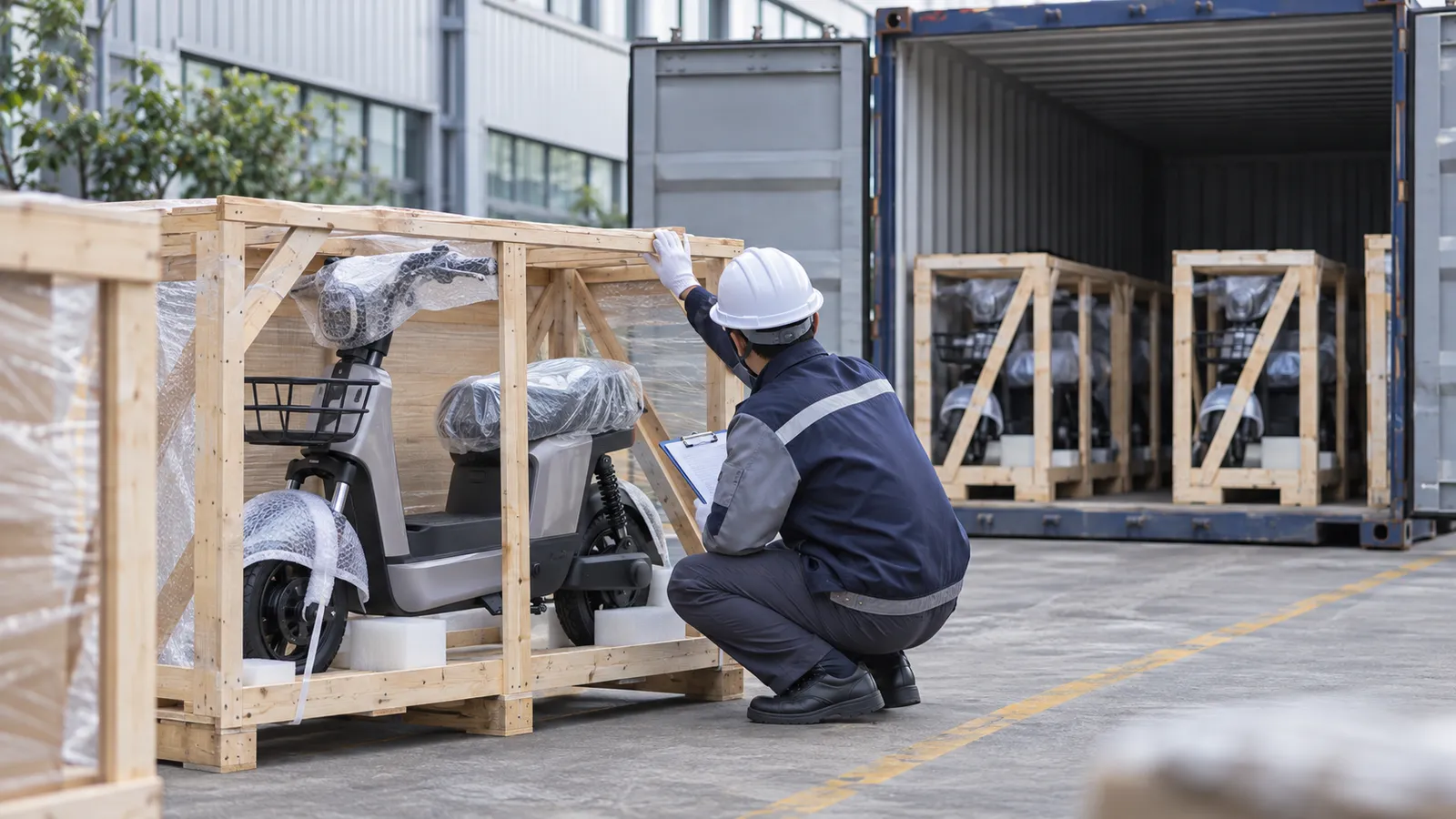
An electric scooter pre-shipment inspection combines ISO 2859-1 AQL sampling, a function test on every sampled unit, battery label and UN38.3 document checks, packing review and container loading photos. Here is the checklist, the sample-size table and how a production video fits in.
Contents
- What does an electric scooter pre-shipment inspection cover?
- How many units should be sampled under ISO 2859-1?
- How do you classify defects on an electric scooter?
- What function checks should each sampled scooter pass?
- How do you check battery labels and dangerous-goods documents?
- What should packing and container loading photos show?
- How does a production video complement third-party inspection?
- Frequently Asked Questions
Key Takeaways
- An electric scooter pre-shipment inspection combines ISO 2859-1 AQL sampling, a function test on every sampled unit, battery label and UN38.3 document checks, packing review and container loading photos.
- Here is the checklist, the sample-size table and how a production video fits in.
An electric scooter pre-shipment inspection (PSI) is the last check before your money and your container leave the factory: it samples finished units by AQL, function-tests them, verifies battery labels and documents, and records packing and loading. Done properly, it turns "I hope the container is right" into a signed record you can rely on when the balance payment is due.
Quick answer: A pre-shipment inspection for electric scooters should cover five blocks: an ISO 2859-1 AQL sample of finished units, a function test on every sampled unit, battery label and UN38.3/MSDS document checks, carton and packing review, and container loading photos. Schedule it after production is complete and before the balance payment, and agree defect classes in writing first.
What does an electric scooter pre-shipment inspection cover?
A PSI covers quantity, conformity to the order, function, safety-critical items, documents, packing and loading. It checks finished goods, not the production process.
Write the scope into your purchase order or a separate inspection protocol before production starts. If the inspector has no reference, they can only check general workmanship. Give them the proforma invoice, the approved configuration, photos of your golden sample (see our electric scooter sample evaluation protocol), the colour and logo artwork, and your defect classification list.
- Quantity and assortment: units per model, colour and battery configuration match the packing list.
- Conformity: motor, controller, battery, charger, tyres, brakes and accessories match the order.
- Function: every sampled unit powers up, rides, brakes and charges.
- Safety-critical items: brakes, steering, lighting, battery mounting, wiring routing.
- Documents and labels: nameplates, frame numbers, battery labels, UN38.3 test summary, MSDS, manuals.
- Packing and loading: carton marking, protection, container condition and stowage.
How many units should be sampled under ISO 2859-1?
Use ISO 2859-1 general inspection level II to set sample size from lot size, then read the accept/reject numbers for your chosen AQL from the standard's single-sampling table.
ISO 2859-1 defines sampling schemes indexed by acceptance quality limit (AQL) for lot-by-lot inspection. Its third edition was published in 2026 and replaces the 1999 edition, so ask your inspection company which edition it works to. The sample-size code letters at general inspection level II are summarised below.
| Lot size (units of one model) | Code letter (level II) | Sample size | Practical note |
|---|---|---|---|
| 9–15 | B | 3 | Small lots: consider a 100% function test |
| 16–25 | C | 5 | Small lots: consider a 100% function test |
| 26–50 | D | 8 | Add a full visual walk-through of all cartons |
| 51–90 | E | 13 | Typical single-model lot in a mixed container |
| 91–150 | F | 20 | Spread samples across colours and battery types |
| 151–280 | G | 32 | Split by model if the container is mixed |
Treat each model as its own lot. A container mixing three models is three lots, each with its own sample. Draw samples at random from different pallets and stacks, not from the units nearest the door. A common buyer convention is zero accepted critical defects, AQL 2.5 for major and AQL 4.0 for minor defects. Because STARGO's MOQ is 10 units, many first orders fall in the 9–15 band, where a statistical sample is only three vehicles. In that case a 100% function test is usually faster to agree than an argument about statistics.
How do you classify defects on an electric scooter?
Classify defects as critical, major or minor in a written list agreed before production; the inspector applies your list, not their own judgement.
| Class | Definition | Electric scooter examples |
|---|---|---|
| Critical | Unsafe, illegal or makes the unit unsaleable in your market | Brake does not stop the wheel; exposed live wiring; battery not secured; wrong battery chemistry or missing battery label; frame crack |
| Major | Function failure or visible defect a customer would return | Display dead; headlight or indicator not working; charger fails to charge; wrong colour; deep scratch on main panel; wrong tyre size |
| Minor | Cosmetic or small deviation that does not affect function | Small paint run under the seat; loose cable tie; slightly misaligned sticker; dust inside the carton |
What function checks should each sampled scooter pass?
Each sampled unit should be unpacked, powered and ridden briefly; a static look in the carton misses most electrical faults.
- Battery voltage at rest measured with a multimeter and compared with the nominal pack voltage.
- Key, remote or NFC unlock; display shows battery level, speed and mode.
- All lights, indicators, brake light, horn and any reverse or parking mode.
- Throttle response through every speed mode on a short ride or on a stand.
- Front and rear brakes lock the wheel by hand; brake light switch triggers the cut-off.
- Charger connected: charging indicator works and charger label matches the destination mains and plug.
- Fasteners on axles, handlebar clamp and brake calipers torque-marked; no rattles over a bump.
- Accessories present: mirrors, keys, manual, charger, tool kit as ordered.
Record the frame number of each sampled unit in the report, so any later warranty claim can be traced to the inspected lot. Our quality control page describes the factory side of these checks.
How do you check battery labels and dangerous-goods documents?
Check that every pack label matches the order and that the UN38.3 test summary and MSDS cover each battery type in the container; your forwarder handles the dangerous-goods declaration.
Scooters with installed lithium batteries are dangerous goods in transport. By sea, the IMDG Code applies; the IMO describes it as mandatory for packaged dangerous goods under SOLAS since 1 January 2004. By air, IATA rules apply, and the IATA Lithium Battery Shipping Regulations stress that errors in marking, labelling or packaging can delay a shipment. At inspection, confirm:
- Pack label: nominal voltage, capacity (Ah) and/or energy (Wh), chemistry, and a serial or batch number.
- The UN38.3 test summary matches the battery model on the label, not just a similar pack.
- The MSDS matches the chemistry (lithium-ion, LiFePO4, lead-acid or graphene).
- Battery state of charge is at the level your forwarder requests for the route.
- Spare batteries, if any, are packed and declared separately from installed ones.
More detail is in lithium battery shipping documents and export documents for electric two-wheelers.
What should packing and container loading photos show?
Photos should prove carton condition, marking, container condition and stowage, so any transit damage can be separated from factory damage when the container is opened.
- Empty container: floor, walls, roof and door seals, with the container number visible.
- Carton marking: model, colour, quantity, gross weight and shipping marks matching the packing list.
- Protection inside the carton: foam or cardboard on panels, mirrors and display, handlebar secured.
- Stowage at 25%, 50%, 75% and full, with lashing or dunnage between rows.
- Closed doors with the seal number visible, and that seal number written on the report.
Who books and pays for the inspection should match your trade term. Under Incoterms® 2020, the term on your contract (FOB, CIF and so on) defines where risk transfers, which is why buyers want the loading record before risk passes. Our guide to loading a first mixed-model container covers stowage planning.
How does a production video complement third-party inspection?
A pre-shipment production video shows your actual container remotely and quickly; a third-party inspection adds statistical sampling, measurements and a signed report. They work best together.
STARGO provides a pre-shipment production video (PSPV) for every container before the balance payment: you see the finished units of your order, functions being demonstrated and loading, then confirm before paying the balance. For a repeat order of a known model, many buyers find the PSPV sufficient. For a first order, a new model or a high-value container, book a third-party inspector as well and send them the same checklist. STARGO's lead time of 15–30 working days, depending on order quantity means you should book the inspector as soon as the finish date is confirmed. See what to check in a PSPV, the payment terms and PSPV process, and container loading and shipping.
Frequently Asked Questions
How many scooters should be inspected in a pre-shipment inspection?
Under ISO 2859-1 general inspection level II, a lot of 51–90 units gives a sample of 13, 91–150 units gives 20, and 151–280 units gives 32. For small lots, many buyers function-test every unit because the statistical sample is only a few vehicles.
What AQL levels are typical for electric scooters?
A common buyer convention is zero accepted critical defects, AQL 2.5 for major defects and AQL 4.0 for minor defects. Critical means unsafe or illegal, such as brake failure or a missing battery label. Agree the defect list and levels in writing before production starts.
Which battery documents should be checked before an electric scooter shipment?
Check the UN38.3 test summary and MSDS for each battery type in the container, and that pack labels show voltage, capacity and chemistry matching the order. Your forwarder confirms the dangerous-goods declaration and labels required for the route.
Can a pre-shipment production video replace a third-party inspection?
It can for some buyers and some orders, but they do different jobs. A video shows the actual units, functions and loading of your container remotely. A third-party inspector applies AQL sampling, measures and signs a report. High-value or first orders often use both.
When should the pre-shipment inspection be scheduled?
Schedule it when production is complete and at least 80% of units are packed, but before the container is sealed and before the balance payment. Book the inspector or video slot when the factory confirms the finish date, usually several working days ahead.
Planning an order and want the inspection steps written into the proforma? Send your model list and inspection requirements to STARGO sales or sales@stargomoto.com.
Entity note: STARGO is the export brand of Guangxi Xinli New Energy Technology Co., Ltd., which assembles two-wheelers in Guigang and three-wheelers in Chongzuo, Guangxi, China. Every STARGO container comes with a pre-shipment production video before the balance payment, and buyers may add their own third-party inspection.