Electric Scooter Service Workshop Setup: Tools, Technician Skills, Battery Safety and Warranty Evidence
·
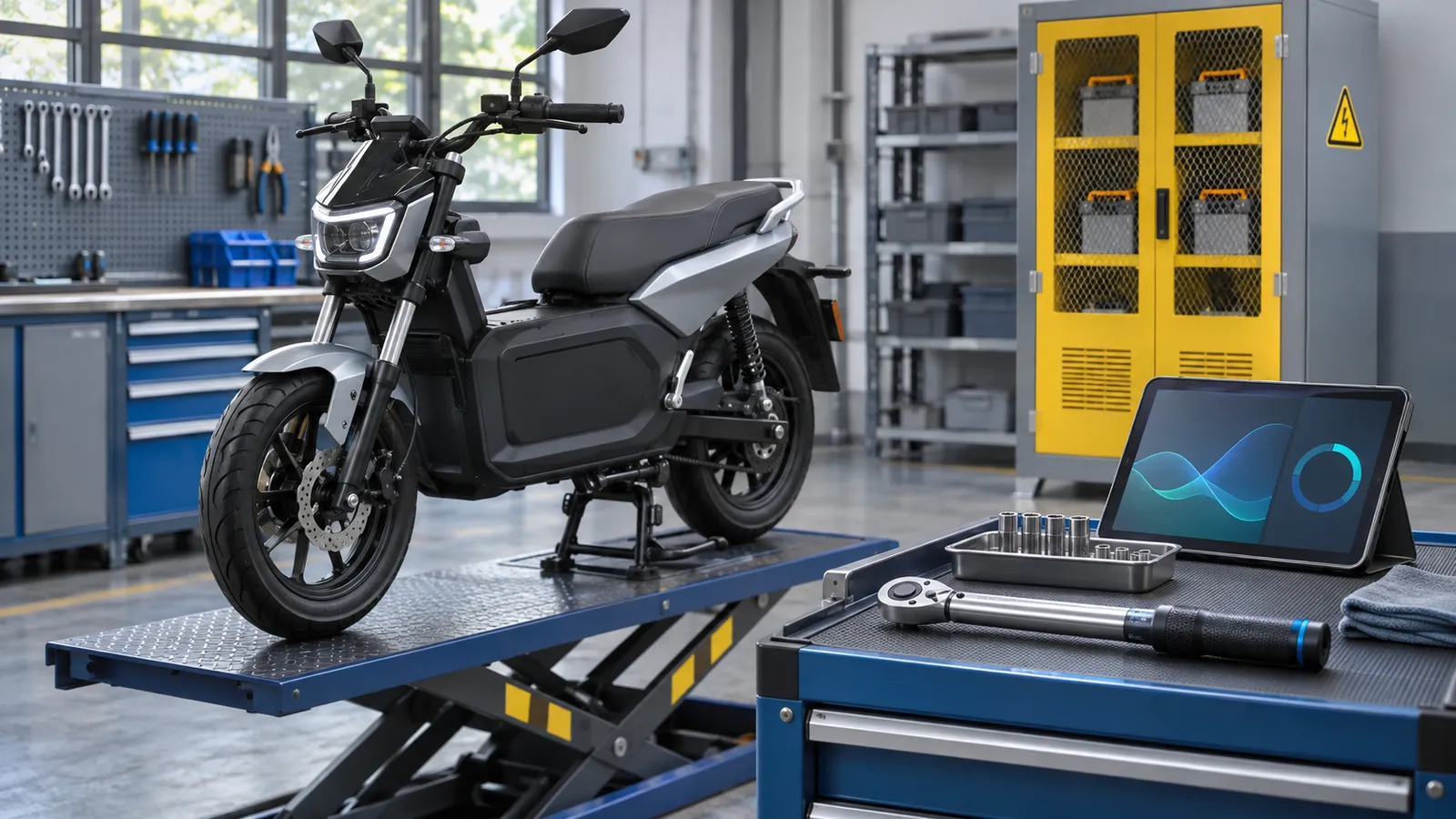
An electric scooter service workshop setup needs four things: zoned space with a separate battery area, the right electrical tools, technicians trained in steps, and a routine for warranty evidence. This guide lists the tools, the safety rules for lithium storage and the photos, videos and serials a claim needs.
Contents
- How should an electric scooter workshop be laid out?
- Which tools does an electric scooter service workshop setup need?
- How should technicians be trained?
- How do you keep lithium batteries safe in the workshop?
- What evidence makes a warranty claim fast?
- Which workshop KPIs should a dealer track?
- How does STARGO support dealer workshops?
- Frequently Asked Questions
Key Takeaways
- An electric scooter service workshop setup needs four things: zoned space with a separate battery area, the right electrical tools, technicians trained in steps, and a routine for warranty evidence.
- This guide lists the tools, the safety rules for lithium storage and the photos, videos and serials a claim needs.
An electric scooter service workshop setup comes down to four decisions: how you zone the space (with a separate battery area), which electrical tools you buy, how you train technicians in steps, and how you capture warranty evidence on every job. Get these right and a small two-bay workshop can support a growing fleet of customers and keep warranty claims fast and clean.
Quick answer: Set up an electric scooter workshop with four zones (reception and diagnosis, repair bays, a separate battery area, parts store), an electrical tool kit built around a rated multimeter, clamp meter, battery capacity tester and motor/controller tester, technicians trained from mechanical to electrical to battery diagnosis, and a job-card routine that records serials, photos, video and measured values for every warranty claim.
How should an electric scooter workshop be laid out?
Lay the workshop out in four zones so that batteries, customers and repair work never share the same space. Zoning is the cheapest safety measure you will buy.
- Reception and diagnosis: where the vehicle is checked in, photographed and its frame number recorded on the job card before work starts.
- Repair bays: one stand or lift per bay, bench with insulated mat, good lighting, compressed air for tyres.
- Battery area: ventilated, non-combustible shelving and bench, away from exits and from flammable stock such as tyres, cartons and solvents, with a quarantine container for damaged packs.
- Parts store: organised by tier and model; see our electric scooter spare parts list for dealers.
Add a short, safe test-ride lane or agreed route. Every repair should end with a ride, not just a power-on.
Which tools does an electric scooter service workshop setup need?
An electric scooter workshop needs a normal motorcycle tool kit plus electrical diagnostic tools; the electrical tools are what separate a real service point from a tyre shop.
| Tool | What it is for | Priority |
|---|---|---|
| Digital multimeter with a safety category rating | Pack voltage, fuse and switch continuity, connector checks | Day one |
| DC clamp meter | Current draw at idle and under load; finding parasitic drain | Day one |
| Battery capacity / discharge tester | Measuring remaining Ah against rated capacity for warranty decisions | Day one |
| Motor and controller tester (hall and phase) | Separating motor, controller and throttle faults | Day one |
| Insulated hand tools and gloves | Working near 48V–72V packs and higher-voltage models | Day one |
| Torque wrench set | Axles, brake calipers, handlebar clamps to specification | Day one |
| Tyre levers, bead breaker, pressure gauge | Tubed and tubeless 10–17 inch tyres | Day one |
| Crimping tool, heat gun, heat-shrink, soldering station | Repairing connectors and harness sections properly | Month one |
| Infrared thermometer | Motor, controller and charger temperature after test rides | Month one |
| Hydraulic brake bleed kit, bearing puller | Disc-brake and wheel-bearing service | Month one |
| Diagnostic cable or app (smart models) | Reading fault codes where the model supports it; confirm at quotation | As models require |
Voltage matters when you choose tools. Mainstream scooters in our catalogue run 48V, 60V or 72V, but performance models go higher: the DP-PRO uses a 96V pack and the OBSIDIAN is listed at 108V/120V. If you sell those, insulated tools, a written isolation routine and a trained technician are not optional. Our guide to choosing motor power explains how voltage and current relate.
How should technicians be trained?
Train technicians in three levels (mechanical, electrical, battery diagnosis) and only let them work on a system once they have passed that level.
- Level 1 — mechanical: tyres, brakes, cables, bearings, suspension, body panels, torque specifications, pre-delivery inspection.
- Level 2 — electrical: reading wiring diagrams, using the multimeter and clamp meter, fuse and switch faults, throttle and brake-switch faults, controller and motor hall/phase tests, charger checks, connector repair and waterproofing.
- Level 3 — battery diagnosis: safe handling, voltage and capacity testing, BMS protection states, recognising swelling, heat or electrolyte smell, quarantine and return procedures.
Level 3 is diagnosis, not pack rebuilding. The U.S. CPSC's Micromobility Information Center advises against using a battery pack that was modified or repaired by unqualified people, or one made with repurposed or used cells. Open a pack or replace cells only when the manufacturer has approved it and supplied the correct parts.
Keep a one-page skills matrix on the wall: each technician, each level, the date passed. It is also useful evidence when a supplier asks who diagnosed a warranty fault.
How do you keep lithium batteries safe in the workshop?
Store, charge and quarantine lithium packs in a dedicated area with clear rules; the risk is highest with damaged packs and unattended charging.
The NFPA notes that the lithium-ion batteries in most e-bikes and e-scooters can catch fire or explode if they are not used correctly or are damaged. CPSC charging advice translates directly into workshop rules: stay nearby while a device charges, use only the charger supplied or recommended by the manufacturer, and unplug when charging is complete.
- No charging overnight or when the workshop is closed.
- Charge on a non-combustible surface, one pack per matched charger, never with a "universal" charger.
- Limit how many packs are stored and keep them at the partial charge given on the battery specification.
- Inspect every incoming pack: casing cracks, swelling, burn marks, wet connectors. A pack that fails goes straight to the quarantine container, outside the main working area.
- Agree extinguisher type, quantity and placement with your local fire authority and insurer, and train staff to use them.
- Keep a log of packs received, tested, quarantined and returned.
Returning a suspect pack is a transport question as well. Lithium batteries are dangerous goods, and the IATA Lithium Battery Shipping Regulations make clear that batteries need special preparation before shipping. Never send a damaged pack by courier or air without your forwarder's dangerous-goods advice; in most cases the supplier will ask for test evidence first so the pack does not need to travel at all. For climate-specific care, see battery care in hot climates.
What evidence makes a warranty claim fast?
A fast claim has identity, evidence and timing: order reference and serials, photos and video of the fault, measured values, and when the fault appeared.
| Fault type | Evidence to collect | Measured values to include |
|---|---|---|
| Battery capacity loss | Photo of pack label and serial; video of the test set-up | Full-charge voltage, measured Ah from a capacity test, rated Ah, charge history if known |
| Motor fault | Video of the noise or failure with the wheel lifted; photo of motor marking | Hall sensor readings, phase-to-phase checks |
| Controller fault | Photo of controller label; video of display error or cut-out | Supply voltage at controller, throttle signal voltage |
| Frame or structural | Close-up photos of the crack with a ruler, wide shot with frame number visible | Mileage, accident history declaration |
| Out-of-box defect | Photos of carton and packing as received; unboxing video if available | Date received, container or seal number |
Measured values matter because many warranty terms are conditional. A lithium battery term written as "12 months at 70% or more remaining capacity" can only be judged with a capacity test, so the technician should record measured Ah against rated Ah, not just "battery weak". For the full process, see the warranty claim process; for what drives battery ageing, see how long electric scooter batteries last.
Which workshop KPIs should a dealer track?
Track a few numbers monthly: turnaround time, first-time fix rate, comeback rate and parts waiting time. They show where the bottleneck is.
- Turnaround time: hours from check-in to customer pick-up, median per job type.
- First-time fix rate: share of jobs not returned for the same fault within 30 days.
- Comeback rate: the inverse view, by technician and by fault type.
- Parts waiting time: days vehicles wait for parts; this feeds your reorder points.
- Warranty claim cycle: days from fault found to supplier decision.
How does STARGO support dealer workshops?
STARGO supports dealer workshops through clear warranty terms, a defined claim intake, matched battery packs and spare-parts quotations.
Warranty terms are: whole vehicle 12 months; motor and controller 12 months; frame (structural) 24 months; lithium battery 12 months at 70% or more remaining capacity; lead-acid and graphene batteries 6 months at 60% or more. A claim needs the order or proforma reference, model, serial or VIN if available, photos or video, and a fault description, which is exactly what the job card above captures. Vehicle lithium battery packs and BMS units are built in-house, so pack diagnosis questions go to the team that designed the pack. Every container also has a pre-shipment production video, which helps separate factory faults from transit or in-service damage. See spare parts and after-sales, spare parts kit and after-sales and the dealer program.
Frequently Asked Questions
What tools does an electric scooter workshop need first?
Start with a category-rated digital multimeter, a DC clamp meter, a battery capacity or discharge tester, a motor and controller tester, insulated hand tools, a torque wrench, tyre tools, a crimping tool with heat-shrink, an infrared thermometer and a stand or lift.
How should a workshop store lithium scooter batteries safely?
Keep packs in a dedicated, ventilated area on a non-combustible surface, away from exits and flammable materials. Separate damaged or swollen packs into a quarantine container, never charge unattended, use only the matched charger, and follow your local fire authority on extinguishers.
What evidence does a warranty claim for an electric scooter need?
Provide the order or proforma reference, model, frame or serial number, clear photos and a short video of the fault, measured values such as voltage or capacity, and when the fault appeared: out of the box or in service, with the date and mileage.
Can a dealer workshop repair lithium battery packs?
A dealer workshop should diagnose packs, not rebuild them. Measure voltage, check connectors and the BMS state, and run a capacity test. Opening a pack or replacing cells should be done only with the manufacturer’s approval, because unqualified pack repairs are a known fire risk.
How many technicians does a new electric scooter workshop need?
Start with at least one technician trained to electrical diagnosis level and one assistant for mechanical work, then add bays as the number of vehicles in service grows. Track jobs per technician per day and turnaround time to see when you need more capacity.
Setting up after-sales for a new territory? Tell STARGO sales (sales@stargomoto.com) which models you plan to sell, and ask for the matching parts list and claim procedure with your quotation.
Entity note: STARGO is the export brand of Guangxi Xinli New Energy Technology Co., Ltd., which assembles two-wheelers in Guigang and three-wheelers in Chongzuo, Guangxi, China. Warranty claims from dealer workshops are reviewed against the published terms using the order reference, serials and the evidence the workshop supplies.