Electric Scooter Spare Parts List for Dealers: How to Stock Fast, Medium and Slow Movers
·
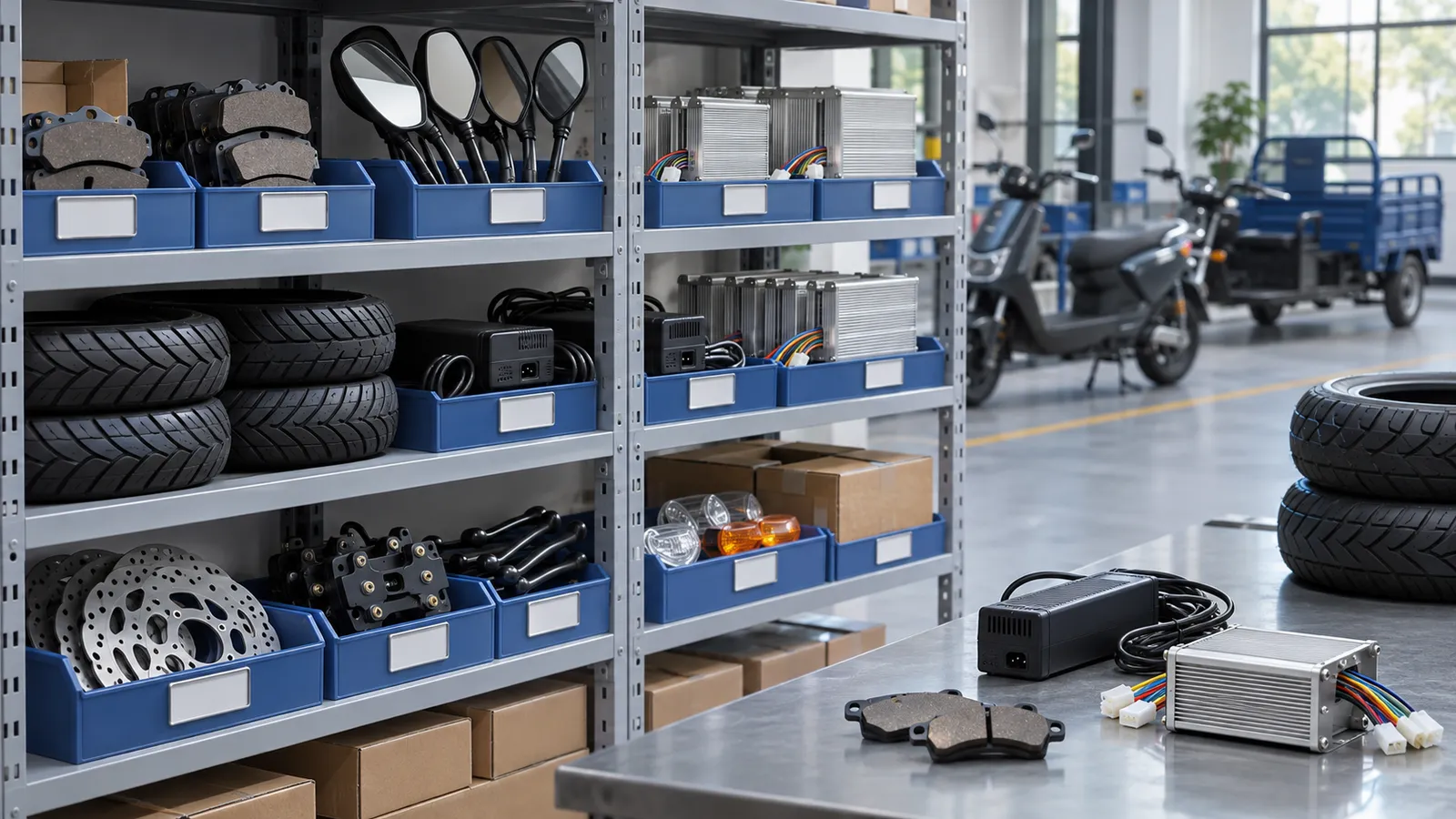
A workable electric scooter spare parts list for dealers is built in three tiers: wear parts you sell every week, electrical parts that fail occasionally, and high-value parts you order against a confirmed fault. This guide shows the first-order kit, reorder formula and failure-mode map.
Contents
- Why do dealers need a tiered spare parts plan?
- Which parts belong in each tier of an electric scooter spare parts list for dealers?
- How should you size the first-order spare parts kit?
- How do you calculate reorder points for spare parts?
- How can failure modes guide what you stock?
- How should you handle battery spares?
- How does STARGO support dealer spare parts planning?
- Frequently Asked Questions
Key Takeaways
- A workable electric scooter spare parts list for dealers is built in three tiers: wear parts you sell every week, electrical parts that fail occasionally, and high-value parts you order against a confirmed fault.
- This guide shows the first-order kit, reorder formula and failure-mode map.
The right electric scooter spare parts list for dealers is not a catalogue of every part; it is three tiers stocked differently: fast-moving wear parts held on the shelf, medium-moving electrical parts held per model, and slow, high-value parts ordered against a confirmed fault. Size each tier from your vehicle count and how long a replenishment takes to reach you.
Quick answer: Stock electric scooter spare parts in three tiers. Tier A (brake pads, tyres, tubes, cables, mirrors, levers, fuses, keys) stays on the shelf for every model. Tier B (controllers, chargers, displays, throttles, lights, switches) is held one or two per model. Tier C (motors, battery packs, frames, painted panels) is ordered against a confirmed fault. Reorder at weekly usage × lead time + safety stock.
Why do dealers need a tiered spare parts plan?
Because the parts that stop a customer riding are rarely expensive, and the expensive parts are rarely needed. A tiered plan puts money where downtime is most likely.
A dealer who stocks one of everything ties up cash in motors and frames that never sell, and still runs out of brake pads. A dealer who stocks nothing loses customers when a scooter waits weeks for a cable. The middle path is to classify every part by how often it is needed and how fast you can get it, then stock each class with a different rule. Our spare parts support checklist covers what to ask a supplier; this article covers what to hold.
Which parts belong in each tier of an electric scooter spare parts list for dealers?
Tier A is wear and damage parts, Tier B is electrical modules, Tier C is high-value structural and energy parts. The table below is a starting template.
| Tier | Typical parts | What drives demand | Stocking rule |
|---|---|---|---|
| A · fast | Brake pads/shoes, tyres, inner tubes, brake and throttle cables, mirrors, levers, grips, fuses, bulbs/LED modules, keys and remotes, side stands | Kilometres ridden, falls, punctures, road quality | On the shelf for every wheel size and brake type you sell; reorder by formula |
| B · medium | Controllers, chargers, displays/instruments, throttles, brake light switches, headlamp and tail-lamp units, ignition switches, DC-DC converters, connectors and harness sections, shock absorbers, wheel bearings | Water ingress, vibration, misuse, charging habits | 1–2 per model (per voltage for controllers and chargers); reorder when used |
| C · slow | Hub or mid-drive motors, battery packs, BMS boards, frames, painted body panels, forks, wheels/rims | Accidents, warranty decisions, rare failures | Order against a confirmed fault; keep one pack only for your top configuration |
Two details trip up new dealers. First, Tier A must be matched to the exact specification: a NOVA runs 10-inch wheels with drum brakes, while a TANK uses 12-inch wheels with front and rear discs, and an Avatar uses 14-inch wheels with a front disc and rear drum. Three models can mean three tyre sizes and two brake-pad types. Second, controllers and chargers are voltage-specific: a 60V and a 72V version of the same model need different parts.
How should you size the first-order spare parts kit?
Size it to cover every vehicle you will sell until the next shipment arrives, using a simple formula per part rather than a fixed percentage.
For each Tier A part, estimate: first-order quantity = vehicles sold before next delivery × expected replacements per vehicle in that period. Example with buyer-filled variables: if you expect to sell 30 scooters before the next container lands, and you judge that one in five will need a brake-pad set in that time, you need 30 × 0.2 = 6 sets, plus a safety margin. Do this per wheel size and brake type, not per model name.
- Tier A: calculated per part as above; round up.
- Tier B: one of each module per model and voltage; two for your top seller.
- Tier C: none at first, except one battery pack for your best-selling configuration if local customers cannot wait for sea freight.
- Consumables: grease, thread locker, cable ties, heat-shrink, connector seals, fuses in every rating used.
Ask for this kit as a separate line on the proforma invoice so it ships and clears customs with the vehicles. Our guide to starting an electric scooter dealership shows where the parts budget sits in the opening plan.
How do you calculate reorder points for spare parts?
Reorder when stock falls to average usage during the replenishment lead time plus a safety stock. The lead time is door to door, not factory lead time alone.
Reorder point = average weekly usage × lead time (weeks) + safety stock. A practical safety stock is (maximum weekly usage × maximum lead time) − (average weekly usage × average lead time). Example: if you use 3 inner tubes a week on average and 5 in a bad week, and replenishment takes 8 weeks on average and 10 at worst, safety stock = 5 × 10 − 3 × 8 = 26, and the reorder point = 3 × 8 + 26 = 50 tubes. Replenishment lead time should add factory production (STARGO quotes 15–30 working days for vehicle orders, depending on order quantity), sea transit and customs clearance for your port.
Review usage monthly from your workshop job cards. As your vehicle population grows, Tier A usage grows with it, so a reorder point set in month one is too low by month six.
How can failure modes guide what you stock?
Map the symptoms customers bring in to the parts that fix them; the map shows which Tier B parts deserve shelf space in your climate and use pattern.
| Customer symptom | Likely causes to check first | Parts to hold |
|---|---|---|
| Scooter will not power on | Blown fuse, ignition switch, loose battery connector, BMS in protection, flat pack | Fuses, ignition switch, connector set, charger |
| Power cuts out under load | Low pack voltage, controller over-current, brake switch fault, throttle hall sensor | Throttle, brake light switches, controller per voltage |
| Will not charge | Charger failure, charging port damage, BMS fault | Charger per voltage, charging port |
| Faults after rain or washing | Water in connectors, display or throttle | Connector seals, display, throttle |
| Weak braking or noise | Worn pads/shoes, stretched cable, glazed disc | Pads/shoes, cables, discs for top models |
| Knocking or wobble | Wheel bearings, loose axle, worn shock | Bearings, shock absorbers |
In humid or rainy markets, connector seals, throttles and displays move up the list; on rough roads, bearings, shocks and tyres do. Track every repair by symptom and part on the job card and re-rank your Tier B list each quarter. Setting up the workshop that produces those job cards is covered in our electric scooter service workshop setup guide.
How should you handle battery spares?
Hold as few battery packs as possible, keep them matched to the vehicle, rotate them, and source replacements from the vehicle manufacturer.
Batteries are the most expensive and most regulated part on the shelf. The U.S. CPSC's Micromobility Information Center advises using only replacement or spare battery packs that are tested and approved for the device and confirmed by the manufacturer as suitable, and avoiding packs modified or repaired by unqualified people. A pack also needs the right BMS settings and connector for the vehicle. In the EU, Regulation (EU) 2023/1542 creates a separate category of light means of transport (LMT) batteries, defined as sealed batteries weighing 25 kg or less that power vehicles such as e-bikes and e-scooters; EU importers should review its obligations for the packs they place on the market.
Shipping matters too. Battery packs sent on their own are dangerous goods, and the IATA Lithium Battery Shipping Regulations explain that packing, marking and documentation errors can stop a shipment. That makes urgent air-freighted packs slow and costly, which is why spare packs usually travel by sea with the vehicles. Store packs at the partial charge given on the battery specification, in a cool, dry, ventilated area, and check voltage monthly. See the battery specifications handbook summary and the battery overview.
How does STARGO support dealer spare parts planning?
STARGO quotes spare parts with a container order or as a follow-on shipment, and can suggest a starter list of fast-moving items for your models and market.
As described on spare parts kit and after-sales, common request categories include controllers, chargers, mirrors, brake parts, tyres and tubes, cables and connectors, lighting and locks; quantities and SKUs are confirmed on the quotation only. Vehicle lithium battery packs and BMS units are built in-house, so replacement packs are matched to the vehicle's BMS and connector. Warranty terms help decide which parts you will need to buy and which will be handled as claims: whole vehicle 12 months, motor and controller 12 months, frame 24 months, lithium battery 12 months at 70% or more remaining capacity, and lead-acid or graphene batteries 6 months at 60% or more. MOQ is 10 units for vehicles, so a small dealer can open with a narrow range and a narrow parts list. More detail: spare parts and after-sales, parts and the warranty claim process.
Frequently Asked Questions
Which electric scooter spare parts sell fastest at a dealer?
Wear and damage parts move fastest: brake pads or shoes, tyres and inner tubes, brake and throttle cables, mirrors, levers, grips, fuses, bulbs or LED modules, and keys or remotes. Stock these by wheel size and brake type for every model you sell.
Should a dealer stock spare battery packs?
Stock a small number only for your best-selling battery configuration, and rotate them. Batteries lose capacity in storage, carry dangerous-goods shipping rules, and should match the vehicle and BMS exactly. Order other packs against a confirmed fault or a warranty decision.
How do I calculate when to reorder a spare part?
Use a reorder point: average weekly usage × replenishment lead time in weeks + safety stock. Lead time must include production, sea transit and customs, not just factory lead time. Review usage monthly and adjust as your vehicle population grows.
Can spare parts ship in the same container as the vehicles?
Usually yes. Ask for a spare-parts line on the proforma invoice so parts ship with the vehicles and clear customs together. Quantities, prices and whether the kit ships in the same container are confirmed on the quotation.
How many spare parts should a new dealer order with the first container?
Size the kit from your vehicle count and the replenishment cycle: enough wear parts to cover every vehicle you sell until the next shipment arrives, one or two units of each electrical part per model, and no slow movers unless they are hard to obtain locally.
Planning your first container? Send your model list and market to STARGO sales or sales@stargomoto.com and ask for a suggested starter parts list with the vehicle quotation.
Entity note: STARGO is the export brand of Guangxi Xinli New Energy Technology Co., Ltd., which assembles two-wheelers in Guigang and three-wheelers in Chongzuo, Guangxi, China. Spare parts can be quoted on the same proforma invoice as the vehicles, with quantities confirmed per order.