Electric Scooter Dealer Marketing: Test-Ride Days, Local Search, WhatsApp and Fleet Outreach
·
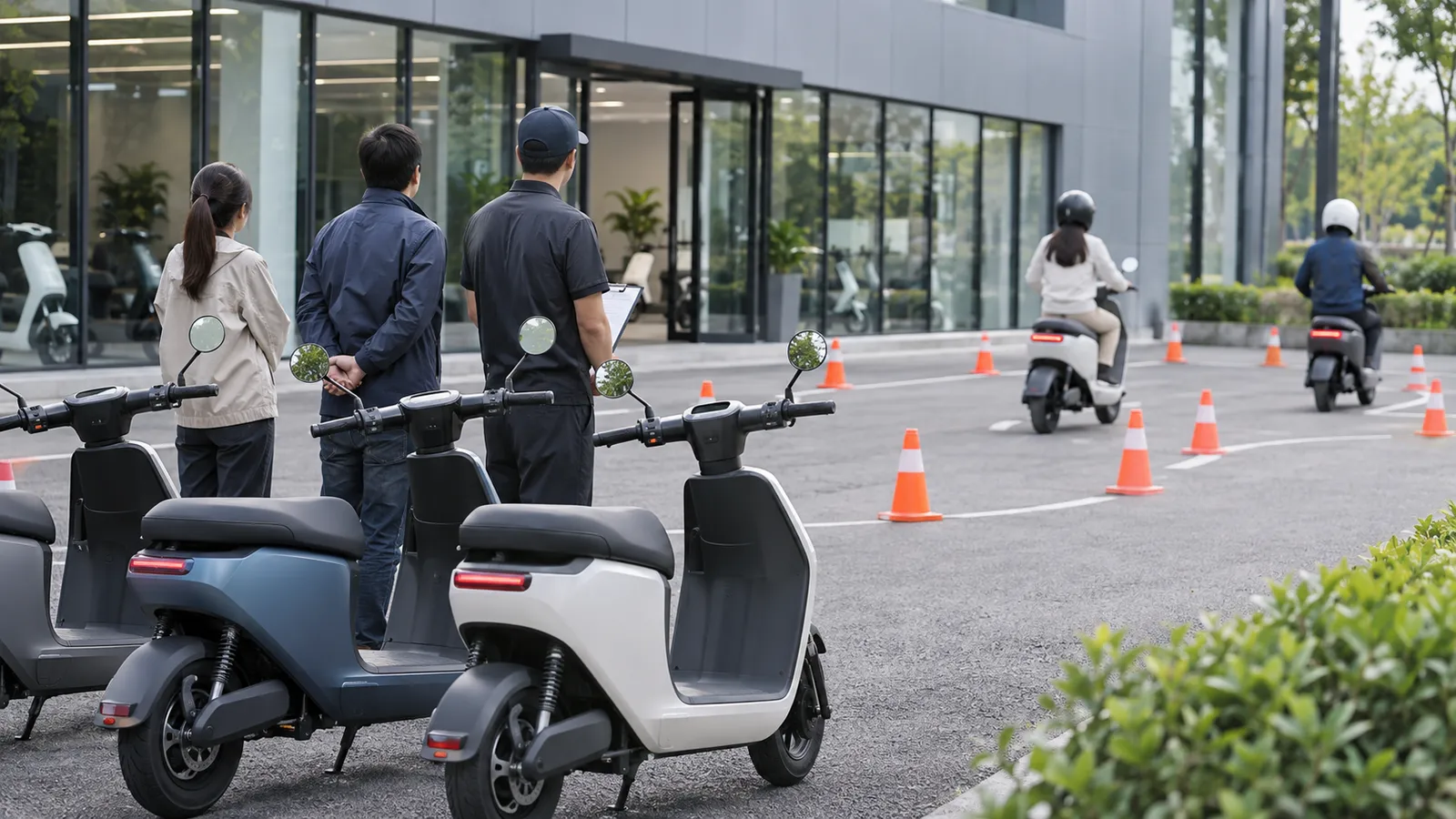
Electric scooter dealer marketing works best as a measured funnel: get found locally, answer fast on WhatsApp, put people on bikes at test-ride days, and pitch fleets with cost-per-kilometre maths. This playbook gives the steps, an event checklist and the KPIs to track every week.
Contents
- Why do test rides matter so much in electric scooter dealer marketing?
- How do you plan an electric scooter test-ride day?
- How can a dealer get found in local search?
- How should dealers use WhatsApp to convert enquiries?
- How do you win fleet and B2B customers?
- Which KPIs prove that dealer marketing is working?
- Which content should an electric scooter dealer publish?
- How does STARGO support dealer marketing and demo fleets?
- Frequently Asked Questions
Key Takeaways
- Electric scooter dealer marketing works best as a measured funnel: get found locally, answer fast on WhatsApp, put people on bikes at test-ride days, and pitch fleets with cost-per-kilometre maths.
- This playbook gives the steps, an event checklist and the KPIs to track every week.
Electric scooter dealer marketing works best as a measured funnel: be easy to find locally, reply fast, put people on bikes, and win fleets with cost-per-kilometre maths. The dealers who grow fastest treat every channel as a source of test rides, because test rides are where most electric two-wheeler sales are decided.
Quick answer: Build four engines and measure them weekly. Local search (a complete Google Business Profile) creates enquiries; WhatsApp converts them into booked test rides; test-ride days turn riders into buyers; and B2B outreach with a pilot fleet wins repeat volume. Track enquiries, response time, test rides, conversion and cost per order by channel.
Why do test rides matter so much in electric scooter dealer marketing?
Because the advantages of an electric two-wheeler are felt, not seen: instant torque, quiet running and no fuel stops. A short ride answers objections a brochure cannot.
Most first-time buyers arrive with three doubts: "Is it powerful enough?", "How far will it really go?" and "What if it breaks?" The ride answers the first. Your range sheet and charging explanation answer the second; our knowledge page on real versus claimed range helps you explain it honestly. Your workshop and parts stock answer the third, which is why marketing and after-sales should be planned together.
If you are still setting up the business, start with our sibling guide on how to start an electric scooter dealership, then return here once you have a showroom and demo bikes.
How do you plan an electric scooter test-ride day?
Pick a safe course, size the demo fleet to expected visitors, brief every rider, and capture contact details before the ride. Run it like a sales event, not a party.
- Location and route: a closed car park or quiet loop is ideal for first-time riders; use an approved road route only for licensed riders on registrable models.
- Legal and safety: confirm licence requirements per vehicle class, certified helmets in several sizes, signed waivers and insurance that covers demo riding.
- Demo fleet: one bike per tier you sell plus a spare of the best-seller. Capacity: ride slots per hour = bikes × 60 ÷ minutes per ride (including briefing).
- Energy plan: each bike's battery energy (Wh = V × Ah) divided by consumption per kilometre gives distance available; schedule charging between sessions if it will not last the day.
- Capture: a registration form (name, phone, current vehicle, intended use, budget band) feeding your CRM or WhatsApp labels.
- Close: an event-only offer such as free first service or accessories, with a deadline, and a follow-up message by the next day.
A practical demo line-up from STARGO's catalogue might include the JOVA (72V, 1000W, 55 km/h, vehicle IPX5 and battery IPX7 rating), the SC3 (72V, 1600W rated, 75 km or 100 km for the SC3 MAX), a retro model from our sibling retro lineup guide, and, for families, a 48V 600W passenger pod such as the Amber.
How can a dealer get found in local search?
Claim, verify and complete your Google Business Profile, keep hours and categories accurate, add real photos and video, and answer every review. These are the factors Google itself names.
Google's help page on improving local ranking says results depend mainly on relevance, distance and prominence, that "businesses with complete and accurate info are more likely to show up in local search results", and that "there's no way to request or pay for a better local ranking." In practice, that means:
- Choose the most specific primary category available (for example, a motor scooter or motorcycle dealer category) and list services such as repairs and battery checks.
- Upload photos of your showroom, workshop, charging area and real customers' bikes (with permission), not only factory images.
- Post each test-ride day as an event or update a week ahead.
- Reply to every review within a few days; a calm, specific reply to a complaint builds more trust than silence.
Measure the result. Business Profile performance insights report calls, messages, bookings, direction requests, website clicks and the search terms people used. Those terms tell you which models and questions to feature in your posts.
How should dealers use WhatsApp to convert enquiries?
Use a WhatsApp Business account with a product catalogue, labels for each funnel stage and saved replies, and aim to answer every enquiry within the same working hour.
The official WhatsApp Business app guide covers using a catalogue to support sales and managing messages with labels and automatic replies. A simple structure that works:
- Labels: New enquiry → Test ride booked → Ridden → Quoted → Ordered → Delivered → Service due.
- Catalogue: each model with real photos, key specs (voltage, motor, battery, range test condition, top speed) and "price on request" or your local price.
- Saved replies: opening hours and location pin, test-ride booking, financing documents, charging explanation, warranty summary.
- Follow-up cadence: one day after a ride, then at 7 days with one new reason to buy (a review, an accessory, a fleet reference).
How do you win fleet and B2B customers?
Approach fleets with a pilot and a cost model, not a brochure. Delivery operators, couriers, campuses and rental shops buy on uptime and cost per kilometre.
- List targets: food and parcel delivery operators, pharmacies, campus security, resorts and rental shops in your area.
- Bring the maths: energy cost per km = consumption (Wh/km) ÷ 1,000 × local electricity tariff. Compare it with fuel cost per km = litres per 100 km ÷ 100 × fuel price. Let the fleet manager fill in their own numbers; our sibling article on electric vs petrol total cost of ownership gives the full framework.
- Offer a pilot: a few bikes for two to four weeks, with logged kilometres, charging and any downtime.
- Quote a package: bikes, spare batteries, a parts kit, service response time and a named contact.
Long-range models matter here: the DM-E Series lists 160 km at 45 km/h for the DM-E1 with a 72V 30Ah × 2 battery. For larger tenders, our sibling fleet RFQ template shows what a professional buyer will ask you.
Which KPIs prove that dealer marketing is working?
Track a short funnel weekly by channel: enquiries, response time, test rides, conversion and cost per order. If you cannot measure a channel, cut its budget.
| KPI | Formula | Where to get it | What to do if it is weak |
|---|---|---|---|
| Enquiries by channel | Count of new conversations per channel per week | Business Profile insights, WhatsApp labels, website form | Improve profile completeness, photos, posts |
| First-response time | Median minutes from enquiry to first reply | WhatsApp / CRM timestamps | Saved replies, shift cover, notifications |
| Test-ride booking rate | Test rides booked ÷ enquiries | WhatsApp labels / calendar | Offer specific time slots, not "come any time" |
| Show-up rate | Test rides completed ÷ booked | Event register | Reminder message the day before with location pin |
| Ride-to-order conversion | Orders ÷ test rides completed | Sales log | Better model match, financing options, next-day follow-up |
| Cost per order | Channel spend ÷ orders from that channel | Ad accounts + sales log | Shift budget to the cheapest converting channel |
| Review volume and rating | New reviews per month; average rating | Business Profile | Ask at delivery and at first service |
Set your own targets from the first month's baseline rather than borrowing someone else's benchmark; local markets differ too much for a universal number to be useful.
Which content should an electric scooter dealer publish?
Publish content that answers buyer doubts in your language: real-range rides, charging how-tos, cost comparisons, model walk-arounds and service visits.
- Short videos: "One day of deliveries on one charge", "How to charge safely at home", "What the first service includes".
- Comparison posts: two of your models side by side for a specific use (commuting vs delivery).
- Seasonal guides: rainy-season or hot-weather care, linking to our sibling article on rainy-season maintenance.
- Proof: delivery photos, workshop photos and genuine reviews, always with customer permission.
How does STARGO support dealer marketing and demo fleets?
STARGO's MOQ is 10 units per order (models can be mixed), so a dealer can build a demo fleet across several tiers without overstocking any single model.
Lead time is 15–30 working days, depending on order quantity, which helps you time stock around a launch event. Every container comes with a pre-shipment production video before the balance payment, and the clips are useful for "coming soon" posts. Dealers who want their own brand on the bikes can review customisation options, and territory terms are explained in the dealer program and the dealer handbook summary. Plan parts for demo bikes through spare parts and after-sales.
Frequently Asked Questions
What is the most effective marketing for an electric scooter dealer?
Putting people on the bike. Riders rarely appreciate instant torque, quiet running and charging convenience from a photo, so test rides convert curiosity into orders. Support them with a complete Google Business Profile, fast WhatsApp replies and a simple running-cost comparison against the petrol scooter the customer rides today.
How many demo bikes does a test-ride day need?
Plan one demo bike per model tier you sell, plus one spare for the most popular model. Size it from expected visitors: ride slots per hour equals bikes times 60 divided by minutes per ride including briefing. Check each bike's battery energy covers the day, or arrange charging between sessions.
Which KPIs should an electric scooter dealer track?
Track a short funnel every week: enquiries by channel, response time, test rides booked and completed, test-ride-to-order conversion, orders, and cost per order by channel. Google Business Profile performance shows calls, messages, direction requests and website clicks, which fill the top of that funnel.
How should dealers approach delivery fleets?
Lead with numbers the fleet manager already tracks: kilometres per rider per day, energy cost per kilometre, maintenance hours and downtime. Offer a paid or loan pilot of a few bikes for two to four weeks, log real consumption, then quote a fleet package with spare batteries, parts and service response times.
Is a test-ride event safe and legal for road-registered scooters?
It can be, if you follow local rules. Check whether riders need a licence for the vehicle class, provide certified helmets, use a closed course or approved route, brief every rider, sign a waiver and confirm your insurance covers demo riding. Low-speed models suit first-time riders best.
Planning a launch event or demo fleet? Tell us your market, target customers and event date through our contact page or sales@stargomoto.com, and we will suggest a demo mix and a delivery schedule that lands before the event.
Entity note: STARGO is the export brand of Guangxi Xinli New Energy Technology Co., Ltd., which assembles two-wheelers in Guigang and three-wheelers in Chongzuo, Guangxi, China. Its 10-unit MOQ per order (models can be mixed) lets dealers build multi-tier demo fleets for test-ride marketing.