STARGO Order Process: 8 Steps from Inquiry to Delivery
·
The STARGO order process runs from inquiry and configuration to proforma invoice, deposit, 15–30 working days of production, a pre-shipment video before the balance, then loading with the export documents (CI, PL, B/L; Form E / CO on request). MOQ is 10 units per order, any model mix.
Contents
- What are the steps in the STARGO order process?
- What should your first inquiry include?
- How are configuration and the proforma invoice confirmed?
- When does production start and how long does the STARGO order process take?
- What happens at the PSPV and balance-payment stage?
- Which documents come with each shipment?
- Where does delivery end: FOB, CIF or DDP?
- How can you shorten the timeline on your first order?
- Frequently Asked Questions
Key Takeaways
- The STARGO order process runs from inquiry and configuration to proforma invoice, deposit, 15–30 working days of production, a pre-shipment video before the balance, then loading with the export documents (CI, PL, B/L; Form E / CO on request).
- MOQ is 10 units per order, any model mix.
The STARGO order process runs in eight steps: inquiry, configuration, quotation and proforma invoice, deposit, production, pre-shipment production video (PSPV) and balance, loading with export documents, then shipping and clearance. Production takes 15–30 working days, depending on order quantity, and the minimum order is 10 units per order, any model mix.
Quick answer: To order from STARGO, send your market, models, quantity and battery preference; confirm configuration and a proforma invoice; pay the deposit; production then takes 15–30 working days, depending on order quantity. You review a pre-shipment production video for your container before paying the balance, then the goods are loaded and shipped with the export document set. MOQ is 10 units.
This guide is written for importers, distributors and fleet buyers placing a first or repeat order. It explains what happens at each stage of the STARGO order process, what you should send or check, and where the timeline usually slips, so you can plan stock arrival and cash flow with fewer surprises.
What are the steps in the STARGO order process?
There are eight steps, and the buyer has a clear decision point at three of them: the proforma invoice, the deposit and the PSPV. The table below shows who acts at each step and what you should have in hand before moving on.
| Step | What happens | Buyer action | Output |
|---|---|---|---|
| 1. Inquiry | You send market, target models, quantity and preferred battery | Share destination country and use case | Model shortlist |
| 2. Configuration | Voltage, battery type, colours, logo and options are agreed | Confirm each line item in writing | Configuration sheet |
| 3. Quotation & proforma invoice | Price, MOQ, Incoterm, payment, lead time and export mode confirmed | Check every field before signing | Proforma invoice (PI) |
| 4. Deposit | T/T deposit paid to the company account | Pay only to the account named on the PI | Production slot |
| 5. Production | Assembly in Guigang (two-wheelers) or Chongzuo (tricycles) | Book freight, prepare import paperwork | Finished units, 15–30 working days |
| 6. PSPV & balance | Pre-shipment production video for your container | Review against the PI, then pay the balance | Buyer confirmation |
| 7. Loading & documents | Container loaded; CI, PL, B/L and battery documents issued, with Form E / CO on request | Check documents against the PI | Export document set |
| 8. Shipping & clearance | Vessel departs; your broker clears customs | Clear import, inspect on arrival | Stock in your warehouse |
The same sequence is summarised for importers in general in our China import checklist, and the payment side is covered in the payment terms and PSPV order flow guide.
What should your first inquiry include?
A useful inquiry names the destination market, the models or segment, the quantity, and the battery chemistry you prefer. Those four inputs decide almost every later answer.
- Market: the country and, if known, the vehicle class you will register under. Certification such as CE, EEC, CB, COC or SONCAP is applied per model and market and confirmed at quotation.
- Models: product links from the catalogue, for example the NOVA retro scooter or the CT3 passenger tricycle, or a segment such as delivery or campus transport.
- Quantity: at least 10 units per order; say whether you plan a mixed-model container.
- Battery: lithium, lead-acid or graphene, plus voltage if you already sell a platform such as 60V or 72V.
If you are still choosing models, read our guide to comparing China electric scooter quotations first; it shows how to normalise battery energy, motor rating and documents across suppliers before you ask for a price.
How are configuration and the proforma invoice confirmed?
Configuration is locked on a written sheet, and the proforma invoice then confirms price, MOQ, Incoterm, payment, lead time and export mode in one document.
Configuration covers voltage and battery capacity, colours, logo placement, packaging language and any OEM options described on the customisation page. Treat the PI as the contract baseline: everything you later check in the PSPV and the documents is compared against it. A practical rule is that any item not written on the PI does not exist, so add charger plug type, spare-parts kit and manual language explicitly.
New buyers often keep the first order at the 10-unit MOQ, a few units of each model, to verify build quality before a full container. STARGO takes no single-unit sample orders; see samples and trial orders at STARGO.
When does production start and how long does the STARGO order process take?
Production starts when the T/T deposit reaches the company account and takes 15–30 working days, depending on order quantity.
Two-wheelers are assembled in Guigang and three-wheelers in Chongzuo, Guangxi, with a combined annual production capacity of approximately 200,000 vehicles. Vehicle battery packs and BMS units are built in-house, which keeps pack configuration inside the same production plan as the vehicle.
To turn working days into a calendar estimate, use a simple formula with your own variables:
- Loading date ≈ deposit date + production working days × 7 ÷ 5 + PSPV review days + booking buffer.
- Worked example: 15 working days × 7 ÷ 5 = 21 calendar days; add 2 days for PSPV review and balance transfer and 3 days of booking buffer, and the container is ready to load about 26 calendar days after the deposit.
- Arrival date = loading date + your forwarder’s quoted transit time + port and clearance days at destination.
Public holidays in China and at your destination sit outside working days, so check them when you plan launches or seasonal stock.
What happens at the PSPV and balance-payment stage?
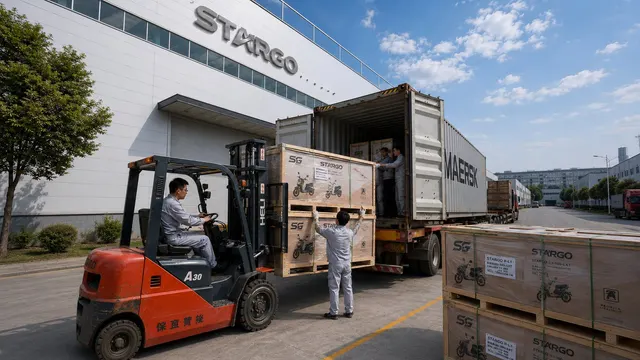
STARGO provides a pre-shipment production video for every container before the balance payment, and you pay the balance only after you have reviewed it.
Use the video to check models, colours, quantities, battery type and packing against the PI. If something does not match, raise it with the export team before you transfer the balance. Our dedicated article on the pre-shipment production video lists what to look for frame by frame and how the PSPV fits alongside third-party inspection.
Which documents come with each shipment?
Every shipment carries a commercial invoice, packing list and bill of lading (CI, PL, B/L) and, for lithium batteries, UN38.3 and MSDS shipping documents. A certificate of origin (CO) is provided on request.
Form E under the China–ASEAN Free Trade Area is provided on request. The Malaysian trade ministry’s ACFTA overview explains that a Form E certificate of origin is issued only when goods meet the agreement’s origin rules, which is why you should request it on the PI rather than after loading. Lithium packs travel as dangerous goods; IATA’s battery guidance sets the rules for any air shipment of spare packs. See export documents for electric two-wheelers and lithium battery shipping documents for the full list, and certifications and export documents for how market certificates are handled per model.
Where does delivery end: FOB, CIF or DDP?
Delivery ends wherever the Incoterms® rule on your PI says it does; the rule allocates costs, risk and tasks between seller and buyer.
The ICC Incoterms® 2020 rules are the reference. Under FOB, risk passes once the goods are on board at the Chinese port and you book the main freight. Under CIF the seller pays freight and minimum insurance to your port, but risk still passes at loading. Our Incoterms guide for electric vehicle imports compares the options, and container loading and shipping explains how containers are packed.
How can you shorten the timeline on your first order?
The biggest time savings come before the deposit: a complete inquiry, a signed configuration sheet and freight booked during production.
- Send the destination, model links, quantity and battery choice in the first message.
- Approve logo, colour and packaging artwork before paying the deposit, not after.
- Ask for Form E or market certificates on the PI so they are prepared in parallel.
- Book the container while production runs so loading follows the PSPV without waiting.
- Name one person on your side who can approve the PSPV within 24–48 hours.
For a planning template covering budget, model mix and container size, use first container order planning together with our article on the 10-unit MOQ and mixed-model orders.
Frequently Asked Questions
How long does a STARGO order take from deposit to loading?
Production takes 15–30 working days after the order is confirmed, depending on order quantity. Add the time you need to review the PSPV and pay the balance, plus the forwarder’s container booking, to estimate the loading date.
What is the minimum order quantity for a STARGO order?
The MOQ is 10 units per order, counted across all models, tricycles included. How several models are split inside one order or container is confirmed on the quotation and proforma invoice.
When do I pay the balance on a STARGO order?
You pay the balance after you have reviewed the pre-shipment production video (PSPV) for your container. STARGO provides a PSPV for every container before the balance payment, so you can raise any discrepancy before the goods leave the factory.
Which export documents come with a STARGO shipment?
Each shipment carries the commercial invoice, packing list and bill of lading (CI, PL, B/L); Form E / CO are provided on request, and lithium batteries ship with UN38.3 and MSDS shipping documents. Market-specific certificates are confirmed per model at quotation.
Can I order one sample unit before the first order?
No. STARGO does not take single-unit or sample orders: the MOQ is 10 units per order, any model mix, so a mixed first order of 10 is the trial before a full container. Terms, freight and battery routing are confirmed on the quotation.
Who handles customs clearance at the destination?
Under FOB or CIF terms the buyer clears import customs with its own broker, using the document set STARGO supplies. The Incoterms® 2020 rule written on your proforma invoice decides exactly where costs and risk pass from seller to buyer.
Ready to start? Send your market, model list, quantity and battery preference to sales@stargomoto.com or through the STARGO contact page, and the export team will return a configuration and quotation for review.
Entity note: STARGO is the export brand of Guangxi Xinli New Energy Technology Co., Ltd., which assembles two-wheelers in Guigang and three-wheelers in Chongzuo, Guangxi, China. Every STARGO order follows the same sequence of proforma invoice, deposit, production, PSPV before balance, and loading with the export documents.