Electric Tricycle Uses: From Last-Mile Delivery to Farms, Campuses and Tourism
·
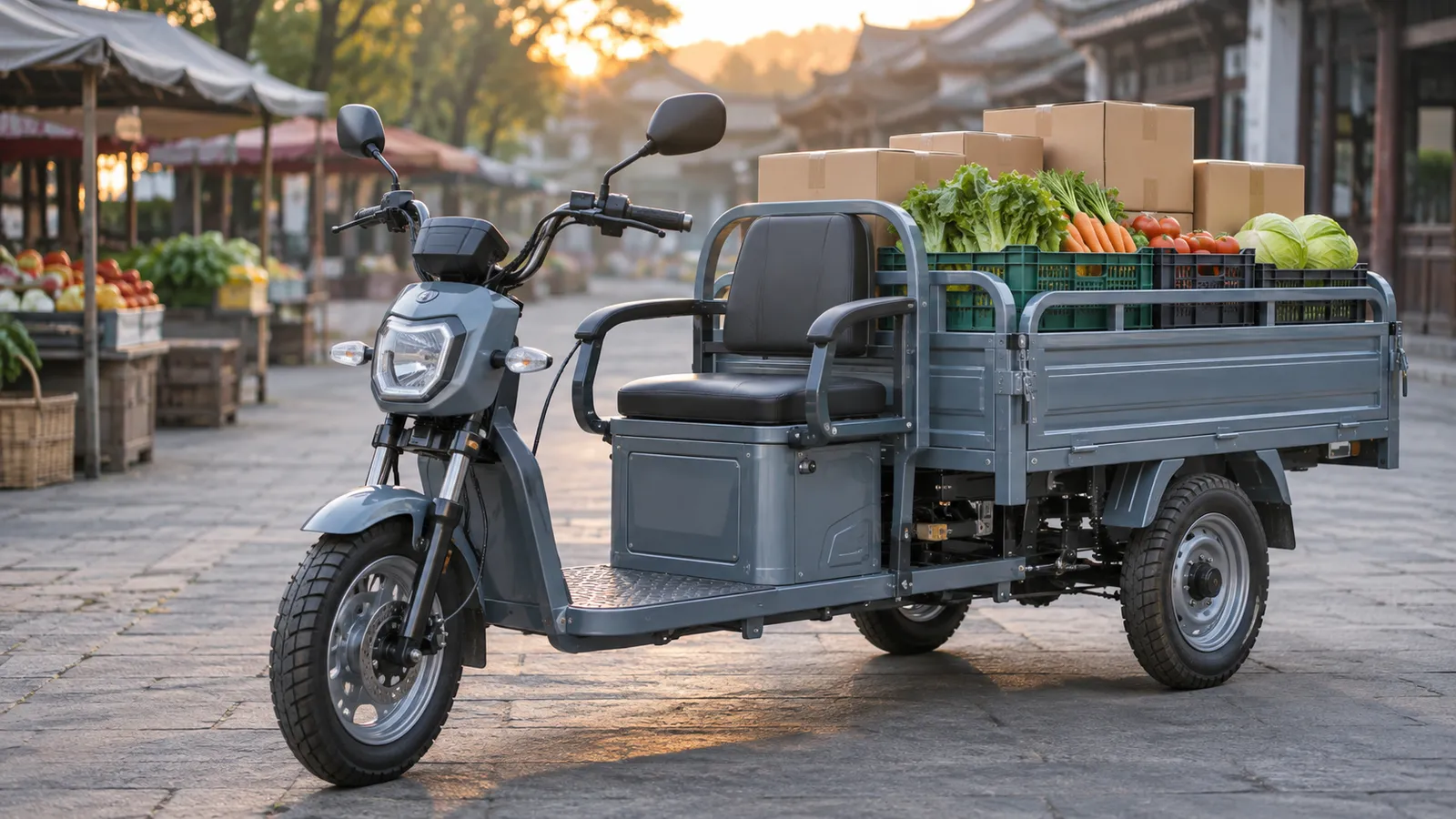
Electric tricycle uses span parcel delivery, market trading, farm haulage, sanitation, campus and resort transport, tourism and passenger shuttles. Each job stresses a different spec — payload, body type, gradeability, range or weather protection — and this use-case map shows which one matters where.
Contents
- Why are electric tricycles growing as working vehicles?
- What are the main electric tricycle uses, and which spec matters for each?
- How much payload and range does a delivery tricycle need?
- What makes a tricycle work on farms and rough tracks?
- Which tricycles suit campuses, resorts and tourism?
- What about sanitation, municipal and passenger taxi use?
- Which registration rules should buyers check first?
- How does STARGO support tricycle buyers?
- Frequently Asked Questions
Key Takeaways
- Electric tricycle uses span parcel delivery, market trading, farm haulage, sanitation, campus and resort transport, tourism and passenger shuttles.
- Each job stresses a different spec — payload, body type, gradeability, range or weather protection — and this use-case map shows which one matters where.
The main electric tricycle uses are last-mile delivery, market vending, farm haulage, sanitation and municipal work, campus and resort transport, tourism and short-distance passenger service. Each application loads the vehicle differently, so the right model depends less on the brochure headline and more on whether payload, body, gradeability, range and weather protection fit the actual job.
Quick answer: Choose an electric tricycle by its job. Delivery needs payload and range under load; markets need an open or box body that is easy to load; farms need gradeability and clearance; sanitation needs a robust tipper or bin body; campuses need low speed and quiet running; tourism and passenger shuttles need seating, stability and weather protection. Confirm local registration rules first.
This use-case map is for importers, distributors, fleet buyers and municipal or resort procurement teams. It is deliberately vendor-neutral; STARGO models are referenced only to show which catalogue specs map to which job.
Why are electric tricycles growing as working vehicles?
Because three wheels carry more load and passengers than a two-wheeler at a fraction of a van's size, and electric drive cuts running noise and fuel use on short, repetitive routes. The IEA reports that global electric three-wheeler sales grew over 10% in 2024 to more than 1 million units, reaching almost one-quarter of three-wheeler sales; India alone sold nearly 700,000, a 57% share, and its PM E-DRIVE scheme funds over 300,000 electric three-wheelers for commercial use (IEA Global EV Outlook 2025).
Not every programme succeeds automatically. An Asian Development Bank evaluation rated the Philippines' large e-trike public-transport project "less than successful" (ADB validation report). The practical lesson for buyers: match the vehicle, charging and operating model to the real use case before scaling.
What are the main electric tricycle uses, and which spec matters for each?
Seven use cases cover most demand, and each has one or two specs that decide success. The grid below is the core of this guide.
| Use case | Typical duty | Spec that matters most | Body / configuration |
|---|---|---|---|
| Parcel and food delivery | Many stops, urban traffic, full shifts | Range under load, payload, charging time | Closed box or cab with cargo box |
| Market vendors and shops | Short trips, heavy irregular loads | Payload, low loading height, durability | Open flatbed with side boards |
| Farms and plantations | Unpaved tracks, slopes, mud | Gradeability, clearance, frame strength | Open bed, optional tipper |
| Sanitation and municipal | Fixed routes, frequent stop-start | Robust body, easy cleaning, water protection | Bin carrier, tipper or closed tank |
| Campus, factory, resort | Low speed, quiet, mixed pedestrian zones | Low speed control, quietness, easy charging | Compact passenger pod or utility bed |
| Tourism rides | Scenic loops, paying guests | Comfort, roof or enclosure, stability, lighting | Premium passenger pod |
| Passenger shuttle or taxi | All-day service, several passengers | Seating capacity, range, weather protection, permits | Standard or long-wheelbase passenger body |
For the cargo-versus-passenger decision itself, see our guide on choosing between cargo and passenger tricycles.
How much payload and range does a delivery tricycle need?
Enough payload for the heaviest normal load plus margin, and enough range under that load for a full shift without mid-day charging. Measure both on your own route rather than relying on unloaded catalogue range.
A simple sizing method with buyer-filled variables:
- Daily distance (D, km): from route data or driver logs.
- Energy use (E, Wh/km): measured on a loaded test ride over your typical route.
- Reserve factor (R): 1.2 to 1.3 to cover hills, heat, headwinds and battery ageing.
- Required pack energy = D × E × R. Compare with pack energy, where Wh = V × Ah.
Example: if your test ride shows E and your route is D, a 73.6V 104Ah LFP pack holds 73.6 × 10⁴ ≈ 7,650 Wh — the energy listed for STARGO's 73.6V 104Ah tricycle battery. Divide that by D × R to find the maximum energy use per km your route can tolerate. STARGO's cargo models such as GROUNDTIGER and RIDGEVALE list 300 kg load, 60–100 km range, 35° climbing and IPX6; confirm whether the load figure includes the rider at quotation. Our sibling article on choosing a cargo tricycle for a delivery business goes deeper.
What makes a tricycle work on farms and rough tracks?
Gradeability at full load, ground clearance, a strong frame and protected electrics. Farm duty is short-distance but punishing: mud, ruts, slopes and wash-down.
- Climbing: ask for the rated climbing angle with full payload, not empty.
- Tyres: deeper tread for mud; confirm load index for the payload.
- Body: an open bed with drop sides is easiest to load; a tipper saves labour for soil, feed or harvest.
- Protection: controller and battery mounted high and sealed; IPX6-rated models such as the PICKUP TRICYCLE suit wet and dusty yards.
- Charging: plan a covered charging point at the farm; long runs from the house to the yard need cable and protection.
The cargo tricycle supplier checklist lists the questions to put to any supplier.
Which tricycles suit campuses, resorts and tourism?
Compact pods for short, slow, quiet trips; premium enclosed pods for paying tourists and all-weather service. Comfort and appearance matter as much as specs here, because the vehicle is part of the guest experience.
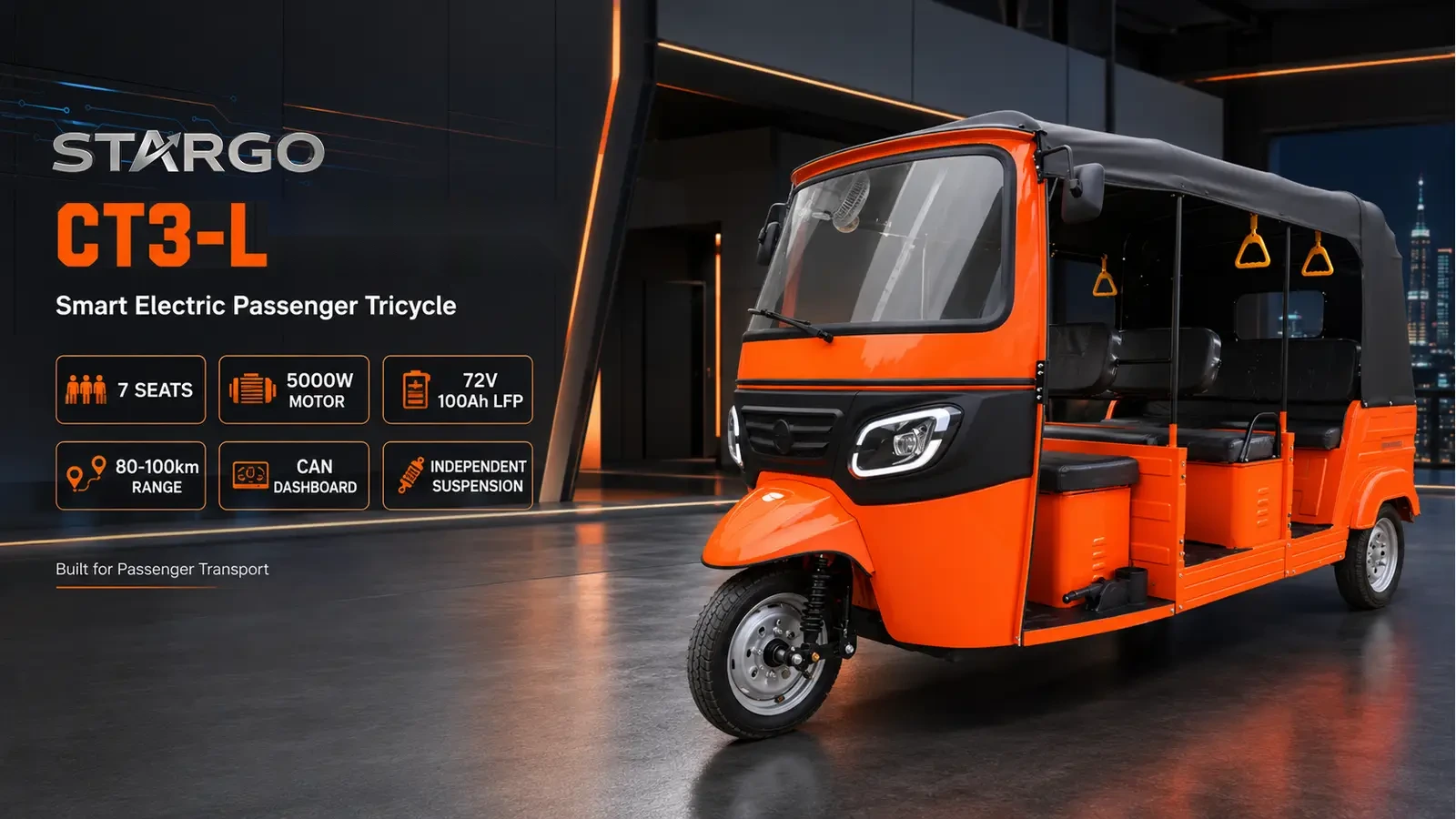
| Setting | Example STARGO model | Catalogue specs |
|---|---|---|
| Campus, retirement community, pedestrian zone | Pudding compact pod | 600W, 48V 20Ah lithium, 300 kg load, about 30° climbing |
| Resort or waterfront, all weather | Veloce Air premium pod | 60–100 km range, 50 km/h, 300 kg load, 35° climbing, IPX6 |
| Urban shuttle, family transport | CT3 four-seat shuttle | 2500W / 5000W DC induction, 72V 100Ah / 140Ah LFP, up to 60 km/h |
| Tourism and upmarket taxi fleets | CT3-L seven-seat long-wheelbase | 4000W / 5000W, 72V 100Ah LFP (dual optional), 80–100 km, 500 kg load, CBS hydraulic drum brakes |
For passenger-specific buying criteria, read our sibling electric passenger tricycle buyer guide and browse the passenger tricycle category.
What about sanitation, municipal and passenger taxi use?
Municipal and taxi buyers should weight durability, serviceability and permits above top speed. These vehicles run all day on fixed routes, often under public scrutiny.
- Sanitation: specify bin carriers or tippers, washable surfaces and sealed electrics; frequent stop-start favours a controller and motor sized for repeated launches with load.
- Municipal maintenance: park crews and utilities need tool racks and lockable boxes; keep spare batteries rotating if shifts are long.
- Passenger taxi: confirm whether the local authority licenses tricycles for paid passengers, what seat count is allowed, and whether doors or full enclosures are required. Market notes for the Philippines, Bangladesh and Nigeria cover local context.
Which registration rules should buyers check first?
Check how your market classifies three-wheelers before shortlisting models, because classification decides licence, helmet, speed and equipment rules. In the EU, Regulation (EU) No 168/2013 places three-wheelers in L-categories such as L2e (three-wheel mopeds) and L5e (powered tricycles), each with its own technical requirements.
Outside the EU, many markets use their own schemes or permit systems for commercial tricycles. STARGO applies CE / EEC / CB / COC / SONCAP per model and market, confirmed at quotation; see certifications and export documents.
How does STARGO support tricycle buyers?
STARGO assembles three-wheelers at its Chongzuo base in Guangxi and builds its vehicle lithium packs and BMS in-house; its battery catalogue lists LFP tricycle packs from a 64V 52Ah entry pack to a 76.8V 150Ah high-capacity pack. MOQ is 10 units per order, any model mix, including tricycles, and lead time is 15–30 working days, depending on order quantity.
Warranty covers the whole vehicle for 12 months, motor and controller for 12 months, frame for 24 months and lithium batteries for 12 months at 70% or more remaining capacity. Browse the cargo tricycle category to compare body types.
Frequently Asked Questions
What are electric tricycles mainly used for?
The main uses are last-mile parcel and food delivery, market and street vending, farm and plantation haulage, sanitation and municipal work, campus, resort and factory transport, tourism rides, and short-distance passenger shuttles or taxi service.
Which spec matters most when choosing an electric tricycle?
It depends on the job. Delivery fleets should start with payload and real range under load; farms with gradeability and ground clearance; tourism and passenger use with seating, stability and weather protection; and campus use with low speed, quiet running and easy charging.
Is an electric tricycle suitable for farm use?
Yes, for short-distance haulage on farm tracks, provided gradeability, ground clearance and frame strength match the terrain and load. Check the rated climbing angle with full payload, tyre type for mud, and whether the battery and controller are protected from water and dust.
Can electric passenger tricycles be used for tourism?
Yes. Resorts, heritage districts, parks and waterfronts use them for quiet, low-emission rides. Look for comfortable seating, a roof or full enclosure, stable handling, good lighting and enough range for a full shift, and confirm local permits for carrying paying passengers.
How do I estimate the battery an electric tricycle needs for my route?
Multiply daily distance by energy use per km measured on a loaded test ride, then add a reserve of 20–30% for hills, heat and battery ageing. Battery energy in Wh equals voltage times amp-hours, so compare packs in Wh rather than Ah alone.
Do electric tricycles need registration?
In many markets, yes, especially for road use or carrying passengers. In the EU, three-wheelers are classified under Regulation (EU) No 168/2013 categories such as L2e and L5e. Rules differ by country, so check local classification before choosing a model.
Have a specific job in mind — a delivery route, a farm, a resort loop? Describe the load, distance and terrain through the contact page or at sales@stargomoto.com, and we will suggest cargo or passenger configurations and battery sizes for your quotation.
Entity note: STARGO is the export brand of Guangxi Xinli New Energy Technology Co., Ltd., which assembles two-wheelers in Guigang and three-wheelers in Chongzuo, Guangxi, China. Its cargo and passenger tricycles are offered from an MOQ of 10 units, with specifications confirmed per application at quotation.