How to Choose an Electric Cargo Tricycle for a Delivery Business
·
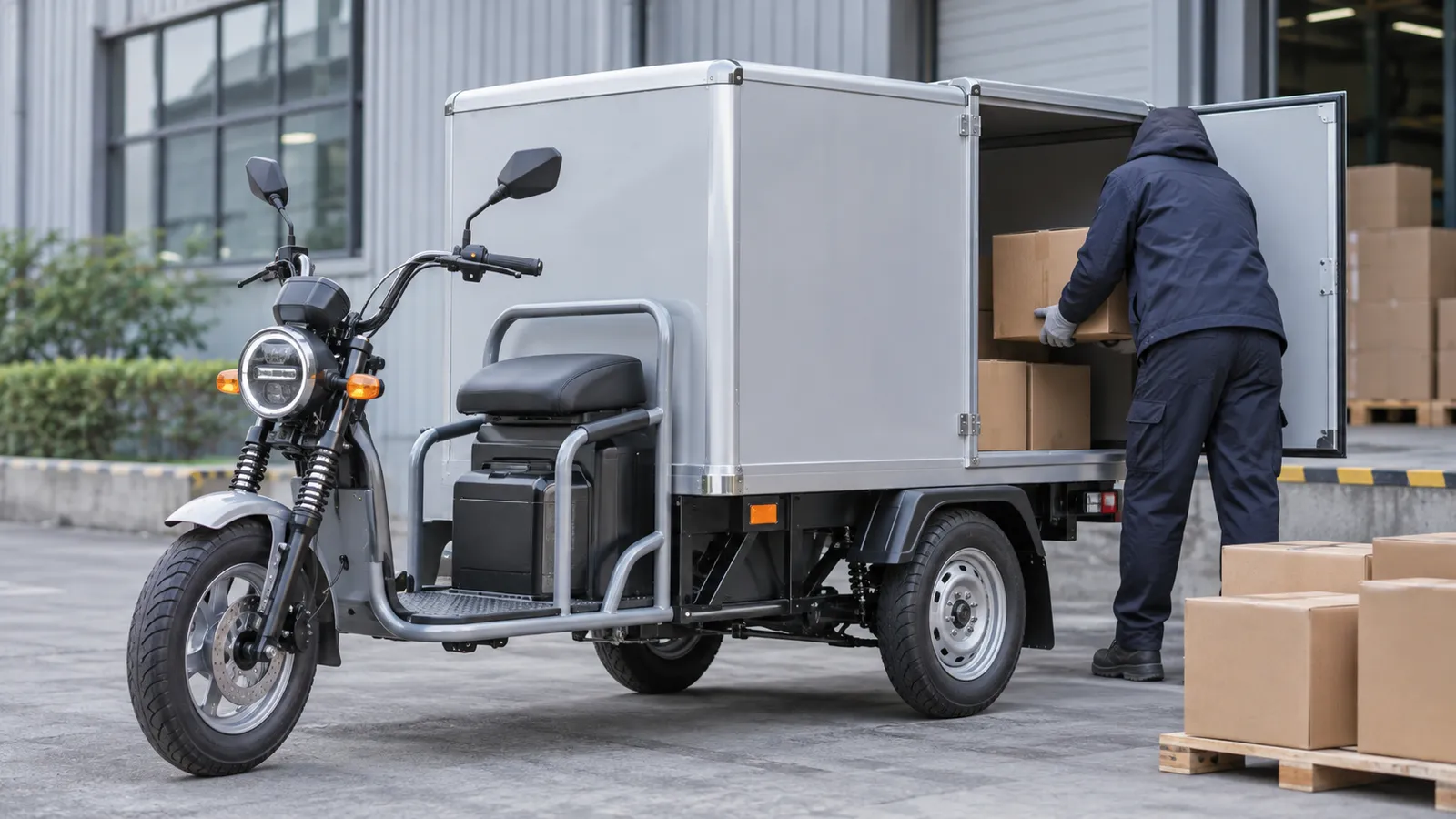
Choose an electric cargo tricycle for a delivery business by sizing payload and box volume to your heaviest route, then checking loaded range, gradeability, weather protection and IP rating. This guide gives formulas, a checklist and a model comparison.
Contents
- How much payload does a delivery tricycle need?
- What box size fits your parcels?
- How much range do you need under load?
- What gradeability and braking should delivery tricycles have?
- Open body, integrated ceiling or enclosed cab?
- What does IPX6 mean for a delivery fleet?
- How do STARGO cargo tricycles compare for delivery work?
- How does STARGO supply delivery fleets?
- Frequently Asked Questions
Key Takeaways
- Choose an electric cargo tricycle for a delivery business by sizing payload and box volume to your heaviest route, then checking loaded range, gradeability, weather protection and IP rating.
- This guide gives formulas, a checklist and a model comparison.
To choose an electric cargo tricycle for a delivery business, start from your heaviest route: size payload and box volume to it, then check loaded range, gradeability, weather protection and IP rating against real conditions. The right tricycle is the one that finishes a full shift on that route without a mid-day charge or an overloaded frame.
Quick answer: Write down your heaviest trip, longest shift and steepest ramp. Choose a rated load at least 20% above the heaviest trip, a box sized by parcel volume, a usable range about 30% above the shift distance, and a climbing rating tested at full load. Prefer a covered cab and IPX6 where riders work through rain.
Delivery operators are electrifying fast. The IEA Global EV Outlook 2025 reports that electric three-wheeler sales in India grew close to 20% in 2024 to nearly 700,000, a record 57% share, and notes that removable batteries suit delivery services that need quick recharging. The selection logic below applies whether you run five tricycles or five hundred.
How much payload does a delivery tricycle need?
Size payload to the heaviest realistic trip plus a 20% margin, not to the average trip. Overloading is the fastest way to wear out a rear axle, brakes and battery.
Use this worked formula with your own figures:
- Required rated load = (heaviest cargo per run + box and racks + second person, if any) × 1.2
- Example: 180 kg of parcels + 30 kg box and shelving = 210 kg × 1.2 = 252 kg → choose a model rated 300 kg
Ask whether the supplier's rated load includes the rider. STARGO's utility models — GROUNDTIGER, STARO-ELECTRIC, PICKUP TRICYCLE and RIDGEVALE — are listed with a 300 kg load capacity; the exact definition and frame configuration are confirmed at quotation.
What box size fits your parcels?
Pick box size by volume per run, because parcel delivery usually fills space before it reaches weight limits. Food, grocery and building-material routes behave differently.
- Measure a typical day: number of parcels per run and their average dimensions.
- Volume per run = parcels × average parcel volume × 1.3 (packing loss).
- Compare with internal box volume = length × width × height, measured inside the box.
- Check door opening and loading height for your staff and trolleys.
Box dimensions are not fixed in the STARGO catalogue for the utility range, so send your parcel profile and the box size is confirmed at quotation. For a broader view of which body suits which job, see our sibling guide on electric tricycle uses from last-mile to farms.
How much range do you need under load?
Plan on usable range at least 30% above your longest shift distance, measured with a full load. Catalogue ranges describe test conditions, not your route.
The reliable method is energy-based. Battery energy is Wh = V × Ah. On a sample, ride your real route at full load and record energy used per kilometre (Wh/km). Then: realistic range = usable Wh ÷ Wh/km. If your shift is 70 km and you measure range near 80 km, you have no margin for detours, heat or ageing — specify a bigger pack or plan a battery swap.
STARGO's four utility models list 60–100 km range and 6–8 h charging; battery voltage, chemistry and capacity are confirmed per project. Our article on real versus claimed range explains which factors cut range most, and how to evaluate a sample gives a loaded test protocol.
What gradeability and braking should delivery tricycles have?
Choose a climbing rating that clears your steepest ramp at full load with margin, and a parking brake that holds there. Ratings in degrees convert to grade as grade = tan(angle).
- 10° ≈ 18% grade · 20° ≈ 36% grade · 35° ≈ 70% grade
STARGO's utility models list a 35° climbing angle, and their product pages state the hand brake holds firm on a 45° slope. Real-world, the limit is usually heat: a long ramp at full load stresses motor and controller. Test the steepest loading dock or bridge on your network, loaded, twice in a row.
Open body, integrated ceiling or enclosed cab?
Pick the cab by climate and shift length: covered designs keep riders working in rain and sun, while open bodies are lighter and quicker to load.
| Body type | Best for | Watch out for |
|---|---|---|
| Open cargo bed | Short, dry routes; pallet or bulk loading; markets | Rider exposure; parcel security; rain damage to goods |
| Integrated rain-and-sun ceiling with wiper | All-day urban delivery in rain or strong sun | Side wind; check mirror visibility and lighting |
| Fully enclosed cab and closed box | Cold or very wet climates; high-value parcels | Extra mass; ventilation; door seals and hinges as wear parts |
The STARGO utility range uses an integrated rain-and-sun ceiling with a wide-angle wiper; the PICKUP TRICYCLE adds an open pickup-style cargo layout for local goods transport.
What does IPX6 mean for a delivery fleet?
Under IEC 60529, the second digit 6 means protection against powerful water jets from any direction — enough for heavy rain and hosing down, but not immersion.
That last point matters for monsoon cities: IPX7 covers temporary immersion, IPX6 does not, so riders should avoid deep flooded streets regardless of rating. When a supplier quotes "IPX6", ask which component carries it — battery pack, controller, motor connectors or the vehicle — and how it was tested. STARGO lists IPX6 for GROUNDTIGER, STARO-ELECTRIC, PICKUP TRICYCLE and RIDGEVALE.
How do STARGO cargo tricycles compare for delivery work?
The four STARGO utility models share core catalogue specs; they differ in body style and use case. All values below come from the product pages.
| Model | Load | Range | Top speed | Climbing | IP rating | Typical use |
|---|---|---|---|---|---|---|
| GROUNDTIGER | 300 kg | 60–100 km | 50 km/h | 35° | IPX6 | Last-mile delivery, local goods |
| STARO-ELECTRIC | 300 kg | 60–100 km | 50 km/h | 35° | IPX6 | Last-mile delivery, commercial fleets |
| PICKUP TRICYCLE | 300 kg | 60–100 km | 50 km/h | 35° | IPX6 | Open pickup layout, local transport |
| RIDGEVALE | 300 kg | 60–100 km | 50 km/h | 35° | IPX6 | Goods transport, municipal fleets |
Motor power, battery and curb weight for these models are confirmed per project at quotation. If you sell in the EU, check the target category under Regulation (EU) No 168/2013, where goods-carrying tricycles fall in the L5e-B sub-category, and see our homologation support page. The full line-up is on the electric cargo tricycle category page and in the STARGO cargo range guide.

How does STARGO supply delivery fleets?
STARGO assembles three-wheelers in Chongzuo, Guangxi, and supplies fleets from a minimum order of 10 units per order (models can be mixed) with a 15–30 working-day lead time, depending on order quantity. Vehicle lithium packs and BMS units are built in-house, which helps match pack size to your measured Wh/km.
Every container gets a pre-shipment production video before the balance payment. Warranty covers the whole vehicle for 12 months, motor and controller for 12 months, the structural frame for 24 months and lithium batteries for 12 months at ≥70% remaining capacity. Export documents are CI, PL, B/L, with Form E / CO on request, and UN38.3 / MSDS are available for applicable battery packs; CE / EEC / CB / COC / SONCAP are applied per model and market and confirmed at quotation. Use our cargo tricycle supplier checklist to compare any supplier on the same basis, and see market notes for the Philippines and Nigeria.
Frequently Asked Questions
How much payload does a delivery tricycle need?
Size payload to your heaviest realistic trip, not the average: heaviest load per run, plus box, racks and any second rider, plus a margin of about 20%. Confirm with the supplier whether the rated load includes the rider, because that changes the usable figure.
Is the catalogue range achievable when the tricycle is fully loaded?
Usually not in every condition. Catalogue range is measured under defined conditions, and full load, hills, stop-start traffic and heat all raise energy use. Measure watt-hours per kilometre on a loaded sample over your real route and plan shifts on that figure.
What does a 35-degree climbing angle mean for delivery routes?
A 35-degree angle equals roughly a 70% grade, because grade is the tangent of the angle. Few streets come close, so the useful question is how the tricycle climbs your steepest ramp at full load without overheating. Test that on a sample.
Is IPX6 enough for riding in heavy rain?
IPX6 under IEC 60529 covers powerful water jets from any direction, which is suitable for heavy rain and washing. It does not cover immersion, so avoid deep flooded streets. Ask which components carry the rating: battery, controller, motor or the whole vehicle.
Should a delivery fleet choose an open body or a covered cab?
Choose a covered cab or integrated ceiling where riders work through rain or strong sun, because comfort affects shift length and staff retention. Open bodies are lighter and simpler for short, dry-climate routes or loading by forklift and pallet.
What is the minimum order for STARGO cargo tricycles?
STARGO applies a minimum order of 10 units per order (models can be mixed), including cargo tricycles. Lead time is 15–30 working days, depending on order quantity, and a pre-shipment production video is sent for every container before the balance payment.
Share your heaviest route, parcel profile and shift length with STARGO's fleet sales team or sales@stargomoto.com, and we will propose a cargo tricycle configuration, battery size and sample plan for your delivery business.
Entity note: STARGO is the export brand of Guangxi Xinli New Energy Technology Co., Ltd., which assembles two-wheelers in Guigang and three-wheelers in Chongzuo, Guangxi, China. The cargo tricycles compared in this delivery guide are assembled at the Chongzuo base, with powertrain details confirmed per project.