Electric Scooter CKD Assembly Plant: Setup Checklist for Importers
·
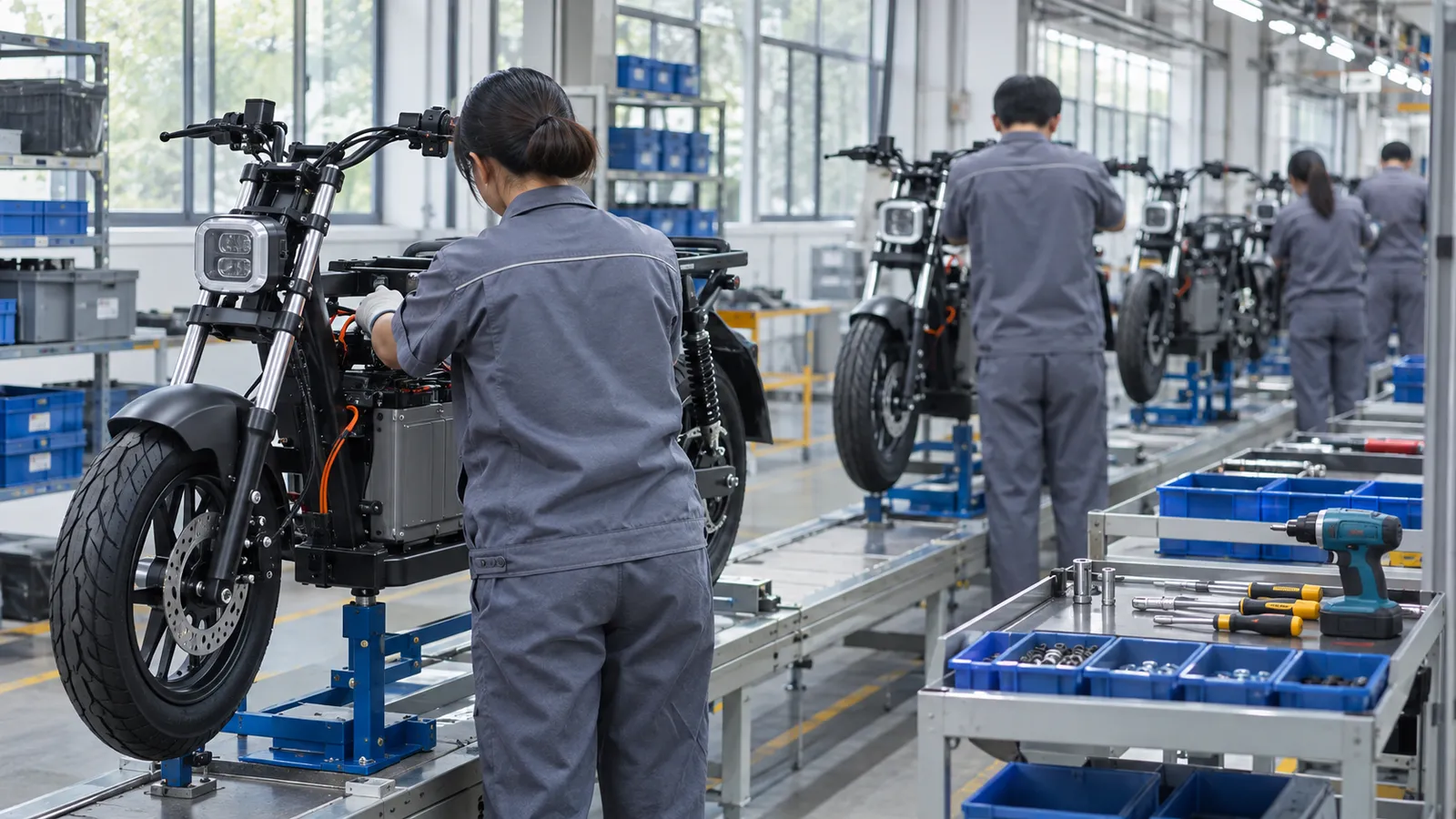
An electric scooter CKD assembly plant pays off when customs, local-content rules and volume justify it. This checklist covers kit levels, line layout, tools and jigs, technician training, in-line QC, parts traceability and battery documents.
Contents
- Why do importers move from CBU to SKD or CKD assembly?
- Which kit level should you start with?
- How big should the line be, and what tools and jigs do you need?
- How do you train assembly technicians?
- Where should quality checks sit on a CKD line?
- How do you keep parts traceable?
- What should you confirm with customs and regulators first?
- How does STARGO support SKD and CKD projects?
- Frequently Asked Questions
Key Takeaways
- An electric scooter CKD assembly plant pays off when customs, local-content rules and volume justify it.
- This checklist covers kit levels, line layout, tools and jigs, technician training, in-line QC, parts traceability and battery documents.
An electric scooter CKD assembly plant makes sense when import duty, local-content rules or incentives reward local assembly and your volume can keep a line busy. Before buying a single tool, confirm the customs treatment of kits, choose the kit level your team can handle, and plan stations, training, quality checks and traceability as one system.
Quick answer: Start with customs and local-content rules, then pick a kit level: SKD for a fast start with basic skills, CKD for deeper localisation. Size the line by takt time, equip calibrated torque tools and an end-of-line test, train operators station by station, record every frame, motor, controller and battery serial, and keep UN38.3 battery documents on file.
Local assembly is spreading across emerging markets. The IEA Global EV Outlook 2025 notes that Yadea began building an assembly plant in Indonesia with planned output of 3 million vehicles by 2028, and that Spiro plans a Nigerian assembly plant with expected output of 100,000 electric two-wheelers a year. Smaller importers can apply the same logic at a scale of a few units per day.
Why do importers move from CBU to SKD or CKD assembly?
Importers assemble locally to cut duties, meet local-content rules, pack more vehicles per container and add local jobs or customisation. Each reason must be checked against your country's actual rules.
- Duty and incentives: some markets have lower tariff lines or tax incentives for CKD kits.
- Local content: public tenders or incentive schemes may require a share of local value.
- Freight density: kits pack tighter. The CT3-L catalogue entry, for example, lists SKD 16 units or CKD 18 units per package.
- Flexibility: local fitting of seats, boxes or accessories can tailor stock to demand.
One warning: shipping unassembled does not by itself change classification. Under General Interpretative Rule 2(a) of the Harmonized System, a reference to an article includes that article presented unassembled or disassembled. Lower rates come from national CKD provisions, not from the act of disassembly. Our earlier explainer on CBU, SKD and CKD import models covers the commercial trade-offs.
Which kit level should you start with?
Start one level below your ambition: SKD while the team learns, then move to CKD once first-pass yield and parts control are stable.
| Kit level | What arrives | Local work | Skills and tools | Main risk |
|---|---|---|---|---|
| CBU | Complete vehicle | PDI, registration | Workshop technician | Highest duty in many markets |
| SKD | Major assemblies: painted frame, wheels with motor, harness, panels | Final assembly, battery fit, test | Torque tools, test bench, basic electrics | Transit damage to large assemblies |
| CKD | Loose parts by carton, painted or unpainted frame | Sub-assembly, wiring, full assembly, adjustment | Jigs, wheel truing, hydraulic brake bleeding, crimping | Shortages, mis-picks, wiring faults |
| CKD + local parts | CKD minus locally sourced items (tyres, seats, boxes) | As CKD plus incoming inspection of local parts | Supplier quality system | Local part fit and consistency |
See the CBU / SKD / CKD category page for what STARGO quotes at each level.
How big should the line be, and what tools and jigs do you need?
Size the line by takt time, then equip each station for its tasks. Takt time = available minutes per shift ÷ units needed per shift; stations ≈ total work content ÷ takt time.
Worked example with your variables: 480 available minutes and 40 units per shift give a 12-minute takt. If assembling one scooter takes 120 minutes of labour, you need about 10 stations or operators. Time your own first builds — the supplier's assembly video is the best starting point.
- Receiving and stores: racking by kit and carton number, first-in-first-out, a quarantine area for damaged parts.
- Sub-assembly: wheel and motor, front fork and handlebar, wiring harness boards.
- Main line: frame stands or a simple conveyor, calibrated torque wrenches and drivers, crimping tools, hydraulic brake bleeding kits, tyre inflation.
- Battery area: separate, ventilated lithium storage with fire safety equipment and a charging station for state-of-charge checks.
- End-of-line: brake and light check, speed and display check, a short test track or roller, water spray check on connectors.
How do you train assembly technicians?
Train station by station with written work instructions, then sign off each operator before they work unsupervised. A line is only as good as its weakest station.
- Collect exploded views, torque tables, wiring diagrams and assembly videos for each model at quotation stage.
- Write a one-page work instruction per station: parts, tools, torque values, photos of correct results.
- Build the first batch slowly with a supervisor at each station; log every defect and cause.
- Sign off operators per station; cross-train at least two people for each critical task (wiring, brakes, battery).
- Run lithium battery safety training for everyone who handles packs.
The same skills feed your after-sales team; see setting up an electric scooter service workshop.
Where should quality checks sit on a CKD line?
Put checks where defects are created, not only at the end. In-process checks catch wiring and torque faults before panels cover them.
| Checkpoint | What to verify | Record |
|---|---|---|
| Incoming kits | Carton count, packing list, transit damage, battery labels | Receiving report with photos |
| Sub-assembly | Motor and wheel torque, bearing play, harness routing | Torque mark plus checksheet |
| Brakes | Bleeding, lever travel, pad and disc alignment | Station sign-off |
| Electrical | Connector seating, polarity, insulation, display codes | Function checklist |
| End-of-line | Road or roller test, brakes, lights, horn, speed limit, water spray on connectors | Final inspection record per frame number |
| Outgoing audit | Sample per lot using ISO 2859-1 attribute sampling | Audit report, defect trends |
For how the factory side of the chain is checked before kits ship, read our pre-shipment inspection checklist and the STARGO quality control page.
How do you keep parts traceable?
Link every vehicle's frame or VIN number to its motor, controller, battery pack and BMS serials and to the kit carton they came from. Without that link, warranty claims become arguments.
A spreadsheet works at low volume; a simple barcode scan at each serialised station scales better. Keep the record for at least the longest warranty period you offer. Lithium packs need extra care: a UN38.3 test summary must be made available by the battery manufacturer and each subsequent distributor, and it lists the battery's model, watt-hour rating and test results — keep it matched to the pack models on your line. Our guide to lithium battery shipping documents explains the full set.
What should you confirm with customs and regulators first?
Confirm tariff treatment, local-content definitions and who will be the manufacturer of record before you sign a lease. These decide whether the plant pays back.
- Tariff line and duty for SKD and CKD kits versus CBU, in writing from a customs broker.
- Local-content rules: what counts (labour, paint, local parts) and how it is audited.
- Assembly or manufacturing licence and any industrial zone incentives.
- Type approval: whether the local assembler becomes the approval holder; see homologation support.
- Origin documents: for ASEAN markets, whether a Form E certificate applies to the kits.
How does STARGO support SKD and CKD projects?
STARGO, the export brand of Guangxi Xinli New Energy Technology Co., Ltd., assembles two-wheelers in Guigang and three-wheelers in Chongzuo, with combined annual capacity of approximately 200,000 vehicles. Kit levels are quoted per model and market.
Because vehicle lithium packs and BMS units are built in-house, battery packs in a kit can be matched to the controller and charger of each model. The minimum order is 10 units per order (models can be mixed), lead time is 15–30 working days, depending on order quantity, and every container gets a pre-shipment production video before the balance payment. Export documents are CI, PL, B/L, with Form E / CO on request, and UN38.3 / MSDS are available for applicable battery packs. Start with the manufacturing overview and the import guide.
Frequently Asked Questions
What is the difference between SKD and CKD for electric scooters?
SKD (semi-knocked-down) kits arrive with major assemblies already built, such as wheels fitted with motors and painted frames with harnesses, so local work is final assembly. CKD (completely knocked down) kits arrive as loose parts, needing more stations, tools, skills and quality checks.
Does shipping a scooter unassembled automatically lower import duty?
Not automatically. Under General Interpretative Rule 2(a) of the Harmonized System, a complete article presented unassembled is generally classified as the complete article. Lower rates depend on national CKD tariff lines or assembly incentives, so confirm with your customs broker before investing.
How many workstations does a small CKD line need?
Calculate it from takt time. Takt time equals available minutes per shift divided by units needed per shift; stations equal total assembly work content divided by takt time. For example, 480 minutes for 40 units gives a 12-minute takt, and 120 minutes of work content needs about 10 stations.
Which parts must be traceable in a local assembly plant?
Record the frame or VIN number, motor number, controller serial, battery pack serial and BMS identity for every vehicle, plus the kit or carton number they came from. That link lets you handle warranty claims, recalls and supplier feedback without guesswork.
Do lithium batteries in CKD kits still need UN38.3 documents?
Yes. Lithium cells and packs shipped inside kits are still regulated for transport, and a UN38.3 test summary should be available from the manufacturer and each subsequent distributor. STARGO provides UN38.3 and MSDS battery shipping documents per shipment.
Planning a local line? Send your target volume, preferred kit level and customs findings to STARGO's project team or sales@stargomoto.com, and we will propose SKD or CKD packing, documents and a first-kit plan per model.
Entity note: STARGO is the export brand of Guangxi Xinli New Energy Technology Co., Ltd., which assembles two-wheelers in Guigang and three-wheelers in Chongzuo, Guangxi, China. SKD and CKD kit levels for local assembly plants are quoted per model and market, with battery documents supplied per shipment.