Electric Scooter IP Rating and Waterproofing: What IPX5, IPX6 and IPX7 Really Mean
·
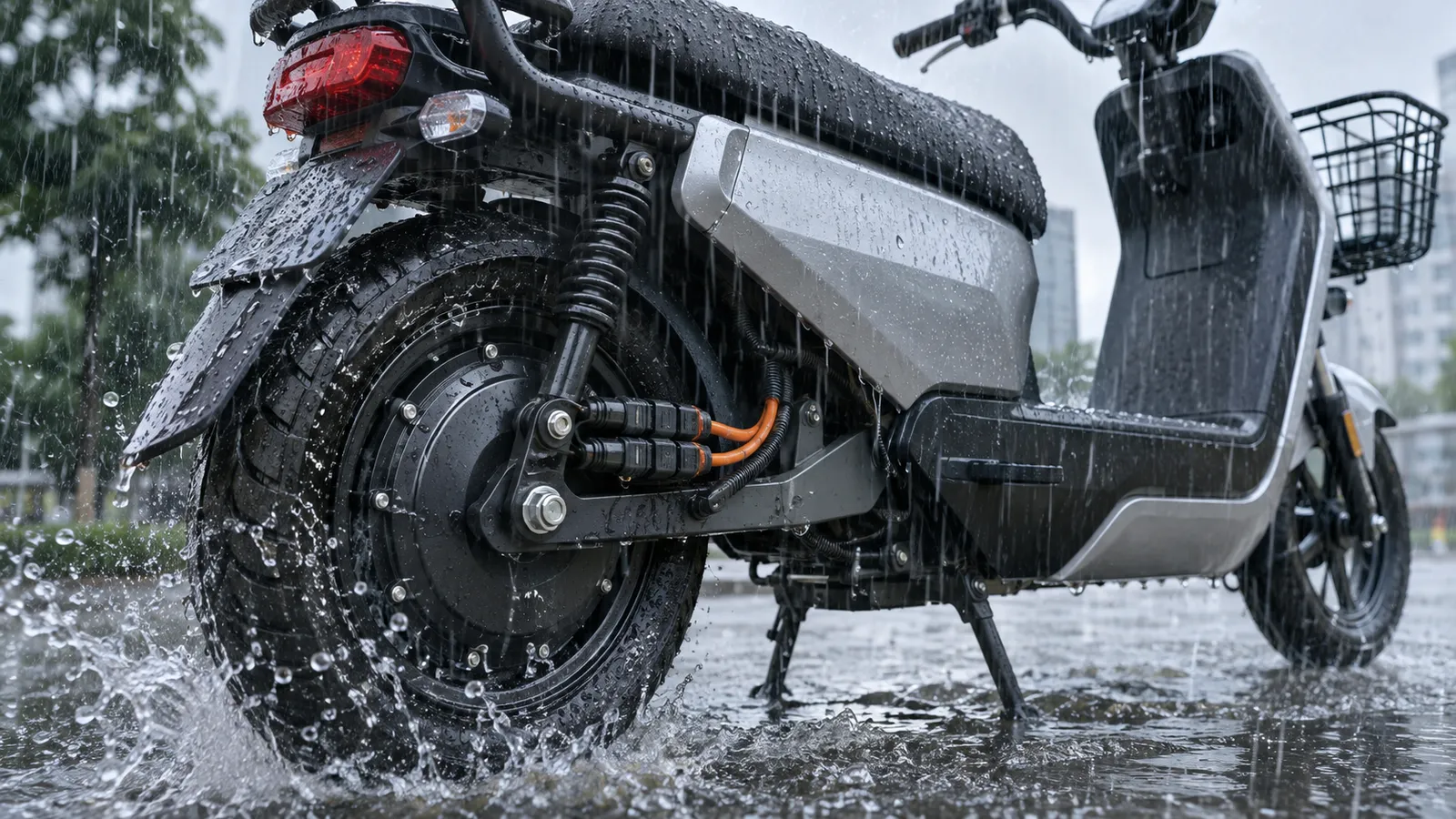
An electric scooter IP rating tells you which water test a part passed under IEC 60529, not that the whole scooter is waterproof. IPX5 and IPX6 cover water jets, IPX7 covers short immersion, and buyers must ask which component carries each rating.
Contents
- How does the IP code work?
- What do IPX5, IPX6, IPX7 and IPX8 mean in test terms?
- Which component carries the rating?
- What does each rating mean for riding in rain and flooded streets?
- How should buyers write IP requirements into an RFQ?
- Which STARGO models list an IP rating?
- Frequently Asked Questions
Key Takeaways
- An electric scooter IP rating tells you which water test a part passed under IEC 60529, not that the whole scooter is waterproof.
- IPX5 and IPX6 cover water jets, IPX7 covers short immersion, and buyers must ask which component carries each rating.
An electric scooter IP rating tells you which standardised water or dust test a specific part has passed, not that the whole vehicle is waterproof. Under IEC 60529, IPX5 and IPX6 mean the part resisted water jets, while IPX7 means it survived temporary immersion; the most useful question a buyer can ask is which component carries which rating.
Quick answer: IP codes come from IEC 60529. The first digit rates dust, the second rates water; X means not tested. IPX5 = water jets (12.5 L/min), IPX6 = powerful jets (100 L/min), IPX7 = immersion to 1 m for 30 minutes. IPX7 alone does not cover jets. Ask whether the rating applies to the vehicle, the battery or the controller.
How does the IP code work?
The IP code has two digits: the first rates protection against solids and dust (0–6), the second against water (0–9).
The system is defined in IEC 60529, "Degrees of protection provided by enclosures (IP Code)", currently consolidated as edition 2.2 (2013). For road vehicles, ISO 20653:2023 adapts the same code to vehicle electrical equipment and adds vehicle-specific tests, such as the "K" codes used for high-pressure washing (for example IPX9K). On scooter spec sheets you will mostly see the IEC form.
- IP5X: dust-protected; some dust may enter but not enough to interfere.
- IP6X: dust-tight.
- X in either position: that property was not tested or not declared. IPX5 says nothing about dust; IP65 covers both.
What do IPX5, IPX6, IPX7 and IPX8 mean in test terms?
Each water digit corresponds to a defined test; higher digits are different tests, not simply "more waterproof".
| Code | IEC 60529 test (summary) | Real-world equivalent for a scooter |
|---|---|---|
| IPX4 | Splashing water from any direction | Light rain, splashes from puddles |
| IPX5 | Water jets: 6.3 mm nozzle, 12.5 L/min ±5%, 2.5–3 m, 1 min per m², minimum 3 min | Heavy rain, spray from traffic, gentle hosing |
| IPX6 | Powerful jets: 12.5 mm nozzle, 100 L/min ±5%, 2.5–3 m, 1 min per m², minimum 3 min | Monsoon downpours, wave from passing trucks, hose washing |
| IPX7 | Temporary immersion for 30 min: lowest point 1 m below the surface for enclosures under 850 mm tall | Short submersion of the rated part, e.g. a battery in a flooded street |
| IPX8 | Continuous immersion under conditions agreed by maker and user, more severe than IPX7 | Rare on scooters; check the stated depth and time |
| IPX9 / IPX9K | High-pressure, high-temperature jets (80 °C water) | Pressure-washer cleaning; mostly seen on commercial vehicle parts |
The key nuance: IEC 60529 treats a part marked only IPX7 or IPX8 as unsuitable for water jets unless it is dual-coded. A battery labelled "IPX5/IPX7" passed both the jet and the immersion test; one labelled just "IPX7" may not have been jet-tested at all.
Which component carries the rating?
Usually one part, often the battery, not the whole vehicle; always ask for the IP code of each critical component.
Spec sheets often show a single IP figure without naming the part. The JOVA smart commuter is a good example of clear labelling: its catalogue entry lists "Vehicle IPX5 · Battery IPX7", meaning the vehicle as a whole resists water jets while the battery pack is also immersion-tested. Use the checklist below when you request quotations:
| Component | Why it matters | What to ask |
|---|---|---|
| Battery pack and BMS | Highest energy; low mounting position | IP code, test report, and whether the vent and cable glands were included |
| Controller | High current; often under the floorboard | IP code, potting or sealed housing, connector type |
| Motor and cable entry | Hub motors sit at axle height in standing water | IP code, cable gland design, bearing seals |
| Main connectors and harness | Corrosion causes intermittent faults | Waterproof connector series, seal material |
| Charging port and charger | Charging while wet is the main shock and short-circuit risk | Port cover design; charger is usually for indoor use |
| Display, switches, lights | Visible failures that generate warranty claims | IP code or sealing method |
Then verify on the sample: spray it, check under the seat and floor for water paths, and confirm the documents match. Our sibling article on evaluating a sample before a bulk order includes a water-spray step.
What does each rating mean for riding in rain and flooded streets?
IPX5 and IPX6 handle rain and spray; only immersion-rated parts should ever sit under water, and then only briefly.
- Rain and road spray: an IPX5 vehicle rating is a sensible baseline for markets with regular rain. IPX6 adds margin for tropical downpours and spray from trucks.
- Standing water: wading depth is limited by the lowest unprotected part, not by the best rating on the sheet. If the battery is IPX7 but the controller is IPX5, the controller sets the limit.
- After a flood: switch off, let the vehicle drain and dry, inspect connectors for water and corrosion, and do not charge until everything is dry.
- Washing: even IPX6 parts should not be pressure-washed at close range unless they carry IPX9K.
For a market-specific checklist, read rainy-season maintenance for Southeast Asia and our Vietnam distributor page.
How should buyers write IP requirements into an RFQ?
State the code, the component and the evidence you expect, so quotations are comparable.
- Name each component and its minimum code, e.g. "battery pack IPX5/IPX7; controller IPX5; vehicle IPX5".
- Ask which standard the claim follows: IEC 60529 or ISO 20653.
- Request the test report or, at minimum, the test conditions used.
- Agree how water damage is treated in warranty; see the warranty claim process for the evidence a claim needs.
- Check the result at sample stage and against production units in pre-shipment checks; our quality control page outlines STARGO's checks.
Which STARGO models list an IP rating?
STARGO's catalogue lists IP ratings on its JOVA commuter and its all-weather tricycles; other models are confirmed at quotation.
The JOVA lists vehicle IPX5 and battery IPX7. The cargo tricycles GROUNDTIGER, STARO-ELECTRIC, PICKUP TRICYCLE and RIDGEVALE, and the Veloce Air premium passenger pod, list IPX6 with an integrated rain-and-sun ceiling and wide-angle wiper. Because STARGO builds its lithium battery packs and BMS units in-house, pack sealing is part of the same production process as the vehicle. Explore the cargo tricycle range for wet-climate delivery work.
Frequently Asked Questions
What does IPX5 mean on an electric scooter?
IPX5 means the rated part resisted water jets in the IEC 60529 test: a 6.3 mm nozzle delivering 12.5 litres per minute from 2.5 to 3 metres, for at least 3 minutes. The X means solid-particle protection was not rated. It covers heavy rain and road spray, not immersion.
Is IPX7 better than IPX6?
Not automatically. IPX7 is a temporary immersion test, while IPX6 is a powerful water-jet test, and IEC 60529 says a part marked only IPX7 need not meet the jet tests. A part that passed both is dual-coded, for example IPX5/IPX7 or IPX6/IPX7.
Can I ride an IPX7 electric scooter through a flooded street?
Only if every exposed part is protected, and usually the rating applies to the battery alone. Motors, controllers, connectors and the charging port may carry lower ratings. Keep wading below the lowest unprotected component, ride slowly, and never charge until connectors are dry.
Which parts of an electric scooter need the highest IP rating?
The battery pack and BMS, the controller, the motor and its cable entry, and the main connectors carry the most risk because they combine high current with low mounting positions. Ask suppliers for the IP code of each of these separately, plus the charger port seal.
What IP ratings do STARGO models list?
The catalogue lists the JOVA smart commuter at IPX5 for the vehicle and IPX7 for the battery, and the GROUNDTIGER, STARO-ELECTRIC, PICKUP TRICYCLE and RIDGEVALE cargo tricycles and the Veloce Air pod at IPX6. Ratings for other models are confirmed at quotation.
Selling into a monsoon or flood-prone market? Tell us your conditions and target models via the contact page or sales@stargomoto.com, and we will confirm component-level IP ratings and sealing details for each model at quotation.
Entity note: STARGO is the export brand of Guangxi Xinli New Energy Technology Co., Ltd., which assembles two-wheelers in Guigang and three-wheelers in Chongzuo, Guangxi, China. Its catalogue states IP ratings per component where available, such as vehicle IPX5 and battery IPX7 on the JOVA.