Electric Motorcycle Series: All 11 STARGO Models Compared
·
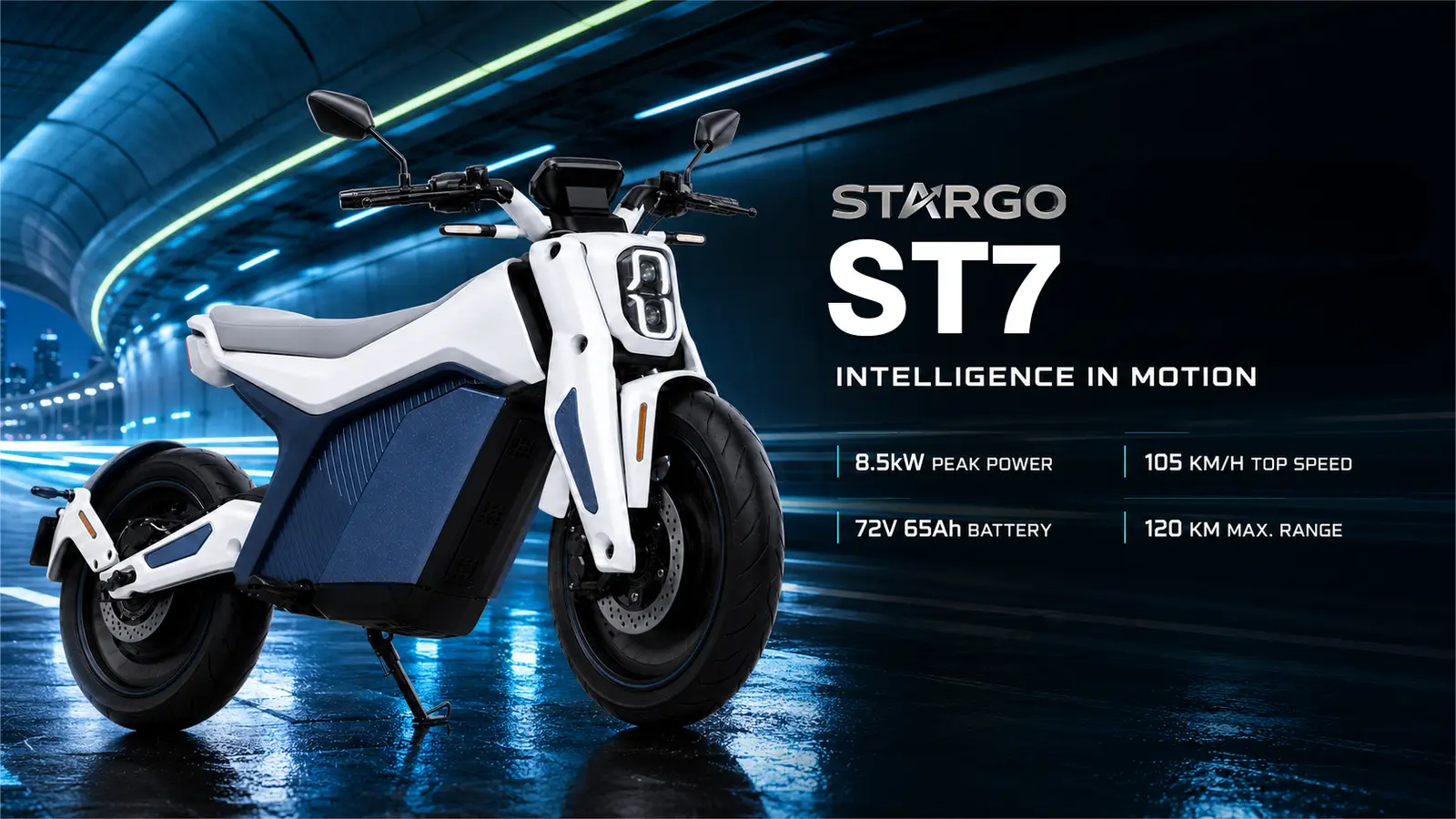
STARGO’s connected line has 11 models, from the 400W SD3 city scooter to the 6.5 kW ST7 flagship and two passenger tricycles. This guide compares catalog specs and shows which buyer each model fits.
Contents
- What is in the electric motorcycle series?
- Which models suit premium and performance buyers?
- Which models are best for daily commuting and rental fleets?
- Which models fit retro styling or rough roads?
- Where do the CT3 and CT3-L passenger tricycles fit?
- How do models map to EU L-categories and braking rules?
- How do you order models from STARGO?
- Frequently Asked Questions
Key Takeaways
- STARGO’s connected line has 11 models, from the 400W SD3 city scooter to the 6.5 kW ST7 flagship and two passenger tricycles.
- This guide compares catalog specs and shows which buyer each model fits.
The electric motorcycle series is STARGO's connected product line: 11 catalog models spanning a 25 km/h city scooter, 60–65 km/h smart commuters, 100–105 km/h premium motorcycles, a central-motor rough-road bike and two passenger tricycles. What ties the series together is smart access (NFC, app or Bluetooth on most models) and a design language built for dealers who want one recognisable family on the showroom floor.
Quick answer: These 11 models are STARGO's smart electric line. The ST7 (105 km/h, 72V 65Ah) and SC5X (100 km/h) are flagships with ABS + TCS; SC5, SC3, SD3 and CC2 are connected commuters; CC1 is retro; CC3 and CB3 handle rough roads; CT3 and CT3-L carry passengers. MOQ is 10 units per order (models can be mixed).
All figures below come from the STARGO catalog. Battery energy is calculated as Wh = V × Ah, a nominal figure that helps you compare packs; real range depends on rider weight, speed and terrain, as explained in our guide to real vs claimed range.
What is in the electric motorcycle series?
Eleven models in four groups: premium motorcycles, smart commuters, retro and rough-road bikes, and passenger tricycles. The table shows headline catalog values.
| Model | Group | Motor (rated / peak) | Battery | Nominal energy | Top speed | Catalog range |
|---|---|---|---|---|---|---|
| ST7 | Premium | 6.5 kW / 8.5 kW | 72V 65Ah lithium | 4,680 Wh | 105 km/h | 120 km nominal |
| SC5X | Premium | 5000W / 8300W | 73.6V 55Ah | ≈4,048 Wh | 100 km/h | 120 km |
| SC5 | Smart commuter | 2200W / 3000W | 72V 32Ah | 2,304 Wh | 65 km/h | Up to 80 km |
| SC3 / SC3 MAX | Smart commuter | 1600W / 2600W | 72V 20Ah / 32Ah | 1,440 / 2,304 Wh | 55 km/h | 75 / 100 km |
| SD3 | Smart commuter | 400W / 1200W | 48V 12Ah | 576 Wh | 25 km/h | Approx. 50 km |
| CC2 | Smart commuter | 1200W | Lead-acid | By configuration | 60 km/h | 40 / 55 / 70 km |
| CC1 | Retro | 1200W | Lead-acid | By configuration | 60 km/h | 40 / 55 / 70 km |
| CC3 | Sport crossover | 1200W | 48V / 60V / 72V 20Ah lead-acid | 960–1,440 Wh | 60 km/h | 40 / 55 / 70 km |
| CB3 | Rough-road | 3.5 kW central / 10 kW | 72V 60Ah lithium-ion | 4,320 Wh | 85 km/h | 140 km at 60 km/h |
| CT3 | Passenger tricycle | 2500W / 5000W options | 72V 100Ah / 140Ah LFP | 7,200 / 10,080 Wh | Up to 60 km/h | Confirmed at quotation |
| CT3-L | Passenger tricycle | 4000W / 5000W options | 72V 100Ah LFP, optional dual | 7,200 Wh (single) | 50 / 60 km/h | 80–100 km |
Which models suit premium and performance buyers?
The ST7 and SC5X are the flagships: 100 km/h-plus top speeds, ABS + TCS, connected dashboards and large lithium packs for showroom hero and touring roles.
The ST7 pairs a 6.5 kW rated hub motor (8.5 kW peak) with a 72V 65Ah lithium battery, approximately 3.5-hour charging, 17-inch wheels (110/70 R17 front, 140/60 R17 rear), front and rear discs with ABS + TCS, and a dashboard with navigation, OTA, GNSS and APP / NFC. Catalog curb weight is 129 kg. The selling points also list radar and a rear camera.
The SC5X uses a 5000W rated (8300W peak) hub motor, a 73.6V 55Ah pack, ABS + TCS, a full-screen navigation display, NFC, app and OTA, and 30 L of storage at 108 kg. Its catalog charging time is approximately 8 hours, so ask about charger options if your customers need faster turnaround. Our 72V vs 96V platform guide explains the service and charger implications of high-voltage bikes.
Which models are best for daily commuting and rental fleets?
SC5, SC3, SD3 and CC2 are the connected commuters: moderate speeds, app or NFC access and features such as cruise, hill hold and energy recovery that suit rental and delivery use.
- SC5 (65 km/h, 72V 32Ah, up to 80 km) adds NFC, Bluetooth, GPS, OTA, cruise and energy recovery with 30 L storage: a strong all-round dealer model.
- SC3 / SC3 MAX gives two clearly separated range tiers (75 / 100 km) on one body, with APP, NFC, GNSS and OTA and 27 L storage. Two battery sizes on one platform simplify parts stocking.
- SD3 is the light option: 400W rated, 48V 12Ah, 25 km/h, 63 kg, with Bluetooth, GPS, GNSS, OTA, cruise, hill hold and hill-descent control. Its low speed makes it a candidate for markets with moped-class rules, subject to local approval.
- CC2 offers quad-mode unlock (NFC, Bluetooth, remote and keyless start), cruise, hill-start assistance and auto hold, at 55 kg excluding battery.
For fleet buyers, the connected features matter more than top speed: GPS and app access support tracking and keyless handover. Our explainer on NFC, GPS and app features covers SIM and data questions to settle per market.
Which models fit retro styling or rough roads?
CC1 brings Italian-inspired retro styling; CC3 is a multi-voltage crossover; CB3 is the central-motor, 300 kg-load machine for rural and rough-road markets.
The CC1 (1200W, 60 km/h, 51 kg excluding battery) combines a round LED lamp and cream-white body with NFC and Bluetooth access. The CC3 uses a steel-tube truss frame, oil-damped suspension, NFC and Bluetooth unlock and a 150 kg load rating, with 48V, 60V or 72V lead-acid options so you can match price band and range per market. The CB3 is different in kind: a 72V 3.5 kW rated central motor with 10 kW peak and a stated 434 N·m wheel torque, 300 kg payload, 200 mm ground clearance, hydraulic damping front and rear, and ≥25° climbing. See hub vs mid-drive motors for why a central motor suits steep, loaded work.
Where do the CT3 and CT3-L passenger tricycles fit?
CT3 is a 3+1 seat urban shuttle with independent rear suspension; CT3-L is a 6+1 seat, 3400 mm long-wheelbase tricycle for resort, campus and taxi routes.
Both run 72V LFP lithium packs and CAN-bus displays. The CT3 offers 2500W or 5000W DC induction motors and 100Ah or 140Ah batteries, up to 60 km/h and ≥20° climbing. The CT3-L offers 4000W or 5000W motors (50 or 60 km/h tiers), a 100Ah pack with an optional second battery, 80–100 km catalog range, 500 kg load, CBS hydraulic drum brakes and 450 kg curb weight with battery. For the full pod line-up, read our passenger pod tricycle guide.
How do models map to EU L-categories and braking rules?
Speed and continuous rated power decide the EU category; ABS rules come from UN Regulation No. 78. Approval status per model is confirmed at quotation.
Under Regulation (EU) No 168/2013, Annex I sets L1e-B mopeds at a maximum design speed of 45 km/h and maximum continuous rated power of 4,000 W, while L3e-A1 motorcycles go up to 11 kW and L3e-A2 up to 35 kW. On catalog figures, the SD3 sits in moped territory, the 60–65 km/h commuters exceed the L1e-B speed limit, and, on rated power alone, the ST7, SC5X and CB3 fall below the L3e-A1 11 kW ceiling (other Annex I criteria also apply). That is a planning guide, not an approval: homologation is model- and market-specific, and STARGO applies CE / EEC per model and market. See homologation support.
Braking is governed by UN Regulation No. 78, which covers L1 to L5 vehicles, defines antilock systems and requires a warning lamp for ABS malfunctions. It excludes vehicles with a maximum speed below 25 km/h.
How do you order models from STARGO?
Choose models, confirm configuration and documents, then order from 10 units per order (models can be mixed) with 15–30 working days' production and a PSPV before balance.
- Shortlist: one premium model, two commuters and, if relevant, a rough-road or tricycle model.
- Configuration: confirm battery, charger plug, colours and documents (CI, PL, B/L; Form E / CO on request; UN38.3 / MSDS for applicable battery packs).
- Order and production: MOQ 10 units per order (models can be mixed); 15–30 working days, depending on order quantity. The steps are mapped in the STARGO order process.
- PSPV and shipment: review the production video, pay the balance, then ship.
Warranty: whole vehicle 12 months, motor and controller 12 months, frame 24 months, lithium battery 12 months at ≥70% capacity, lead-acid 6 months at ≥60%. Browse the wider electric motorcycle range to compare with other STARGO lines.
Frequently Asked Questions
How many models are in the electric motorcycle series?
The STARGO catalog lists 11 models: ST7 and SC5X (premium), SC5, SC3, SD3 and CC2 (smart commuters), CC1 (retro), CC3 and CB3 (sport and rough-road), plus the CT3 and CT3-L passenger tricycles.
Which model is the fastest?
The ST7 has the highest catalog top speed at 105 km/h, from a 6.5 kW rated, 8.5 kW peak motor and a 72V 65Ah lithium pack. The SC5X follows at 100 km/h with 5000W rated and 8300W peak power.
Which models have ABS?
The catalog lists ABS plus TCS (traction control) on the ST7 and SC5X. Other models use front and rear disc brakes or front disc with rear drum. Confirm the exact brake package for your market at quotation.
Is the CB3 a hub-motor motorcycle?
No. The CB3 uses a 3.5 kW rated central motor with 10 kW peak, 72V 60Ah lithium battery, 300 kg load capacity, 17-inch wheels and a climbing angle of at least 25 degrees, aimed at rural and rough-road use.
Can I order a mixed lineup?
Yes. STARGO’s MOQ is 10 units per order (models can be mixed), so a dealer can trial several models in one order. Lead time is 15–30 working days, depending on order quantity, and every container is filmed (PSPV) before the balance payment.
Are models road-legal in the EU?
Road legality depends on type approval under Regulation (EU) No 168/2013 for the specific model and category. STARGO applies CE / EEC per model and market, confirmed at quotation. Do not import for road use until the approval status of your model is confirmed in writing.
Want a quotation for your market? Send STARGO your shortlist with target speeds, battery preferences and destination, and we will confirm configuration, documents, lead time and PSPV steps for each model.
Entity note: STARGO is the export brand of Guangxi Xinli New Energy Technology Co., Ltd., which assembles two-wheelers in Guigang and three-wheelers in Chongzuo, Guangxi, China. These two-wheelers come from the Guigang base and the CT3 / CT3-L tricycles from Chongzuo.