In-House Battery Pack and BMS: Why It Matters When Buying Electric Scooters
·
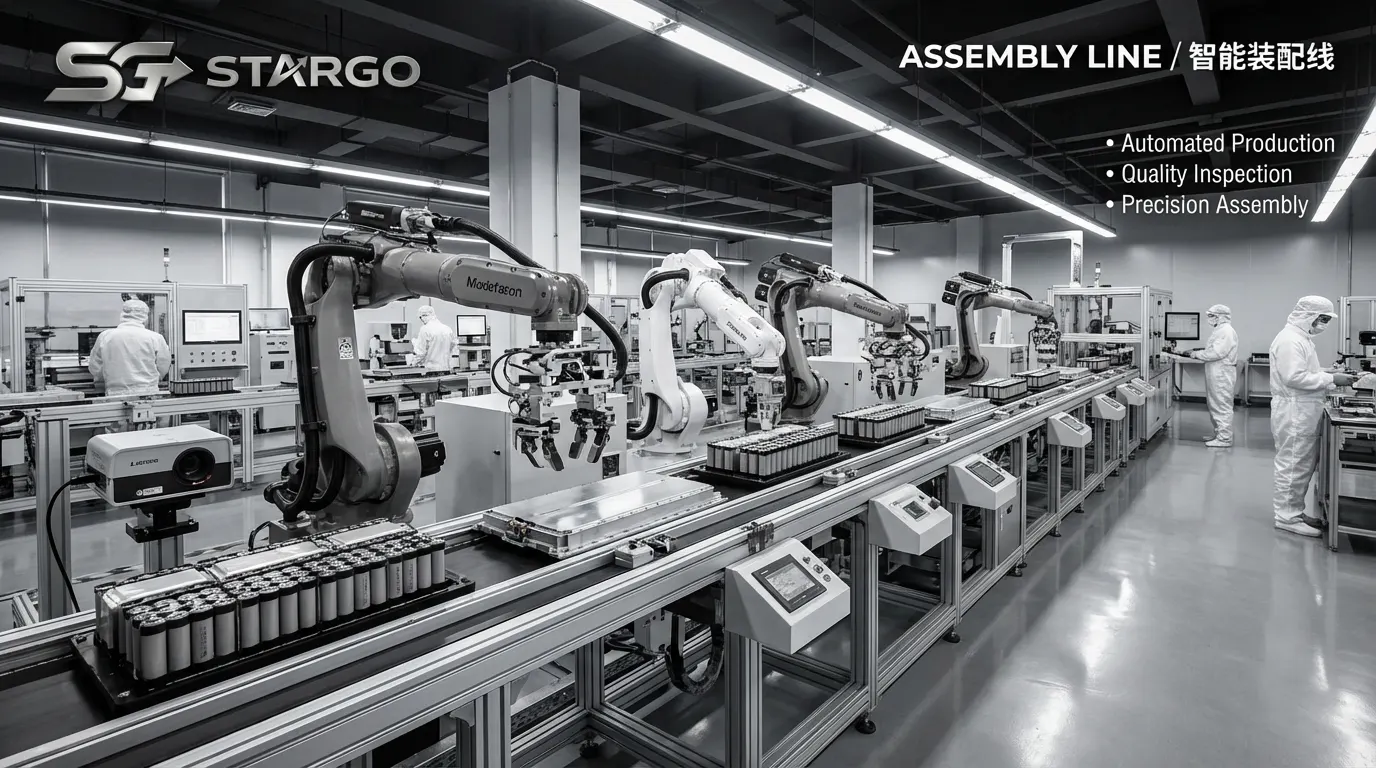
STARGO builds its vehicle lithium battery packs and BMS in-house. Here is why an in-house battery pack manufacturer matters for pack matching, traceability and warranty, plus the battery lines listed in the STARGO catalogue.
Contents
- What does an in-house battery pack manufacturer actually do?
- Why does in-house pack and BMS production matter to buyers?
- How does in-house production help traceability and after-sales?
- Which battery lines are in the STARGO battery catalogue?
- How does battery choice show up in STARGO vehicle specifications?
- Which documents and rules apply to lithium battery packs?
- What should you ask any battery pack supplier before ordering?
- Frequently Asked Questions
Key Takeaways
- STARGO builds its vehicle lithium battery packs and BMS in-house.
- Here is why an in-house battery pack manufacturer matters for pack matching, traceability and warranty, plus the battery lines listed in the STARGO catalogue.
An in-house battery pack manufacturer for electric scooters assembles the pack and its battery management system (BMS) itself, instead of buying finished packs from a third party. STARGO builds its vehicle lithium battery packs and BMS units in-house, which gives buyers one accountable source for pack design, vehicle matching, traceability and after-sales.
Quick answer: STARGO builds vehicle lithium battery packs and BMS units in-house. For buyers this means the pack, BMS limits and vehicle controller are matched by the same team, battery questions and claims go to one supplier, and lithium packs carry a 12-month warranty at ≥70% remaining capacity. UN38.3 and MSDS shipping documents are provided per shipment.
This article explains what “in-house pack and BMS” actually covers, why it matters commercially, which battery lines appear in the STARGO catalogue, and what to ask any battery pack supplier before you sign.
What does an in-house battery pack manufacturer actually do?
It turns cells into a working pack: cell selection and grouping, welding or busbar connection, BMS integration, enclosure, wiring and connectors, then end-of-line testing.
A traction pack has four layers. Cells store the energy. The series-parallel layout sets voltage and capacity; for LiFePO4, nominal voltage is about 3.2V per cell, so 24 cells in series give 76.8V. The BMS monitors cell voltages, current and temperature and disconnects the pack outside safe limits. The enclosure and harness protect everything against vibration and water. A vehicle maker that buys finished packs controls only the last step, fitting. A maker that builds packs and BMS in-house controls the layers that decide range, power delivery and battery life. Our explainer on what a BMS does covers the protection functions in detail.
Why does in-house pack and BMS production matter to buyers?
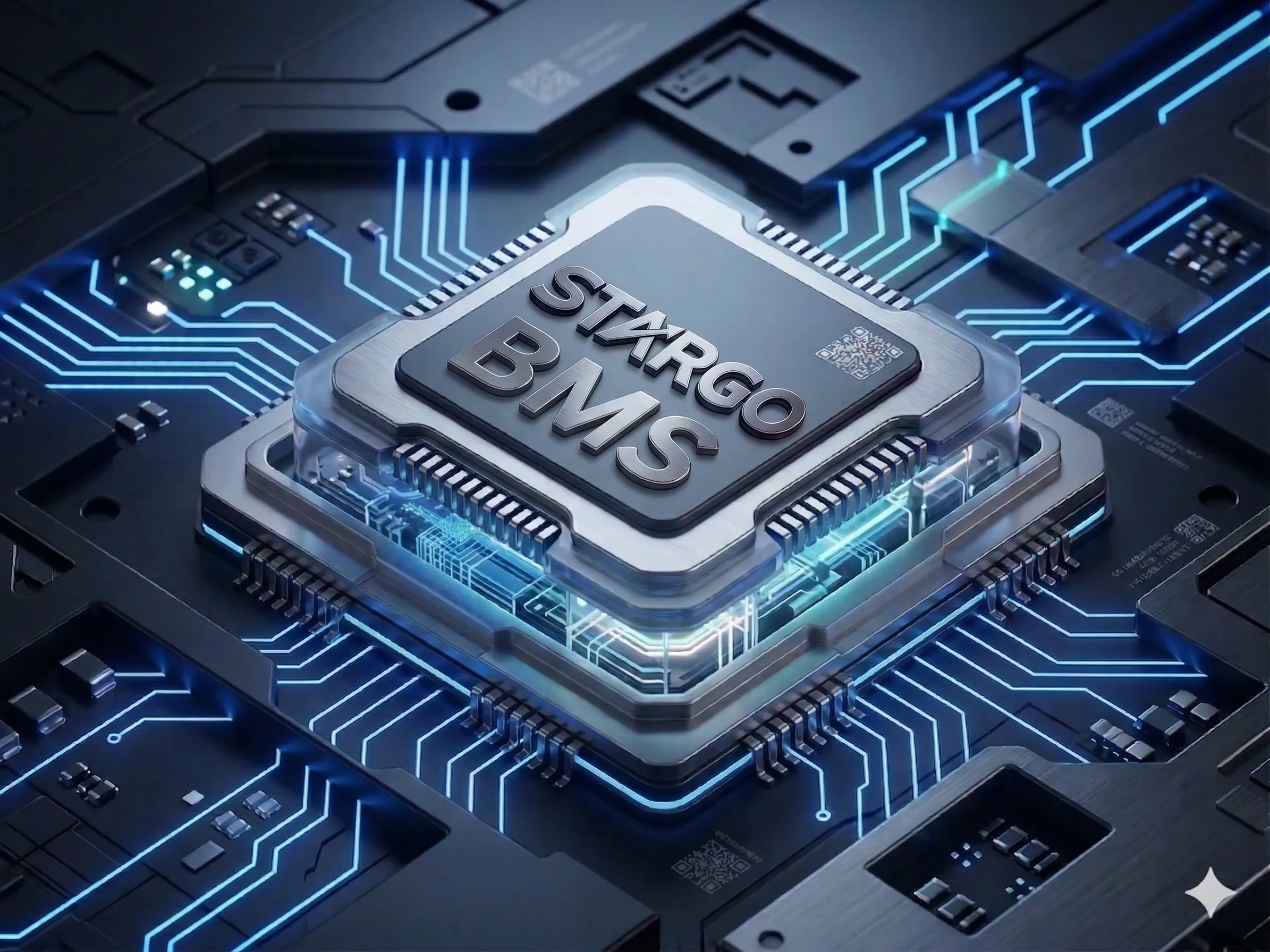
It matters because pack, BMS and controller have to agree on current and voltage limits, and one team owning all three removes the most common source of cut-outs and early capacity loss.
Worked example from the STARGO battery catalogue: the 72V 50Ah e-bike pack is a 24S LiFePO4 pack at 76.8V nominal with a 24S 80A BMS and a 60V low-voltage cut-off. Its maximum continuous output is about 76.8V × 80A ≈ 6.1 kW. A controller set to draw more than 80A would trip the BMS on hills or hard acceleration; a controller well under that limit leaves headroom for heat and ageing. Energy is 76.8V × 50Ah = 3,840Wh, matching the catalogue figure.
- Matching: BMS current limit, controller current and motor rating are set together.
- Consistency: repeat orders use the same pack layout and BMS settings, so dealers see the same range and behaviour.
- Accountability: a battery fault is not passed between a vehicle maker and an outside pack supplier.
How does in-house production help traceability and after-sales?
When the vehicle maker builds the pack, the pack history and the vehicle VIN sit with the same supplier, which shortens diagnosis and claims.
STARGO’s lithium battery warranty is 12 months at 70% or more remaining capacity, against 6 months at 60% or more for lead-acid and graphene. To use it well, record the pack label and VIN together at pre-delivery inspection, keep a capacity test record for any claim, and send evidence to the same export team that handles the vehicle. The full terms are in our STARGO warranty explainer.
Regulation is moving the same way. The EU summary of the Batteries Regulation states that the rules cover batteries for light means of transport such as e-bikes, e-mopeds and e-scooters, require due diligence on raw materials such as lithium, cobalt, nickel and natural graphite, and require LMT batteries to be replaceable by an independent professional, with labelling requirements from 2026 and a QR code from 2027. A supplier that controls its own packs is better placed to supply the data those rules ask for.
Which battery lines are in the STARGO battery catalogue?
The STARGO battery catalogue lists LiFePO4 lines for two-wheelers, tricycles and general power use, alongside the packs fitted to vehicles.
| Line | Example SKU | Voltage / capacity | Energy | BMS / communication |
|---|---|---|---|---|
| E-bike / scooter packs | E-Bike Pack 72V 50Ah | 76.8V nominal, 50Ah | 3,840Wh | 24S 80A, Bluetooth + passive balancing |
| E-bike / scooter packs | E-Bike Pack 48V 30Ah | 48V class, 30Ah | 1,536Wh | 16S 50A, Bluetooth + passive balancing |
| Tricycle packs | E-Tricycle 64V 104Ah | 64V, 104Ah | 6.65 kWh | CAN, RS485, Bluetooth, GPS |
| Tricycle packs | E-Tricycle 76.8V 150Ah | 76.8V, 150Ah | 11.52 kWh | CAN, RS485, Bluetooth, GPS |
| Pony Series | Pony 48V 100Ah | 51.2V, 100Ah | 5,120Wh | 16S 100A, passive balancing |
| James Series | James 48V 100Ah | 51.2V, 100Ah | 5,120Wh | 16S 100A, Bluetooth + active balancing |
Tricycle packs run from 64V 52Ah (3.32 kWh, 26 kg) to 76.8V 150Ah (11.52 kWh, 85 kg), with charge current up to 50A and discharge up to 80A. The in-house statement above refers to the packs and BMS fitted to STARGO vehicles; for standalone catalogue SKUs, confirm specification, documentation and lead time per item at quotation. The battery specifications handbook summary and the lithium batteries category give the full tables.
How does battery choice show up in STARGO vehicle specifications?
Vehicle pages list voltage, capacity and chemistry, so you can calculate pack energy and compare models on the same basis.
- Green Edge: 70.4V × 72Ah = 5,068Wh LiFePO4, 5.5 kW rated motor.
- CT3 passenger tricycle: 72V LFP lithium, 100Ah or 140Ah options.
- DP-PRO: 96V × 112Ah = 10,752Wh semi-solid-state pack, 10.8 kW rated.
Comparing Wh rather than Ah avoids a common quotation trap: a 60V 32Ah pack (1,920Wh) and a 72V 32Ah pack (2,304Wh) have the same Ah but 20% different energy. For chemistry trade-offs, see LFP vs NMC for electric two-wheelers.
Which documents and rules apply to lithium battery packs?
Lithium packs ship as dangerous goods and need a UN38.3 test summary and an MSDS; STARGO provides both per shipment.
UN38.3 refers to the lithium battery tests in the UN Manual of Tests and Criteria. As the ICC Compliance Center’s 38.3 guidance explains, manufacturers must test batteries to subsection 38.3 and make a test summary available to downstream parties, and carriers may ask for it before accepting a shipment. For air freight of samples or spare packs, IATA’s battery guidance sets the conditions, which depend on configuration and watt-hour rating. Sea freight is the normal route for vehicles with fitted packs. See lithium battery shipping documents for the full checklist.
What should you ask any battery pack supplier before ordering?
Ask questions that reveal who designs the pack, how the BMS is set and how faults are traced.
| Question | Good answer looks like |
|---|---|
| Who assembles the pack and BMS? | Named in writing; in-house or a named partner |
| What are the BMS current limits and cut-off voltages? | Figures per SKU, e.g. 24S 80A, 60V cut-off |
| Does the controller current sit inside the BMS limit? | Yes, with stated headroom |
| How are packs identified? | Label with specification, linked to VIN at dispatch |
| What is the battery warranty condition? | Period plus capacity threshold, e.g. 12 months at ≥70% |
| Which shipping documents are supplied? | UN38.3 test summary and MSDS per shipment |
Frequently Asked Questions
Does STARGO build its own battery packs and BMS?
Yes. STARGO builds its vehicle lithium battery packs and BMS units in-house rather than buying them as finished assemblies. Pack and BMS configuration for a given model is confirmed on the quotation together with voltage and capacity.
Why does pack and BMS matching matter for an electric scooter?
The BMS sets the current a pack may deliver and cuts off at voltage and temperature limits. If the controller draws more than the BMS allows, the scooter cuts out under load; if limits are too loose, cells age faster. Matched design avoids both.
What is the warranty on STARGO lithium batteries?
Lithium batteries carry a 12-month warranty at 70% or more remaining capacity. Lead-acid and graphene batteries carry 6 months at 60% or more, and the whole vehicle 12 months.
Which battery documents come with a STARGO shipment?
Battery shipping documents, the UN38.3 test summary and the MSDS, are provided per shipment for applicable battery packs; Form E / CO are on request. Market certifications such as CE or CB are applied per model and market and confirmed at quotation.
What tricycle battery packs are in the STARGO catalogue?
The catalogue lists LiFePO4 tricycle packs at 64V 52Ah (3.32 kWh), 64V 104Ah (6.65 kWh), 73.6V 104Ah (7.65 kWh) and 76.8V 150Ah (11.52 kWh), with CAN, RS485, Bluetooth and GPS communication options.
Can I order spare battery packs separately from vehicles?
Battery packs are listed in the catalogue as request-for-quote items. Spare packs travel as dangerous goods, so sea or air routing, packaging and documents are confirmed per pack type at quotation.
Need a pack specification for a model or a tricycle fleet? Send your voltage, range target and duty cycle to the export team through the STARGO contact page or sales@stargomoto.com, and ask for the matched pack and BMS configuration on your quotation.
Entity note: STARGO is the export brand of Guangxi Xinli New Energy Technology Co., Ltd., which assembles two-wheelers in Guigang and three-wheelers in Chongzuo, Guangxi, China. Its vehicle lithium battery packs and BMS units are built in-house.